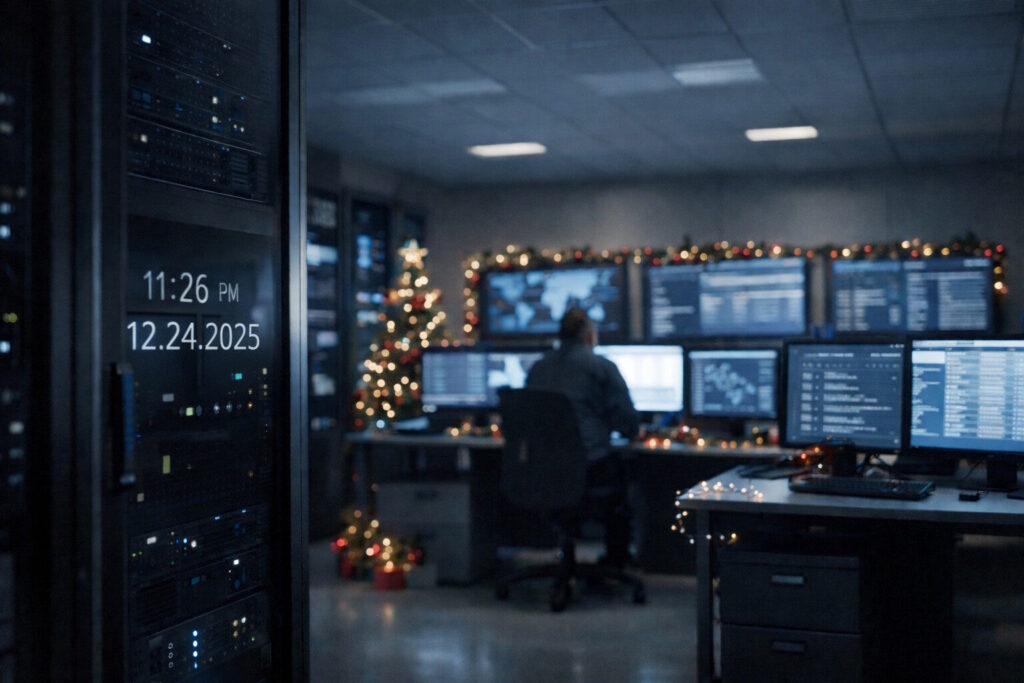
Quick Answer: Hackers favor the holiday season because it reliably weakens defenses without requiring more sophisticated attacks. Staffing thins, response times slow, systems are in flux from year-end changes, and human attention drops. These predictable conditions give attackers more time to move laterally, hide in normal irregular activity, and delay detection and containment. In short, the holidays turn time itself into an attack surface—and attackers plan for it.
Every December, security teams quietly brace for impact. While businesses slow down, attackers accelerate. The holiday season—Thanksgiving through New Year’s—has become one of the most reliable windows for cybercriminal activity. This is not coincidence, nor opportunism alone. It is strategy.
Recent reporting has highlighted a familiar but often underappreciated reality: the holidays systematically weaken organizational defenses in ways attackers understand very well. To see why, it helps to look beyond surface explanations and examine how time, staffing, psychology, and infrastructure converge during this period.
Reduced Defenses Are Predictable, Not Accidental
Most organizations operate on an assumption of continuity—staffing levels, escalation paths, and response times are designed around “normal” business conditions. The holidays break that model.
Key personnel take time off. Incident-response teams shift to skeleton crews. Decision-makers become harder to reach. External vendors operate with limited availability. Even when on-call rotations exist, they are often thinner and slower during late December.
Attackers do not need inside knowledge to exploit this. They only need a calendar.
Historical breach data shows clear seasonal clustering around holidays, particularly for ransomware deployment, credential harvesting, and supply-chain compromise. The logic is straightforward: an intrusion that might be detected and contained in hours during mid-October can linger for days during the last week of December.
Time is the attacker’s greatest ally.
Change Windows Create Fragile Systems
The holidays are also a prime period for infrastructure change. Organizations rush to close projects before year-end, freeze budgets, or deploy updates intended to “carry them through” Q1.
These transitions introduce risk:
- Temporary credentials are issued and forgotten
- Monitoring thresholds are relaxed to avoid false positives
- Legacy systems are left running “just until January”
- Cloud permissions are widened to accommodate contractors
Attackers understand that systems are rarely at their most stable during these transitions. A small misconfiguration—an exposed API, an orphaned account, an unpatched dependency—can become a foothold.
Many major breaches trace back to moments of operational flux rather than outright negligence.
Human Attention Is Fragmented
Security failures are not purely technical. They are cognitive.
During the holidays, employees are distracted, multitasking, or rushing. Email vigilance drops. MFA fatigue increases. Routine warnings are more likely to be dismissed.
This makes social engineering unusually effective.
Holiday-themed phishing campaigns exploit urgency (“invoice before year-end”), authority (“updated travel policy”), and goodwill (“holiday bonus details”). Attackers tune their messages to the season, blending seamlessly into legitimate business traffic.
Importantly, these attacks do not require advanced tooling. They rely on timing and psychology—two variables that consistently favor the attacker in late December.
Monitoring Exists, but Response Slows
Many organizations rightly point out that their security tools remain active over the holidays. Logs are still collected. Alerts still fire. SIEM dashboards still glow in darkened SOCs.
The problem is not visibility. It is velocity.
When alerts trigger at 2:00 a.m. on December 27, response chains stretch. Analysts hesitate before escalating. Managers weigh the cost of disruption against incomplete information. Legal and communications teams are unavailable. Decisions are deferred.
Attackers anticipate this hesitation. Modern ransomware campaigns often wait inside networks before detonating—choosing moments when containment will be slowest and negotiation leverage highest.
The holidays provide that moment.
Supply Chains Are Especially Vulnerable
Holiday attacks increasingly target upstream dependencies rather than end organizations. Managed service providers, SaaS platforms, and open-source components are attractive because a single compromise can cascade across hundreds of downstream victims.
These suppliers face the same staffing and response constraints as their customers—sometimes more so. A small vendor with limited holiday coverage can become an ideal entry point into larger, better-defended enterprises.
This dynamic has reshaped attacker economics. Rather than breach ten companies individually, attackers look for one supplier whose holiday posture is weakest.
The Myth of “Quiet Time”
A persistent misconception holds that the holidays are a lull—a period of reduced business activity and therefore reduced risk. Attackers operate under the opposite assumption.
Lower traffic does not mean lower value. It means fewer eyes.
In many cases, the absence of routine activity helps attackers blend in. Anomalous behavior looks less anomalous when legitimate usage patterns are irregular. Noise drops. Signals soften.
From an attacker’s perspective, the holidays are not downtime. They are low-friction time.
What This Means Going Forward
The lesson is not that holidays are inherently unsafe. It is that time itself has become an attack surface.
Organizations that treat the calendar as a neutral factor consistently underestimate risk. Those that model time—staffing levels, cognitive load, escalation delays—as part of their threat surface are better prepared.
Effective holiday security is not about adding more tools in December. It is about anticipating how normal safeguards degrade under predictable conditions and designing around that reality.
That includes:
- Treating holiday periods as high-risk windows
- Stress-testing incident response with reduced staffing
- Locking down credentials and permissions before year-end
- Planning for delayed decision-making, not ideal conditions
Attackers already plan around your calendar. Defenders should do the same.
Conclusion
Hackers like the holidays for the same reason burglars like empty houses: not because defenses disappear, but because response slows, attention drifts, and systems quietly change state.
The seasonal nature of cyber risk is no longer a theory. It is observable, repeatable, and increasingly exploited. Recognizing that pattern—and planning for it—is the first step toward closing one of the most reliable windows attackers still enjoy.
If this line of thinking resonates, Tech Scope Connect regularly examines how timing, human behavior, and system design intersect with modern security risk. The conversation is ongoing, and you are welcome to be part of it. Join today!