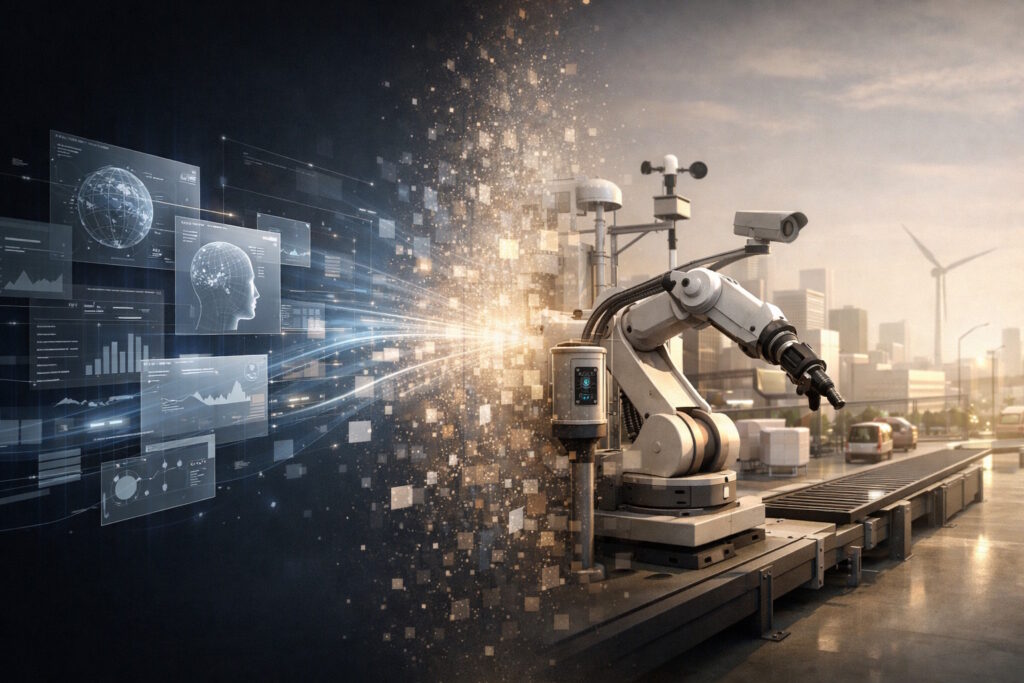
Key Takeaway: Physical AI refers to artificial intelligence systems that interact directly with the real world through sensors, machines, and automated actions rather than remaining confined to software and screens. By linking perception, decision-making, and physical movement, physical AI enables organizations to respond to real-time conditions in environments such as manufacturing, logistics, healthcare, and infrastructure. Its growing relevance comes from advances in sensors, edge computing, and learning models, which together allow AI to move from analysis to action while reshaping how work gets done in physical settings.
When Intelligence Gets Hands and Feet
Physical AI is the moment artificial intelligence stops living only on a screen and starts taking action in the world. You may also hear it called embodied AI, real-world AI, or embodied intelligence. Either way, the idea feels immediate because it touches places you already know. It shows up on factory floors, in hospitals, and on city streets. It can even appear quietly in buildings that manage themselves.
If you have ever asked, “Will AI ever do more than write text?” you are already circling the point. People did not build AI just to talk. They built it to sense, decide, and respond. That shift matters to business, public services, and daily life. It also raises new questions about safety, trust, and responsibility.
Physical AI in Plain English
A simple way to think about it is this. Traditional AI often gives you an answer, a summary, or a prediction. Physical systems go further because they connect those outputs to movement and control. They perceive the environment through sensors, interpret what they see, and then act through machines. In other words, physical AI links perception to action in real time.
That can sound abstract, so imagine a warehouse robot at peak volume. It does not only “know” where an item sits. It navigates a busy aisle, avoids a person, and adjusts its grip. The intelligence matters because the world changes every second. In physical settings, the cost of a mistake can be a dropped package or a safety incident. That reality pushes reliability to the center of design.
You might wonder, “Is this just robotics with a new label?” Robotics is part of the story, but not all of it. The bigger change is that learning systems now guide more of the behavior. They can adapt to variation instead of following rigid scripts. That difference explains why the topic has gained so much attention.
Why It Feels New Right Now
Several trends have lined up at once. Sensors became cheaper and more capable, so machines can notice more detail. Computing moved closer to where work happens, so devices can respond faster. Better models improved perception, planning, and control, even in messy environments. Networks also became more reliable, which helps teams manage fleets and update software.
Just as important, companies have collected more operational data. They now understand where delays, errors, and waste tend to appear. That creates a clearer business case for systems that can respond in real time. It also makes pilots easier to justify, because leaders can measure outcomes. As physical AI matures, that measurement discipline will matter even more.
When people ask, “Why didn’t we do this ten years ago?” the honest answer is that the pieces were not ready together. Physical environments punish fragility. A model that performs well in a lab still has to face glare, dust, noise, and human unpredictability. The recent wave of progress has made those conditions more manageable.
Where You Will Meet It First
You do not have to look far to find early examples. Many of them already run in the background. The most visible uses tend to appear where speed, safety, or labor constraints matter. That is why physical AI often enters through operations and infrastructure first.
In logistics, machines sort parcels, move pallets, and track inventory with fewer pauses. In manufacturing, vision systems check quality and guide assembly steps. In health care, robots can deliver supplies, disinfect rooms, or assist with repetitive tasks. In agriculture, autonomous equipment can monitor crops and reduce chemical use. In buildings, smart control can fine-tune lighting and climate based on occupancy and weather.
Some readers ask, “Does this replace people?” In most real deployments, it changes work before it replaces it. Teams often shift from lifting, scanning, or driving to supervising and maintaining. They also spend more time on exceptions, where judgment matters most.
What Physical AI Looks Like Day to Day
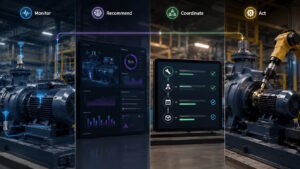
In day-to-day terms, you can think of these systems as closing the loop. They sense what is happening, make a choice, and then check the result. That loop repeats constantly, and it happens faster than a person could manage alone.
A delivery robot might slow down near a crosswalk and re-route around a crowd. A production line camera might flag a defect and adjust a setting upstream. A building system might notice a conference room filling up and increase ventilation. None of these actions needs drama. The value often comes from quiet consistency.
What It Can Do Well—and What Still Takes Care
Physical systems shine in narrow, well-defined tasks. They can repeat actions with steady precision. They can also monitor environments continuously, which helps teams catch problems early. When conditions stay within a known range, performance can look almost effortless.
The harder part comes when conditions break expectations. Floors get wet, lighting shifts, people move unexpectedly, and tools wear down over time. In those moments, a system needs clear boundaries and safe fallback behavior. That is why responsible deployments include constraints, supervision, and ongoing testing. Physical AI succeeds when teams treat safety as a design requirement, not a slogan.
A common conversational question is, “Can I trust it around people?” Trust depends on design, training, and the rules around operation. It also depends on context. A robot in a fenced cell differs from one in a public hallway. Many organizations start in controlled spaces for that reason. They expand only after they gather evidence and improve safeguards.
Conclusion: From Intelligence to Action
Physical AI moves intelligence out of dashboards and into the environments where real work unfolds. As systems begin to sense, decide, and act in physical spaces, the conversation shifts from what AI can analyze to what it can responsibly do. That transition will shape operations, roles, and expectations across industries in the years ahead.
If you want to keep exploring how developments like physical AI are redefining the boundary between digital systems and the real world, Tech Scope Connect offers a place to stay engaged through ongoing discussions, live newscasts, and expert-led conversations on emerging technology. Join us today!