
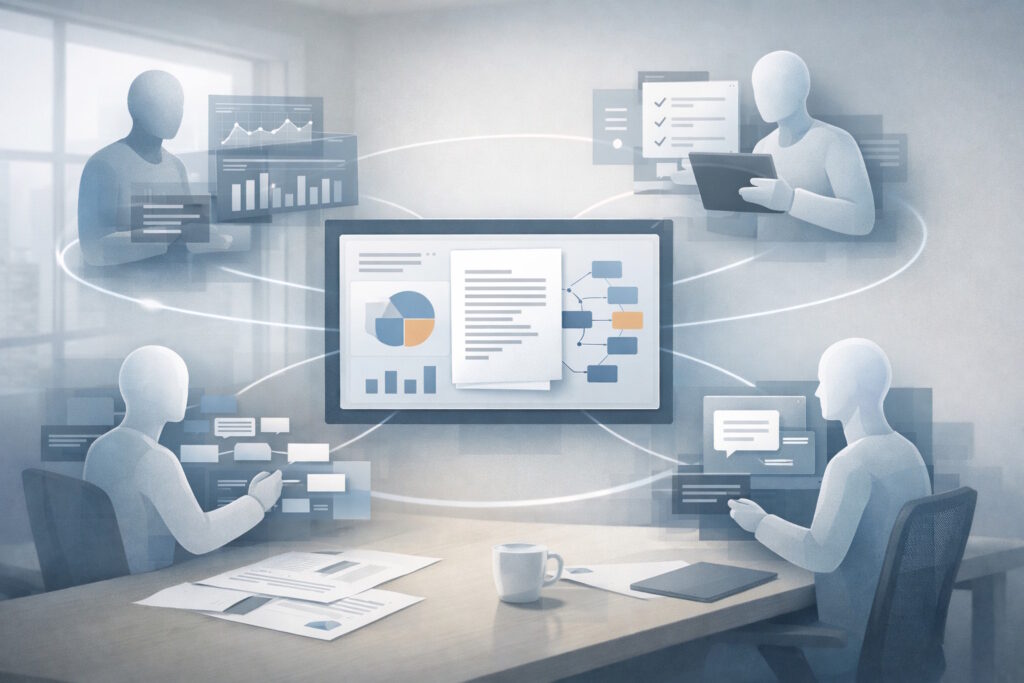
Key Takeaway: Multi-agent systems describe an AI approach where multiple autonomous agents work together, each handling a specific role, to solve problems more effectively than a single system acting alone. By distributing tasks, sharing context, and coordinating decisions, these systems better reflect how real organizations operate, making them well suited for complex, dynamic environments where collaboration, verification, and adaptability matter.
When AI Starts Acting Like a Group Project
Multi-agent systems are changing how we think about AI, because one “brain” no longer has to do everything. In plain terms, you can picture them as teams of autonomous agents, sometimes called agent-based AI or collaborative agents, working side by side. That framing matters right now, because many real-world problems look less like a single math question and more like a busy workplace. Decisions pile up, information arrives late, and priorities collide.
If you have ever thought, “Why can’t AI handle this like a well-run team?” you are already close to the idea. Multi-agent approaches aim to divide work, compare perspectives, and bring results together. They can support everything from customer service workflows to robotics and supply chains. Even when you never see the agents, you may feel the difference in speed and consistency.
Why Multi-Agent Systems Feel Like a Team Sport
Start with a simple question: what is an “agent” in AI? An agent is a piece of software that can observe something, decide what to do, and take action. It might answer questions, sort requests, monitor a system, or suggest next steps. You can think of it as a worker with a job description.
Now imagine you have several agents in the same environment. One agent tracks priorities. Another searches for relevant information. A third checks rules and constraints. A fourth drafts the response a customer will see. Instead of one system juggling every task, you get a set of smaller roles that coordinate.
This design often looks more natural than a single, all-purpose system. Most organizations already break work into roles for a reason. Specialization reduces errors and improves focus. It also makes it easier to improve one part without rebuilding everything.
You might wonder, “Do the agents always cooperate?” Not always. Some setups encourage collaboration, while others model competition. In a market simulation, agents might “compete” the way buyers and sellers do. In a planning workflow, agents tend to align around one outcome.
One more point helps the concept click. Multi-agent systems often create emergent behavior, meaning the overall result looks smarter than any single agent. You do not always program “the answer” directly. You shape how agents interact, then you evaluate what they produce.
Where Multi-Agent Systems Show Up in Daily Life
Even if you do not call it a multi-agent system, you may already rely on the pattern. Consider a help desk. One component classifies your request. Another pulls account history. Another suggests a resolution. A final step checks tone and accuracy before sending. Each step acts like an agent with a narrow focus.
Robotics offers another easy example. Picture a warehouse with many mobile robots. Each robot avoids obstacles and picks tasks locally. At the same time, the fleet as a whole meets shipping deadlines. No single robot controls the entire warehouse, yet coordination still emerges.
You also see agent teamwork in cybersecurity. One agent watches network activity. Another reviews alerts for known patterns. Another recommends a response. Together, they shorten the time between detection and action.
These examples matter because they show a practical truth. Many environments change too fast for one centralized decision-maker. Distributed work often fits the reality on the ground.
Meet the “Cast”: Roles That Make Agent Teamwork Easier
When people picture AI, they often imagine one assistant doing everything. In multi-agent designs, you usually assign roles, even if they remain informal. A few common role types appear again and again.
A “planner” agent can break a goal into steps. A “research” agent can gather inputs from allowed sources. A “checker” agent can look for contradictions or missing constraints. A “communicator” agent can translate results into user-friendly language. None of these roles requires magic. The value comes from separation of concerns.
This separation also supports accountability. If an output looks wrong, you can often trace where it went wrong. That is harder when one system handles every step internally.
You may ask, “Do agents need to talk to each other?” Usually, yes. They might exchange messages, write into a shared workspace, or hand off structured notes. The details vary, but the goal stays the same. Agents need a reliable way to share context without confusion.
How Agent Teams Coordinate Without Constant Supervision
Coordination sounds complicated, but the basic idea is familiar. Teams coordinate through rules, shared goals, and feedback loops. Agents can do the same.
Some systems use a simple handoff. Agent A finishes a task and passes results to Agent B. Other systems allow parallel work, then compare answers. That comparison can reveal gaps, like missing assumptions or conflicting interpretations.
A common concern is “groupthink,” where everyone repeats the same mistake. Good designs counter that by encouraging independent work before consolidation. They also add verification steps. The goal is not more chatter. The goal is better outcomes.
In real deployments, a human often remains in the loop, at least for high-stakes decisions. That oversight can reduce risk and support continuous improvement.
What Makes This Approach Exciting—And What to Watch Carefully
Multi-agent systems attract attention because they promise scale through collaboration. They can handle complex workflows more gracefully than a single monolithic tool. They can also adapt to new tasks by adding or swapping roles.
That said, more agents can create new failure modes. Communication can become noisy. Agents can make inconsistent assumptions. A small misunderstanding can ripple into a bigger error.
You should also watch for “confidence without evidence.” If one agent produces a persuasive answer, others might accept it too quickly. Strong systems add checks that reward evidence and penalize unsupported claims.
Finally, there is a practical cost. Every extra agent adds computation, latency, and design complexity. The best setups earn their complexity by improving quality, speed, or resilience.
Conclusion: Seeing AI as a Team, Not a Tool
AI becomes easier to understand—and easier to trust—when it reflects how real work gets done. Multi-agent systems do exactly that by modeling intelligence as collaboration rather than isolated output. As these approaches gain traction, the most valuable skill may be learning how to think alongside systems that plan, verify, and adapt as a group.
If you want to keep exploring how collaborative AI models like this are shaping real-world technology decisions, Tech Scope Connect offers thoughtful coverage through live discussions, expert panels, and emerging-tech conversations. Join us and stay connected to how these ideas move from concept to practice.