Key Takeaway: AI robotics fails differently than traditional software because it operates in the physical world, where uncertainty, motion, and real-time interaction introduce risks that code alone does not face. Unlike digital systems, autonomous robots must continuously sense their environment, interpret imperfect data, and act through physical mechanisms that are subject to timing, wear, and external conditions. When failures occur, they are visible, tangible, and immediate, which is why trust, safety design, and “graceful failure” matter as much as technical accuracy in AI robotics systems.
When Code Meets the Physical World
AI robotics shows up in places that once felt purely “human,” from hospitals to sidewalks. You may call them intelligent robots, autonomous robots, or smart machines. Whatever the label, they act in the real world, not on a screen. That is why failure feels different, and often more personal, when a robot gets something wrong.
If an app crashes, you restart it and move on. When a machine drops a package, clips a curb, or freezes in a doorway, the moment becomes physical. People notice, cameras capture it, and trust rises or falls in seconds. This article explains why robotic failure is not just “a bug.” It also explains why that matters.
A Glitch You Can Undo, and a Mistake You Can’t
Software can fail quietly when a webpage loads slowly or a button disappears. The harm usually stays contained inside a device. Engineers can patch code overnight, and many users never learn what happened.
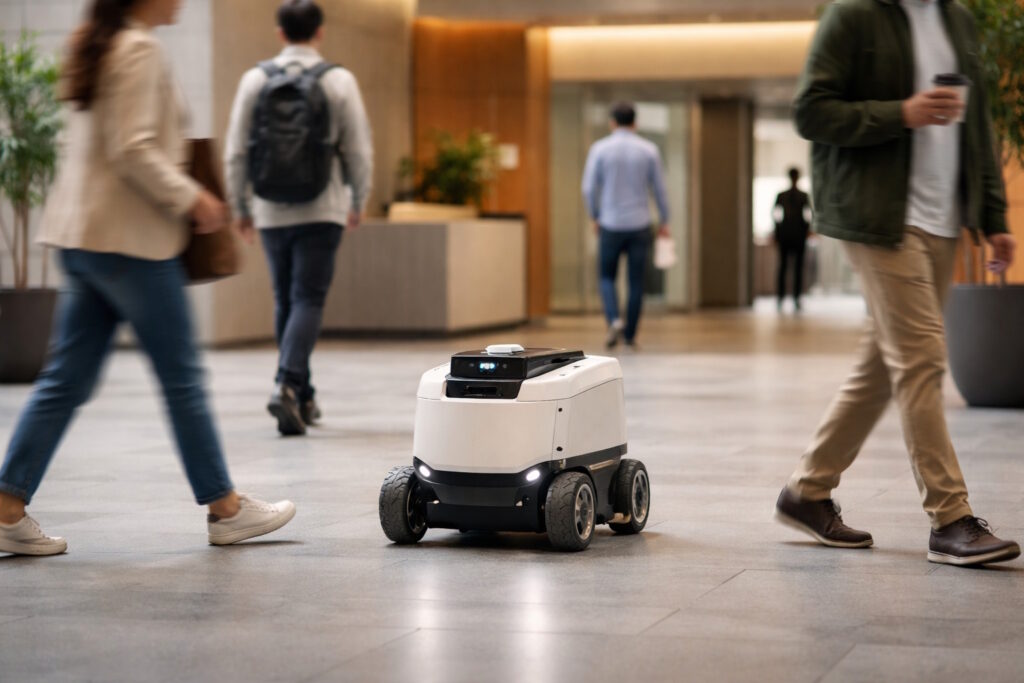
Autonomous machines fail in public, where small errors draw attention. A robot can block a hallway, startle a patient, or scrape a table edge. Even a minor misstep can feel unsettling because it plays out at human scale. The gap between “minor error” and “real consequence” shrinks when motion enters the picture.
This difference does not mean robots are reckless by design. The environment adds complexity that software alone does not face. In a physical setting, a system must sense, decide, and move, often under time pressure.
Why AI robotics fails differently than software
In a traditional software product, the system mostly controls its own inputs. Your phone knows the screen size. A database query returns structured text. Even when software meets surprises, it usually meets them as data. In the physical world, surprises arrive as wind, glare, loose rugs, and moving people. A robot interprets those signals through sensors and models. Then it acts with motors, wheels, arms, or rotors. Each step adds a new place where reality can push back.
The world refuses to stay still
A robot does not operate inside a neat test file. It operates near people, pets, carts, and doors. Lighting changes across the day, and floors vary from tile to carpet. A hallway that was clear five seconds ago can fill with motion. Because of that, a “working” system can still look clumsy in a new setting. Sometimes it slows down too much. Other times it stops and waits. It can also choose a path that seems odd to a human observer. Those behaviors often reflect caution, not incompetence.
Sensors guess, they do not “know”
Humans blend sight, sound, and context without thinking. Robots approximate that process with cameras, lidar, radar, microphones, and touch sensors. Each sensor has blind spots. Cameras struggle with glare and darkness, and lidar can misread glass. When sensors disagree, the robot must resolve the conflict. It makes an educated guess about what it sees. That guess can be wrong, even when the code runs exactly as intended.
Motion brings momentum, wear, and timing
Physical systems live in time, where timing and friction matter. Wheels slip, grippers wear down, and batteries sag. A delay of half a second can change the outcome of a turn. A software program can pause without consequence. A moving robot cannot always pause safely, especially on stairs or near a curb. That is why engineers treat robotics as a marriage of software and hardware. The behavior you see comes from the whole body of the system.
A Simple Map of Failure: Seeing, Thinking, Moving
When people ask, “Why did the robot do that?” the answer usually fits one of three buckets. The robot misread the world, it chose a poor plan, or it failed to execute a plan. Often, more than one bucket contributes.
AI robotics and the messy real world
This is the heart of the issue for AI robotics. These systems do not only compute. They perceive and act under uncertainty. A robot can “understand” an object at one angle and misclassify it at another. It can plan around a clear path and then meet a stroller that was not there before. With that in mind, many viral robot mishaps make more sense. The robot did not “forget” how to move. It met a situation that stressed its assumptions.
Seeing: perception slips
Perception problems can look like carelessness. A delivery robot nudges a planter. A drone drifts near a branch. In many cases, the robot did not truly “see” the obstacle in time. Sometimes an object blends into the background. Sometimes reflections confuse the sensor. In outdoor settings, dust and rain can also interfere with sensing.
Thinking: the plan breaks down
Planning failures are harder to spot because the robot may see everything and still choose poorly. It might take a tight corner too sharply. It might hesitate at a doorway. It might try to pass when it should wait. These moments often reflect tradeoffs. A robot balances speed, safety, and comfort. Humans do this with social cues. Robots approximate it with rules and learned patterns. The approximation can misfire, especially in crowded spaces.
Moving: execution misses the mark
Even with good perception and planning, the robot still has to move. Motors must deliver the right force, and wheels must grip the floor. Arms must hold items at the right angle without slipping. Small mechanical drift can accumulate over time. A joint can loosen, or a wheel can lose traction. The robot may then understeer, overshoot, or drop an item. This kind of failure can look “dumb,” but the cause can be mundane.
“Is It Safe?” What Safety Means in a Physical System
People often ask a direct question: “Are robots safe around me?” The answer depends on design choices, context, and oversight. Still, many safety ideas repeat across the field. Designers assume things will go wrong. They add layers of protection, so one mistake does not become a hazard. They include emergency stops and clear boundaries. They monitor system health, like battery status and sensor quality. They also test in controlled spaces before expanding into messy ones.
You can think of it as seatbelts for autonomy. A safer system tries to fail gently. It slows down when unsure. It hands control to a human when risks rise. It prefers a stop over a surprise. This safety mindset also shapes public communication. A company that explains limits earns more trust than one that sells perfection. People accept a cautious robot more readily than a confident one that seems unpredictable.
Conclusion: Learning to Trust Systems That Can Fail
Understanding failure in autonomous physical systems starts with recognizing that robots are not just software with wheels. They operate in environments that shift constantly, rely on imperfect sensing, and must act through physical components that wear, slip, and age. When failures happen, they are visible and tangible, which is why thoughtful design, cautious behavior, and realistic expectations matter as much as innovation itself.
If you find yourself thinking more about how AI systems interact with the world around us—Tech Scope Connect offers a way to stay engaged with those conversations. It’s a place to explore ideas, hear diverse viewpoints, and keep up with how AI is influencing real decisions beyond the lab. Join now!