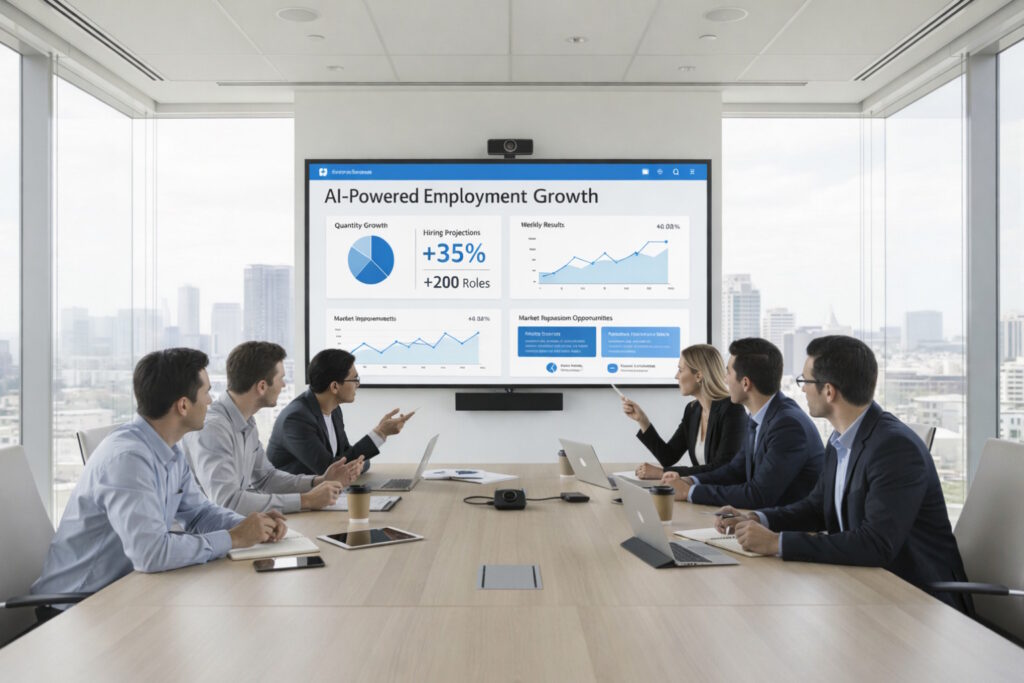
Key Takeaway: Businesses are using artificial intelligence to support growth by improving efficiency, expanding operations, and opening new areas of work. As companies adopt AI tools, they often create new roles, seek professionals with AI experience, and reshape existing positions to include skills like data analysis and technology integration. Rather than simply replacing jobs, artificial intelligence is helping many organizations scale their activities, which can lead to increased hiring and evolving career opportunities.
The Jobs Conversation Is Changing
Artificial intelligence has become part of everyday business, and it is reshaping how leaders think about growth and hiring. You have likely heard the familiar worry: “Will AI replace jobs?” Yet many companies now ask a more practical question. If we work faster and serve more customers, will we hire more people?
This article offers a clear view of how AI adoption can connect to employment growth. We will keep the discussion grounded and nontechnical. The goal is to help you see the big picture, not to overwhelm you with jargon.
How Artificial Intelligence Turns Efficiency Into Hiring
When businesses bring in artificial intelligence, they often start with efficiency. That word can sound like a polite way to say “cut costs.” Sometimes it is. More often, leaders want to remove the slow steps that block growth.
Think about the work that eats time without adding much value. Teams sort requests, compile reports, chase approvals, and clean data. These tasks pile up, then the backlog becomes the limit. AI tools can reduce that drag. When the backlog shrinks, capacity opens up.
Now a different question appears. “If we can deliver more with the same team, should we take on more?” Many businesses do. They expand marketing output, increase customer support coverage, or launch a new product tier. Those moves create demand for people.
A simple example: faster service, larger footprint
Imagine a services firm that uses AI to draft first-pass proposals and summarize discovery calls. The team does not eliminate the account managers. It gives them time back. Those managers then take more meetings. Sales closes more work. The firm adds project leads and specialists to deliver.
That pattern shows up across industries. AI speeds up parts of the workflow. Humans move into higher-value work. Growth follows when leadership reinvests the time savings.
New Roles Appear When Companies Scale With AI
Employment growth tied to AI does not only mean “more of the same jobs.” It often means different roles, shaped by new responsibilities. AI systems do not run themselves. People design processes, set guardrails, and review outputs.
In many organizations, three kinds of work expand quickly.
- First, teams need people who translate business needs into workable AI-supported steps. The job title varies. The function stays consistent. Someone must connect the tool to real outcomes.
- Second, businesses need oversight. AI can draft content, classify tickets, or recommend next steps. It can also get details wrong. Review and quality control become part of daily operations.
- Third, AI creates new offerings. A company may add faster turnaround packages, personalized customer journeys, or predictive services. Each new offering brings customer success work, enablement, and support.
If you find yourself thinking, “This sounds like a new layer of operations,” you are reading the situation correctly. AI often becomes a new capability that needs owners and standards.
The Skills Shift Behind Employment Growth
As companies adopt AI tools, the labor market shifts with them. Businesses still need strong communicators and managers. They also look for people who feel comfortable working alongside AI-enabled systems.
You can see this shift in everyday job descriptions. Employers ask for comfort with dashboards, metrics, and process improvement. They want people who can judge output quality and spot errors early. They value employees who can connect tools across systems.
Three skill areas come up repeatedly.
- Data literacy matters in more roles than before. Many positions now involve interpreting trends and explaining results. You do not need to build models. You do need to understand what the numbers suggest.
- AI oversight is becoming a normal responsibility. Teams need people who can evaluate outputs and reduce risk. They also need leaders who can set standards and train others.
- Technology integration increasingly drives productivity. AI tools often connect to customer platforms, content libraries, or internal knowledge bases. That integration work supports scale.
A common question sounds like this: “Do I need to learn to code?” Usually, no. Yet you may benefit from learning how AI tools fit into your workflow. That knowledge can turn into career leverage.
Recruiting for artificial intelligence experience
If AI supports business expansion, hiring becomes part of the plan. Companies need people who can build, manage, and improve AI-supported workflows. They also need employees who can use these tools responsibly.
Many firms recruit for specialized AI roles. You might see titles like machine learning engineer, data scientist, or AI product manager. These professionals help select tools, manage data, and guide deployment.
At the same time, hybrid roles are growing across departments. A marketing manager may oversee AI-assisted content production and performance tracking. An operations lead may run AI-enabled forecasting. A support leader may manage AI triage tools and escalation rules.
This is an important point for the employment story. Job growth does not only happen inside AI startups. It also happens inside established businesses that integrate AI into daily work. In practice, many firms hire a small core of specialists, then upskill teams around them.
If you are hiring, you might ask, “Who should we bring in first?” Often, the answer depends on your bottleneck. Some companies need data expertise. Others need change management and workflow design. The best path usually matches the business problem, not the trend.
What AI-Driven Growth Looks Like Across the Business
AI touches more than the technology team. That is one reason it can connect to employment growth. When multiple departments adopt AI tools, the company can move faster as a whole.
- In marketing, AI can help with research, drafts, and campaign analysis. That can increase output without lowering standards, if teams maintain review. More output can mean more demand generation, which can fuel hiring in sales and customer success.
- In sales, AI can support lead qualification and meeting preparation. That can improve follow-up and consistency. When revenue grows, headcount often follows.
- In customer support, AI can categorize tickets and suggest responses. That can shorten response times and improve coverage. Humans still handle complex cases and relationship-sensitive work.
- In operations and finance, AI can speed up forecasting and reporting. Leaders can make decisions faster with clearer inputs. That pace supports expansion into new regions or new product lines.
If you have wondered, “Where do the new jobs actually show up?” They often appear in delivery, customer success, program management, enablement, and oversight. AI can accelerate growth, but it does not replace trust-building work.
Conclusion: Growth Still Needs People
AI can drive employment growth when leaders use it to expand capacity, improve service, and create new offerings. The story is not only about automation. It is also about new roles, new skills, and better ways to scale. Recruiting matters, too, because companies need specialists and hybrid talent to make AI work in real operations. When businesses adopt artificial intelligence with clear goals and thoughtful oversight, they often find that growth still depends on people.
Curious about how artificial intelligence is reshaping hiring and the future of work? At Tech Scope Connect, we explore these shifts through expert discussions, live newscasts, and global technology summits. Join the conversation and stay informed about the trends shaping tomorrow’s workforce.