Quick Answer: Ambient IoT works by using tiny, connected devices that harvest energy from their surroundings, such as radio waves, light, heat, or motion. These low-power devices handle simple tasks like identification, lightweight sensing, and basic location tracking, then send small amounts of data to a nearby reader or network. In short, ambient IoT connects more everyday objects without relying on traditional batteries, which makes devices smaller, cheaper, and easier to maintain.
Ambient IoT is starting to matter because it offers a lighter way to connect everyday objects. At its core, ambient IoT refers to small, connected devices that draw usable energy from their surroundings and use it to perform a limited task. Instead of relying on a traditional battery, these devices harvest just enough power to identify an item, sense a simple condition, or send a small signal. The appeal is easy to see: batteries add size, cost, maintenance, and waste, especially when you want to connect huge numbers of ordinary items.
If you have noticed the term more often lately, there is a reason. 3GPP now has dedicated Release 19 work on the topic. Its current material describes devices that are batteryless or have limited energy storage, tiny form factors, and ultra-low complexity. That means this is no longer just a catchy phrase. It is taking shape as a defined area within industry standards.
Ambient IoT, in Plain English
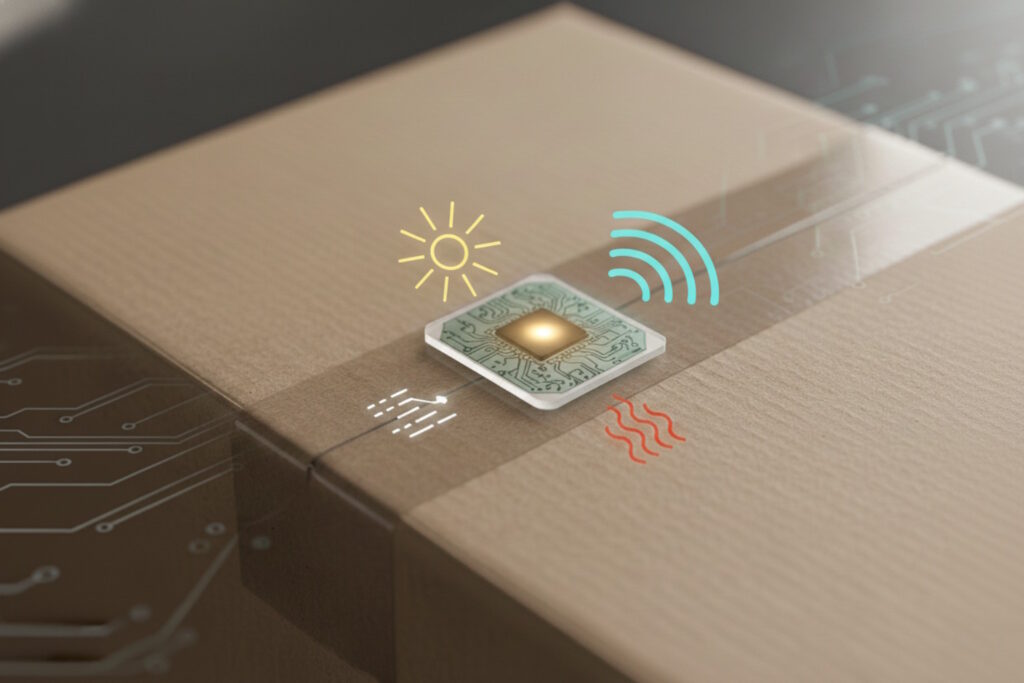
So, what does ambient IoT actually mean? At a practical level, the device runs on harvested energy. It may have no battery, or only a small amount of stored energy. Its sweet spot is not heavy computing. It is simple work such as identification, lightweight sensing, and sometimes positioning. Think of a tag that can say, “I am here,” “This package is mine,” or “This area is a bit too warm.”
So, does that mean every object around you will suddenly talk to the cloud? Not exactly. Most devices in this category do one tiny job well. They favor tiny packets, very low data rates, and small tasks that fit a tight energy budget. ITU says the most essential use is tag-based identification. It also notes that lightweight sensing is meant for simple monitoring, not remote control or video. So this technology sits closer to smart tags than to smart cameras.
A Tiny Power Source With a Big Job
So, how does the system actually work? First, the device collects energy from its environment. That energy can come from radio waves, light, vibration, or heat. Sometimes the surrounding environment gives enough power on its own. In tougher settings, a network may add a charging node or another helper to keep performance stable. The goal is modest and practical. Give the device enough energy to wake up, do a small task, and communicate briefly.
Next, the device uses that small energy budget carefully. It may store a little energy for a short time, then spend it on one basic action. That action might be sharing an identifier, reporting a simple condition, or helping with location awareness. Because the available energy is limited, the device design stays small, lean, and frugal. For that reason, ambient IoT works best when the message is short, and the job is narrow.
Some devices send their own small signal. Others use a clever shortcut called backscatter. In backscatter, the device reflects and modulates an existing signal instead of creating a full new one. That approach cuts power use sharply, which makes it useful for very constrained devices. You do not need to memorize the term. The simple takeaway is easy to grasp. Some devices speak softly, while others almost bounce a signal back to the network.
Why ambient IoT feels different
What makes ambient IoT feel new is not only the power model. It is also the scale it could support. If batteries stop being the default, many more everyday objects become practical to connect. Tags can stay tiny, and maintenance can stay light. Because of that, the concept attracts attention in warehouses, mail flows, and large indoor spaces with huge numbers of low-cost items.
From Whisper to Useful Signal
Of course, a tiny tag does not create value by itself. It still needs something nearby to hear it. 3GPP describes a reader node that interacts with the device. ITU also describes topologies with gateways, assist nodes, and charging nodes. In plain language, think of a nearby listener and a network that knows what to do with the signal. One part handles the radio exchange. Another turns that small message into useful application data.
From there, the value becomes easy to picture. A device shares a small piece of information. The reader or gateway receives it. The network matches that signal to an item, place, or status. Then an application turns it into something useful for people, such as inventory visibility, item finding, or a location hint. That end-to-end path is why the technology matters. The signal is only the beginning. The real story is the useful outcome.
Where You Might Notice It First
A smart warehouse is one of the clearest examples. ITU describes tags attached to packages or mail. Those items can then communicate with the network directly, instead of waiting for manual checks. That makes inventory and tracking much easier to automate. If a package moves, arrives, or goes missing, the system has a better chance of noticing quickly.
You can also imagine smaller, more personal uses. ITU highlights personal asset searching for items such as keys, passports, wallets, and books. It also points to indoor positioning, where many tags can help create location references inside large buildings. So if you are asking, “Where would I actually see this first?” the answer is simple. You will see it where lots of objects need light-touch tracking, not heavy computing.
The Limits Behind the Hype
This does not mean every connected device will switch to this model. The same reports that outline the opportunity also spell out the limits. These devices live with unstable and limited energy. Their architecture stays extremely simple to control cost and power use. They also face deployment complexity, because systems may need to manage both communication paths and energy transfer paths. In multi-protocol environments, compatibility can become tricky too.
As a result, the technology shines in a specific lane. It works best for identification, light sensing, and other small exchanges. It is not the right fit for rich media, advanced processing, or big two-way data flows. In a way, that limit is part of the appeal. The devices do not try to do everything. They try to do one useful thing with very little power.
Conclusion
Ambient IoT works by pairing tiny, energy-harvesting devices with a network that hears and interprets very small signals. That simple shift opens the door to more connected packages, everyday items, and indoor spaces. It does so without making every object bulky or battery-hungry. The field is still developing, but the direction is clear. Small devices can deliver real value when the job is small and the design is smart.
If you want to keep following where ideas like ambient IoT are headed, Tech Scope Connect is a good place to stay connected to the broader conversation around emerging technology. Join us!
Sources:
- Analysis on Requirements and Use Cases of Ambient Power-Enabled Internet of Things | itu.int
- Release 19 Ambient IoT | 3gpp.org
- 5G; Architecture Support for Ambient Power-Enabled Internet of Things | etsi.org
- Ambient IoT: Redefining Wireless Communication for Industry 4.0 | 3gpp.org