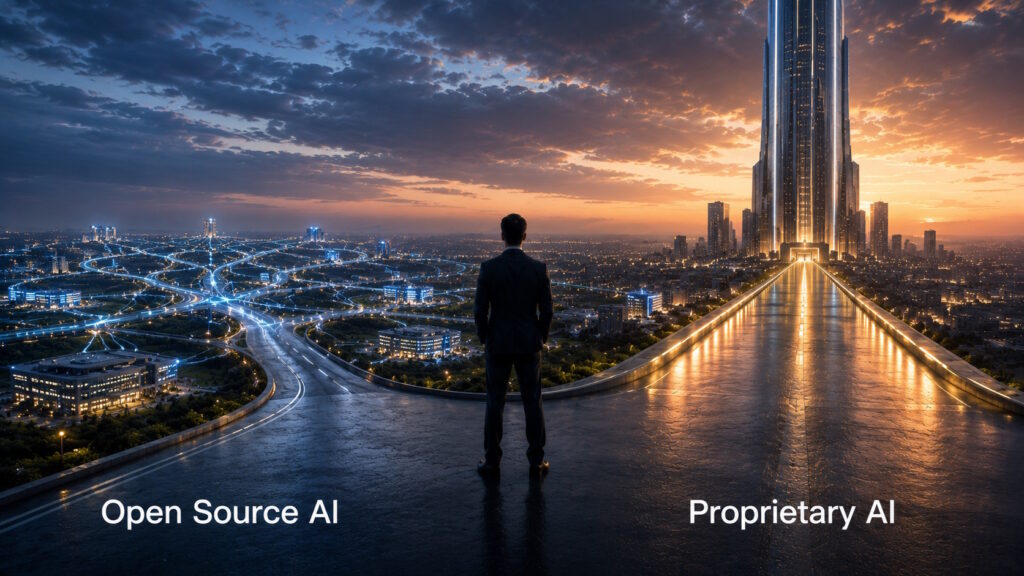
Key Takeaway: Open source AI and proprietary AI each offer distinct advantages for businesses. Open source AI provides greater flexibility, customization, and control, while proprietary AI often delivers faster deployment, managed services, and enterprise support. For most organizations, the decision is not about choosing a winner. It is about understanding the tradeoffs between control and convenience and selecting the right approach for each business need.
The AI Choice Behind the Hype
Open source AI is moving into boardroom conversations as open models challenge proprietary platforms for business attention. Community-built tools now sit beside managed, closed platforms in the same strategy conversations. For business leaders, the question is no longer only, “Which AI tool should we try?” It is also, “How much control do we want over the systems we rely on?”
At a basic level, open source AI gives companies more visibility and flexibility. Proprietary AI usually gives them a smoother, more managed experience. Both can help a business move faster. Both can also create new risks when leaders treat them like simple software purchases.
The debate feels especially timely now. AI is no longer a novelty sitting outside the business. It is moving into customer service, content creation, software development, operations, sales, and decision support. As that happens, AI becomes part of the operating layer of the company. So, what should a business know before picking a side?
What Open Source AI Means for Business
Open source AI usually refers to AI systems that let users inspect, adapt, and share more of the technology. The Open Source Initiative frames open-source AI around core freedoms to use, study, modify, and share an AI system. In business language, that means more room to shape the technology around your own needs.
A company might want to adjust a model for a specific industry. It might want to run AI closer to its own data. It might also want more choice over hardware, cloud providers, and deployment options.
This does not mean every business should build its own AI stack. Most companies do not want that burden. But it does mean open models can give technical teams more options than a locked platform.
A natural search question here is, “What is open source AI good for?” For many companies, the answer starts with flexibility. It can help when a business needs customization, internal control, or a path away from one-vendor dependence.
Proprietary AI: The Easy Button Still Has Power
Proprietary AI takes a different path. A vendor owns and manages the model, the platform, and many of the updates. The customer usually gets access through an app, API, or enterprise subscription. That can sound limiting. In many cases, it is also convenient.
A business can start quickly. Employees can use a polished interface. IT teams may get admin controls, support, security documentation, and service commitments. OpenAI, for example, positions ChatGPT Enterprise around managed access, privacy, security controls, and administrative features for organizations. For a small team, that simplicity can matter more than model control. For a large enterprise, vendor support can also reduce friction during rollout.
A common question sounds like this: “Why choose proprietary AI over open models?” The answer usually starts with speed, support, and less operational complexity. Not every company wants to manage infrastructure. Not every team has AI engineers. Sometimes the best AI system is the one people can use safely by Monday morning.
The Real Debate: Control Versus Convenience
The open-versus-closed debate often sounds technical. For executives, it becomes much more practical. Who controls the roadmap? Who decides which features stay? What happens if prices rise? How hard would it be to move to another provider? Could the company run the system in a different environment later? These questions turn AI from a tool decision into a strategy decision.
Open models may offer more control, but they can require more work. Proprietary platforms may offer less control, but they often reduce complexity. Neither side gives you everything.
This is the tradeoff at the center of the debate. Businesses want innovation without chaos. They want convenience without becoming trapped. They want strong capabilities without losing control over data, workflows, or long-term costs.
The right answer depends on the workload. A marketing team may value convenience. A healthcare, finance, manufacturing, or government team may put more weight on data control and compliance.
Where open source AI gives companies room to move
Open source AI becomes especially interesting when a company wants to shape AI around its own business. Think about a manufacturer that wants an assistant trained around maintenance documents. Think about a logistics company that needs AI inside a private environment. Think about a software company that wants more control over how a coding model behaves.
In those cases, open models may create more room to experiment. They can also support local or private deployment, depending on the model and license. Mistral, for instance, describes open-weight models that can run on compatible infrastructure, while also offering managed options.
This conversation keeps expanding beyond the models themselves. Open ecosystems also include frameworks, chips, developer tools, and deployment platforms. AMD describes ROCm as an open software stack that supports open frameworks, models, and tools for AI workloads.
For businesses, that points to a larger market shift. AI competition is becoming an ecosystem battle, not just a model race.
Where Proprietary Platforms Still Win Hearts
Proprietary AI remains attractive because it hides much of the mess. Most users do not want to think about model weights, inference costs, or deployment patterns. They want to ask a question and get a useful answer. They want the system to connect with tools they already use. They want security teams to feel comfortable enough to approve it.
That is why closed platforms will not disappear. They can package AI in a way that feels familiar to business users. There is also another factor: pace. Proprietary AI providers often update quickly. A business may gain access to new capabilities without changing its own infrastructure. For fast-moving teams, that can feel like a major advantage.
The tradeoff sits beneath the surface. The easier path may also deepen dependence on one vendor’s pricing, roadmap, and policies.
Why Tech Companies Are Fighting Over the AI Stack
The open-versus-proprietary debate is also a fight over influence. AI does not run in the air. It needs chips, data centers, software frameworks, developer communities, cloud services, and business applications. Each layer creates leverage.
This is why companies across the tech world care about open ecosystems. If AI becomes a core business layer, the winners may shape how companies build, buy, and deploy intelligence. For buyers, this creates both opportunity and confusion. More options can mean more freedom. It can also mean more decisions.
A practical question is, “Will my business need one AI platform or many?” The likely answer is many. Some teams will use managed AI tools. Others will need custom models, private deployments, or industry-specific systems. The best strategy may look less like picking a camp and more like building a portfolio.
The Future Looks Hybrid, Not Winner-Take-All
Technology history rarely gives us clean endings. Linux did not eliminate Windows. Android did not eliminate iOS. The open web did not eliminate proprietary platforms. Instead, markets found different roles for each model.
AI will likely follow a similar pattern. Many businesses may use proprietary AI for everyday productivity. They may use open models for sensitive workflows, specialized applications, or cost-sensitive deployments. They may run some AI in the cloud and some closer to their own systems.
This hybrid approach feels more realistic than a single winner. It also gives business leaders a better frame. The question is not, “Which future will win?” A better question is, “Which approach fits this workload, this risk level, and this business goal?” That is a much more useful conversation.
Conclusion: Choose the Model That Matches the Moment
Open and proprietary AI are not just two technology categories. They represent two different ways to think about control, speed, and dependence. Open models can give businesses more flexibility and room to customize. Proprietary platforms can offer faster adoption and a simpler user experience. Both can create value when companies match them to the right use case.
For now, the smartest path may not require loyalty to one side. It requires awareness. Leaders should understand where they need control, where they need convenience, and where vendor dependence could become a future problem. As AI moves deeper into business operations, these choices will shape more than software budgets. They will influence how companies innovate, protect data, and build competitive advantage.
The debate over open source and proprietary AI is only beginning. If you want to follow how these technologies are evolving—and what they could mean for businesses in the years ahead—join the conversation at Tech Scope Connect. Through our articles, live newscasts, and expert discussions, we explore the trends shaping the future of technology and business.
Sources:
- The Open Source AI Definition – 1.0 – Open Source Initiative | opensource.org
- What is ChatGPT Enterprise? | help.openai.com
- Deployment | docs.mistral.ai
- ROCm for AI | amd.com