
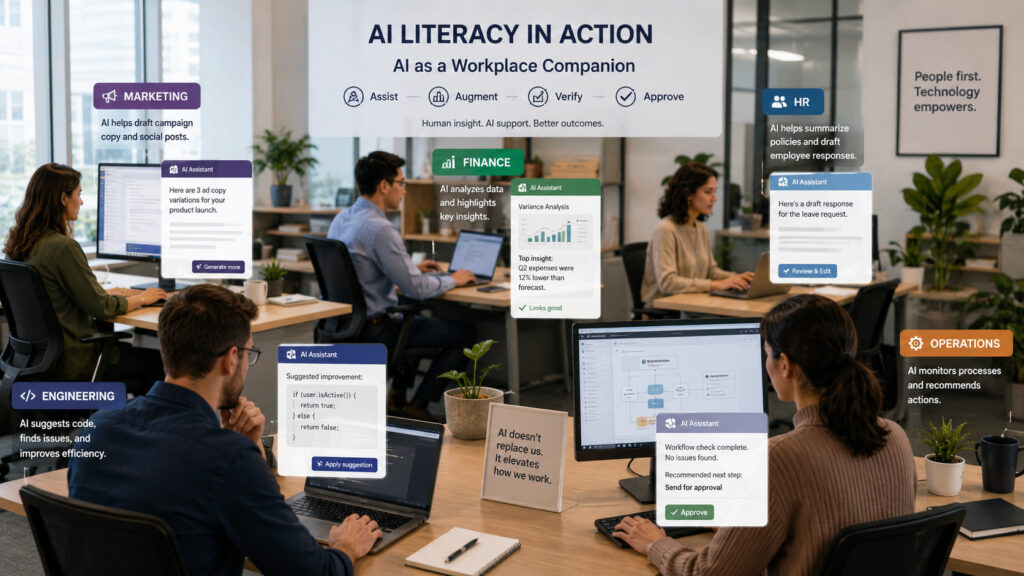
Key Takeaway: AI literacy in the workplace is becoming a basic employee capability, not a specialist advantage. It helps people choose suitable AI tasks, provide useful context, verify outputs, protect sensitive data, and recognize when human judgment should take over. Employees who combine AI use with sound judgment can work more effectively without sacrificing accuracy, trust, or accountability.
AI Has Joined the Daily Workflow
AI literacy in the workplace is quickly becoming a basic expectation across nearly every business function. Employers increasingly value practical AI skills. For employees, AI fluency now means more than knowing which button to click. You may already see AI inside email, search, analytics, customer service, or project software. The challenge is no longer finding AI. It is knowing how to use it without surrendering judgment.
A chatbot can draft a message, summarize a report, or suggest ideas within seconds. That convenience can create false confidence. A polished response may still contain incorrect facts, weak assumptions, or information that should remain private.
Learning a few prompts helps, but it does not cover the whole job. Employees also need to understand AI’s limits, risks, and place within human-led work.
What Does Being AI-Literate Actually Mean?
AI literacy describes the knowledge and judgment needed to use artificial intelligence responsibly and effectively. It does not require a computer science degree or the ability to build an AI model.
Instead, it helps you recognize suitable tasks, provide useful context, examine results, and know when a person should decide. An AI-literate employee understands what a tool can do, where it may struggle, and what responsibility remains human.
Do employees need coding skills to become AI-literate? Usually, they do not. A marketer, accountant, manager, and engineer will need different levels of technical knowledge. However, each person should understand the tools used within their role.
That understanding includes a healthy sense of doubt. AI can produce useful answers, yet it can also miss context or invent details. Fluency means benefiting from speed without confusing confidence with accuracy.
Why AI Literacy in the Workplace Is Moving From Helpful to Expected
Demand is already visible. LinkedIn’s 2026 labor market report found U.S. jobs requiring AI literacy grew 70% year over year. Coursera also reported a 234% yearly increase in generative AI enrollments among enterprise learners.
These figures reflect more than curiosity about a popular technology. AI now appears inside many tools that employees already use. As access expands, employers need people who can apply the technology without creating avoidable errors or risks.
Public institutions have noticed the same shift. The U.S. Department of Labor released an AI Literacy Framework in February 2026 for workforce and education programs. The EU AI Act also includes AI literacy provisions for staff who work with AI systems.
No single statistic means every role will change in the same way. However, the direction is becoming clearer. Basic AI knowledge now supports everyday readiness, much like digital communication or online research skills.
The Everyday Skills Behind Confident AI Use
So, what does AI literacy look like during an ordinary workday? It often appears in small decisions rather than dramatic technical projects:
Start with the task, not the tool
AI can help summarize documents, organize notes, brainstorm options, and create an early draft. Those uses provide a starting point rather than a finished answer. Some tasks carry much greater risk. Decisions involving safety, hiring, healthcare, legal rights, or money require stronger review. Employees should consider the consequences before bringing AI into the process.
Give context without giving away too much
Useful output depends on a clear goal, relevant background, and sensible boundaries. An unclear request often produces a vague answer. More context does not always mean more private information. Customer records, passwords, contracts, and internal strategy may require approved systems and stronger safeguards. AI literacy includes knowing where useful context ends and unnecessary exposure begins.
Read smooth answers with a skeptical eye
AI often presents an answer in a calm, convincing voice. Style can make weak information look stronger than it is. A thoughtful review covers facts, dates, calculations, sources, and assumptions. It also considers whether the response fits the audience and task. The level of checking should match the level of risk.
Know when human judgment owns the decision
AI may support a decision, but support does not equal accountability. People still need to consider values, consequences, exceptions, and business context. Human review becomes especially important when an output affects another person. A manager cannot hand responsibility to a tool simply because the answer arrived quickly.
Connect the output to a real goal
A useful AI result should improve a real process, decision, or customer experience. Novelty alone does not create value. The practical skill lies in working with the tool, spotting weak output, and linking technology to business goals. This keeps attention on outcomes rather than impressive demonstrations.
A Good Prompt Is Only the Starting Point
Prompting gets attention because a better request can improve the response immediately. However, a strong prompt cannot guarantee correct facts, safe data handling, or sound decisions.
Reliable AI-assisted work usually includes several stages. A person chooses the task, supplies context, reviews the answer, checks important claims, and approves the final action. Each stage adds judgment that a clever prompt cannot replace.
Can AI replace professional expertise? Not in the way many quick demonstrations suggest. Domain knowledge helps people notice missing details, unrealistic recommendations, and subtle errors.
AI literacy therefore goes beyond speaking to a machine. It involves managing a workflow and understanding where human experience adds the most value.
Training That Fits the Work, Not Just the Tool
Organizations often begin with a broad demonstration of a popular AI platform. That can spark interest, but it rarely prepares every role equally.
Useful training connects AI to real responsibilities. Marketing teams may focus on source checking, brand voice, and copyright concerns. Human resources may need guidance around privacy, bias, and employment decisions. Finance teams may emphasize calculations, confidential data, and approvals.
Clear policies should explain approved tools, restricted information, review expectations, and escalation routes. Employees also need practical examples that match their daily work.
Training should evolve as tools, business needs, and risks change. The goal is not maximum AI use. The goal is thoughtful use that supports better work without weakening trust or accountability.
Conclusion: A Smarter Baseline for Modern Work
AI literacy does not turn every employee into an AI specialist. It helps people work with AI while keeping responsibility where it belongs.
The strongest employees will not simply produce more content or try every new platform. They will choose appropriate tasks, question polished answers, protect information, and bring experience into the final decision.
Organizations benefit when employees share a common foundation. Teams can explore useful ideas while following clearer boundaries and review practices.
AI literacy in the workplace will continue to evolve as AI becomes part of everyday work. If you want to stay informed about the technologies, skills, and workplace trends shaping the future, join the conversation at Tech Scope Connect. Our live newscasts, expert discussions, and global summits explore how emerging technologies are transforming business and the workforce.
Sources:
- AI Literacy – Questions & Answers | digital-strategy.ec.europa.eu
- Building a Future of Work That Works | economicgraph.linkedin.com
- Introducing Coursera’s Job Skills Report 2026: The Most Critical Skills the World’s Learners Need This Year | blog.coursera.org
- TEN 07-25 | U.S. Department of Labor | dol.gov