Key Takeaway: Visual AI agents are moving computer vision beyond fixed alerts and object detection. At the edge, they can interpret visual context, answer natural-language questions, and connect events to controlled workflows. Traditional vision systems still handle fast, focused tasks, while newer models add context and decision support. The result is a more useful camera system that helps people make clearer decisions while remaining in control.
Cameras Are Learning to Do More Than Watch
isual AI agents are changing what cameras can do at the edge. These intelligent vision systems can move beyond spotting objects or triggering fixed alerts. Some can interpret a scene, answer questions, and connect what they see to a controlled workflow. In simple terms, AI-powered video assistants are becoming more useful partners in daily operations.
This shift arrives as organizations place more intelligence near cameras, machines, vehicles, and other data sources. Computer vision remains a leading edge AI workload. Meanwhile, agentic and physical AI are gaining attention across industrial and commercial settings.
The change is easy to understand. A camera once told you that something happened. A newer system may help explain what happened, why it matters, and who should respond.
What Are Visual AI Agents?
Visual AI agents combine visual understanding with language, context, and approved tools. They can review images or video and respond to natural-language questions. You might ask, “Is anything blocking the emergency exit?” Another user might ask, “What happened before this machine stopped?” The system can search relevant footage and return a useful answer.
Traditional computer vision usually handles a predefined task. It may count vehicles, detect defects, track people, or identify missing safety equipment. These systems remain valuable because they often work quickly and consistently.
A vision-language model adds more flexibility. It can describe a scene, summarize an event, or compare activity across different moments. NVIDIA describes visual agents that answer broad questions about live or recorded video using natural language.
However, a model that describes an image does not automatically become an agent. An agent also connects its interpretation to a goal or workflow. It might find a procedure, check a maintenance record, create a ticket, or notify a supervisor.
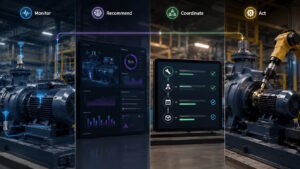
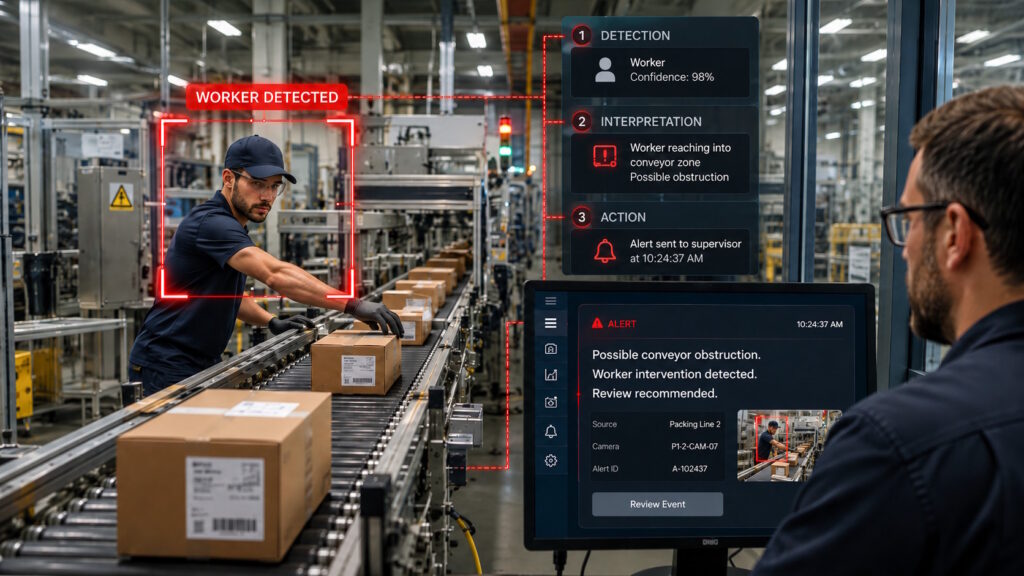
The simplest progression looks like this: detection, interpretation, contextual reasoning, and bounded action. Each step adds value without removing human control.
From a Detection to a Decision
Consider a camera near a factory conveyor. A traditional system detects a worker entering a restricted zone while the conveyor runs. That alert may be accurate, but it leaves several questions unanswered. Why did the worker enter? Was the worker authorized? Did a problem occur on the line?
A visual system could review the surrounding footage. It might notice that a container became misaligned before the worker reached toward the conveyor. The agent could then check other available information. It might review machine status, an open maintenance ticket, or the approved safety procedure.
Instead of sending a basic alert, the system could provide context. It might report that the worker responded to a blockage while the conveyor remained active. From there, the system could save the clip, prepare a summary, and notify the shift supervisor. It could also request human approval before opening an incident case.
This is what “moving from detection to decisions” really means. The camera does not take unrestricted control. It helps people understand an event and select the right next step.
Why the Edge Changes the Picture
In this context, “the edge” means computing near the place where visual data originates. That could mean a smart camera, local gateway, industrial computer, on-site server, robot, or vehicle. Not every task needs a distant cloud system. Local processing can screen video, identify relevant events, and respond without sending every frame elsewhere.
Why Visual AI Agents Fit Local Operations
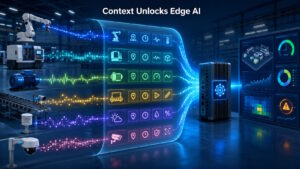
Video creates a huge stream of information. Most organizations do not need to upload all of it for constant cloud analysis. An edge system can examine routine activity locally. It can then send an alert, summary, selected image, or short clip when something deserves attention.
Qualcomm’s edge-first video platform follows this approach. It runs AI on devices or local appliances while keeping raw footage on-site. The platform sends selected metadata and events upstream instead.
Local processing can also support faster responses and reduce network dependence. It may help organizations protect sensitive footage and continue working during connection problems. Still, the cloud will remain useful. Some systems will divide tasks among cameras, local servers, enterprise software, and cloud services. The best location depends on speed, privacy, cost, and computing needs.
The Best Systems Blend Proven Vision With New AI
Visual AI agents will not simply replace traditional computer vision. In many cases, both approaches will work together. A lightweight model can watch a video stream continuously. It can detect objects, track movement, count items, or flag unusual activity.
Then a more flexible model can review the important moment. It can answer a question, add context, or explain why the event deserves attention. This combination helps control computing demands. It also preserves the speed and predictability of specialized vision models.
NVIDIA’s current reference workflows combine traditional computer vision with generative AI and visual reasoning. The first layer identifies useful clips, while the next layer performs deeper analysis.
The agent layer can then connect the result to business systems. It may check inventory, maintenance history, access permissions, sensor readings, or operating procedures. The camera therefore becomes part of a larger information flow. It no longer acts as an isolated alarm source.
Where This Shift Could Make a Difference
The appeal of this technology comes from its broad range of possible uses. Each setting starts with a practical question about visible activity.
Manufacturing and logistics
A factory manager might ask, “What happened during the two minutes before the line stopped?” The system could find the relevant footage and summarize the event. A warehouse team could ask, “Where was this package last seen?” The agent might search several camera feeds and connect the result to inventory data.
These tools could also support defect review, procedure checks, loading operations, and incident investigation. They would help teams find useful evidence without manually watching hours of video.
Retail and smart buildings
Retail teams could investigate empty shelves, long checkout lines, or misplaced products. Building managers could review blocked exits, maintenance issues, or unusual activity. The system might answer, “Which shelf stayed empty for more than twenty minutes?” It could then create a restocking task for an employee.
A visual agent may also help staff review events across several locations. That could make existing camera networks more useful for daily operations.
Transportation, healthcare, and robotics
Traffic teams could ask why vehicles slowed at a specific intersection. The system might distinguish roadwork, a delivery stop, and a collision.
Healthcare organizations may explore carefully governed uses around room status, equipment location, and operational safety. High-stakes medical decisions would require much stronger review and validation.
Robotics takes the idea one step further. A robot can combine visual understanding with planning and physical movement. Current edge platforms increasingly support agentic workflows for robotics, inspection, and industrial automation.
Smart Cameras Still Need Smart Guardrails
More capable visual systems also create new risks. A model may misunderstand an action, miss a small object, or confuse the order of events. Poor lighting, blocked views, and unusual camera angles can reduce reliability. A confident answer may still rest on incomplete evidence.
Organizations should match the agent’s authority to the consequences of an error. Saving a clip carries less risk than stopping equipment or restricting access. Clear permissions can limit what the system may do. Human review can protect higher-impact decisions. Audit trails can show what the agent saw, concluded, and recommended.
NIST’s AI Risk Management Framework encourages organizations to define human roles and oversight for operational AI systems. It also recognizes that different uses require different levels of human involvement.
The safest approach keeps critical controls separate from open-ended generative responses. Proven sensors and validated safety systems should continue handling emergency functions.
Conclusion: The Camera Becomes Part of the Workflow
The next chapter of computer vision involves more than better object detection. It brings visual information into conversations, investigations, and everyday decisions. Traditional vision systems will still handle many fast and focused tasks. Newer models can add context, answer questions, and make video easier to use.
At the edge, these capabilities can stay close to the people, equipment, and events they support. The result may feel less like a smarter camera and more like a responsive operational tool. Visual AI agents will not turn every camera into an autonomous decision-maker. Their real promise lies in helping people move from an alert toward a clearer, controlled response.
Curious about how AI and edge technologies are reshaping real-world operations? Join the conversation at Tech Scope Connect for expert perspectives, live newscasts, and global summits exploring what comes next.
Sources:
- The Power of Small: Edge AI Predictions for 2026 | dell.com
- Develop Generative AI-Powered Visual AI Agents for the Edge | developer.nvidia.com
- NVIDIA Jetson Brings Agentic AI to the Physical World | blogs.nvidia.com
- App. C: AI Risk Management and Human-AI Interaction | airc.nist.gov
- Qualcomm Insight Platform: Unified Control, Edge-First, Ai-Powered Video SAAS | qualcomm.com