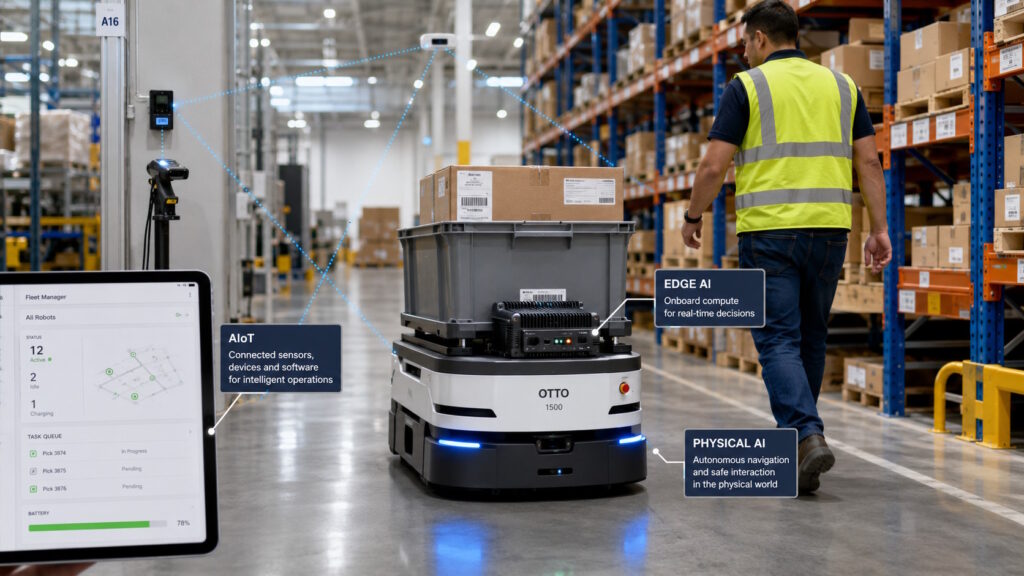
Quick Answer: AIoT describes connected devices and systems that use artificial intelligence to analyze data, improve decisions, or automate responses. Edge AI refers to AI processing that happens on or near the device producing the data. Physical AI describes systems that can perceive their surroundings, make decisions, and act in the physical world. These technologies are not competing alternatives. A single solution, such as an autonomous warehouse robot, can use AIoT connectivity, edge AI processing, and physical AI capabilities at the same time.
Three Terms, Three Different Questions
AIoT, edge AI, and physical AI are changing how connected devices, local intelligence, and embodied systems work in the real world. You now see these ideas in stories about factories, vehicles, buildings, robots, and smart infrastructure. They often appear together, but each term highlights a different part of the technology.
So, what is the difference between them?
Think of the terms as three lenses. One shows the connected ecosystem. Another shows where the intelligence operates. The third shows how intelligence can understand and influence a physical environment.
Why the Vocabulary Grew With the Technology
AI once felt closely tied to software, websites, and large cloud platforms. Today, intelligence also appears inside cameras, machines, gateways, vehicles, appliances, and robots.
One label cannot explain every feature of these systems. Connectivity, processing location, and physical behavior each reveal something different.
The terms also do not form a simple ladder. A system does not “graduate” from one category into the next. Instead, each label helps you examine the same technology from a different angle.
AIoT: The Big Picture of Connected Intelligence
Here, AIoT refers to the Artificial Intelligence of Things. It combines AI with the networks of sensors, devices, software, and connections that make up IoT.
A traditional IoT system collects and shares information. An intelligent connected system can also interpret data, recognize patterns, support decisions, or trigger a response. Cisco describes this architecture as a combination of devices, sensors, networking, edge resources, and cloud computing.
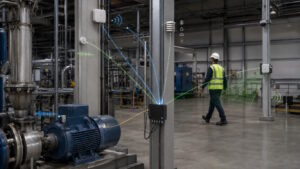
Picture a commercial building with connected thermostats, occupancy sensors, lighting controls, and energy meters. The devices collect information about temperature, activity, and electricity use. Intelligence can then identify patterns and help adjust conditions across the building.
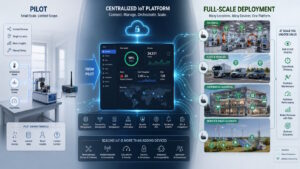
The analysis does not need to happen in one location. A device may handle one task, while a gateway handles another. The cloud may support storage, coordination, or larger calculations.
This broad system view makes AIoT useful for discussing smart buildings, predictive maintenance, connected healthcare, asset tracking, and industrial monitoring. It explains how connected parts work together, rather than where every calculation happens.
When Intelligence Moves Closer to the Moment
Edge processing shifts attention from the whole ecosystem to the location of the computation. It places AI models on, or near, the device producing data.
NIST describes several levels of edge intelligence, depending on the role of devices and network-edge nodes. At a basic level, an edge device can run an AI function created somewhere else.
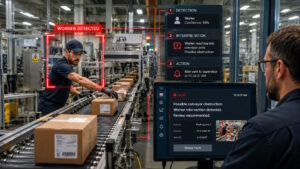
Consider a factory camera that checks products for visible defects. Sending every video frame to a distant platform could add delay and network traffic. A nearby processor can analyze images close to the production line and flag a problem quickly.
Does local processing eliminate the cloud? Usually, it does not.
Many systems divide the work. Nearby hardware manages time-sensitive decisions, while cloud services support storage, model updates, coordination, or deeper analysis. This hybrid approach lets organizations match each task with a suitable location.
The simplest question is, “Does the system run intelligence near the place where the data appears?” When the answer is yes, edge AI likely plays a role.
When Software Starts Acting in the Real World
Physical intelligence shifts the focus again. It describes systems that perceive their surroundings, interpret what they sense, and turn decisions into real-world actions.
NVIDIA defines physical AI around autonomous systems that perceive, understand, reason, and perform actions in physical environments. Its examples include robots, autonomous vehicles, cameras, and smart spaces.
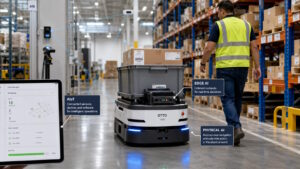
A warehouse robot offers a clear example. Cameras and other sensors help it detect shelves, objects, workers, and obstacles. Its software interprets that information and chooses a safe movement. Motors then turn the decision into action.
Is physical AI simply another name for robotics? Not quite.
Some robots repeat fixed, preprogrammed movements in controlled settings. More adaptive machines can respond when objects move, routes change, or people enter their surroundings. Physical AI emphasizes that loop between sensing, reasoning, and action.
Industry and research sources frame the term in slightly different ways. In simple terms, the action loop offers the clearest guide: sense, interpret, decide, and act.
Edge AI and Physical AI: Different Jobs, Shared Systems
These two concepts often appear together, but they answer different questions. Edge AI asks where the model runs. Physical AI asks what a system can understand and do within a real environment.
A stationary inspection camera may analyze images locally and identify defects. It can qualify as an edge application, even when it controls no machinery. A mobile robot may process sensor data onboard, choose a route, and move through a busy facility. Local intelligence supports its physical behavior, so both concepts apply.
Neither term automatically proves the other. Still, machines that must react quickly often benefit from processing near their sensors and controls.
One Warehouse Robot, Three Useful Labels
Can one system fit all three descriptions? Yes, and a warehouse robot shows how. The robot connects with inventory software, facility sensors, and a fleet-management platform. That wider environment represents the connected-system view.
It processes camera and proximity data onboard, close to the moving machine. That feature represents local intelligence. It detects obstacles, plans a route, and physically moves goods. Those capabilities represent intelligence acting in the real world.
Nothing about this example requires three separate products. Each label highlights a different feature of one solution. The same mental model works for connected vehicles, agricultural machines, automated factories, and other smart environments.
Why Clear Labels Lead to Better Questions
Clear terminology improves more than technical conversations. It also helps business leaders ask better questions before evaluating a product or project.
A connected-system discussion should cover devices, data sharing, integration, and management. A local-processing discussion should examine response time, hardware needs, connectivity, and cloud coordination. A physically active system also raises questions about safety, movement, surroundings, and human interaction.
These categories do not replace a detailed evaluation. They give nontechnical readers a practical starting point.
They can also make product announcements easier to understand. A description may sound broad while explaining only one layer. Knowing the distinctions helps you identify what the announcement says and what it leaves unanswered.
The Future Will Blend the Categories
Factories, buildings, vehicles, and infrastructure will keep gaining more intelligence. Many systems will combine broad connectivity, nearby processing, and physical action.
The boundaries may look blurry at times. That does not make the terms useless. It reflects the way modern technology combines several capabilities within one environment.
The best approach is to avoid treating the labels as a ranking. Each term answers a separate question about a connected and increasingly intelligent world.
Conclusion: Three Lenses, One Clearer Picture
AI is moving beyond isolated software and into devices, facilities, vehicles, and machines. Clear language makes that shift easier to understand.
AIoT provides the ecosystem view. Edge AI reveals where intelligence operates. Physical AI explains how a system perceives and responds through real-world action.
Once you understand these three lenses, many technology stories become easier to follow. You can see how devices connect, where decisions happen, and whether software can influence physical activity.
To keep exploring how AIoT, edge AI, and physical AI are reshaping connected operations, join the conversation at Tech Scope Connect. Our articles, live newscasts, and summits offer practical perspectives on the technologies moving from software into the physical world.
Sources:
- What is Physical AI? | nvidia.com
- Fundamentals of Physical AI | arxiv.org
- What is the Artificial Intelligence of Things (AIoT)? | cisco.com
- Edge AI | nist.gov
- What is Physical AI? | nvidia.com
- Physical AI Learning | docs.nvidia.com