Key Takeaway: Artificial intelligence is changing how information moves across modern networks. While download speed has long been the focus, many emerging AI applications rely on uploading images, video, audio, and sensor data before they can generate useful responses. Better upload speeds, reliable connectivity, and low latency will help support these experiences as AI becomes more integrated into everyday business and consumer technology.
The Internet Is Learning to Listen
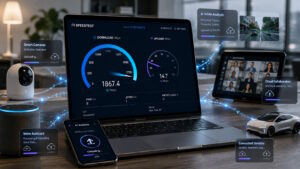
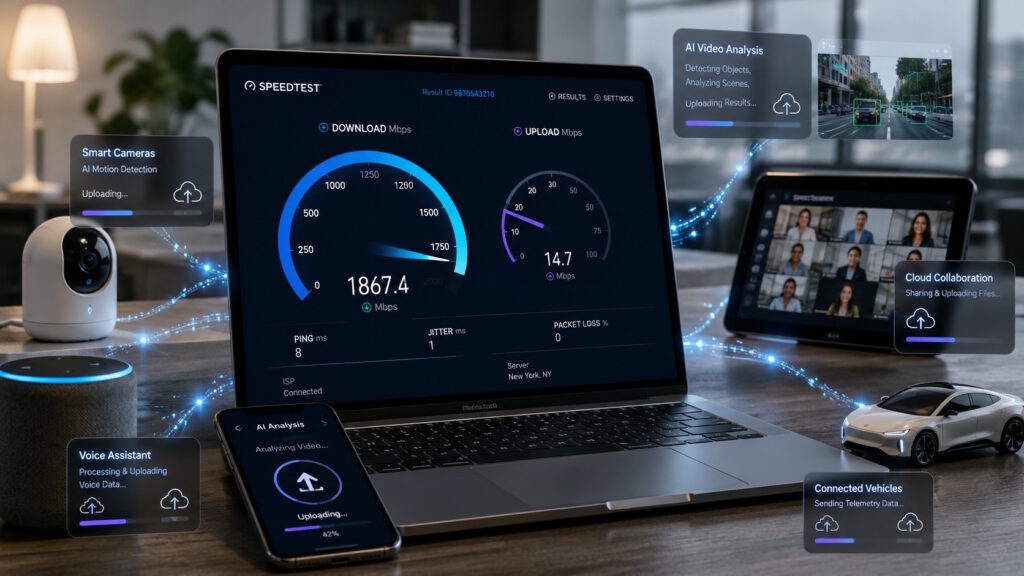
Artificial intelligence is changing what our devices send across the internet, not only what they receive. AI tools now work with photos, voices, video, documents, and sensor readings. These intelligent systems depend on connectivity that moves information smoothly in both directions.
For years, most people judged an internet connection by its download speed. That made sense when browsing, streaming, and downloading shaped most online activity. Newer digital experiences often begin with information moving away from your device.
Before a visual assistant can explain a camera view, it must receive the image. Before a transcription tool can process a meeting, it needs the audio. A smart camera may also send clips or alerts for remote analysis.
This shift does not mean AI is breaking the internet. Direct generative AI still represents a small share of mobile traffic today. However, its growing use reveals why uploads deserve more attention alongside downloads.
Why Downloads Have Always Taken Center Stage
Network providers designed many home and mobile connections for people who consumed more content than they created. A movie travels from a platform to your screen. A webpage moves from a server to your browser. Software updates and social feeds follow the same direction.
Providers therefore gave many services far more download capacity than upload capacity. You may see hundreds of megabits per second for downloads and much less for uploads. The industry describes this arrangement as an asymmetrical connection.
That balance still works well for many everyday activities. Yet it can feel restrictive during video meetings, cloud backups, livestreams, or large file transfers. Those familiar examples already show what happens when upstream traffic becomes more important.
How Artificial Intelligence Changes the Direction of Data
Text-based chat does not usually require much bandwidth. A text prompt and response carry little data compared with images, audio, or video. The picture changes when an AI service needs to see, hear, or monitor something.
A user might upload a product image and ask for design feedback. A technician could show a machine to a visual assistant during an inspection. A farmer might send crop images from a field. A connected building may transmit sensor readings for ongoing analysis.
In each case, the useful result begins with an upload. The flow looks simple:
Device → network → AI service → network → device
The response could be only a paragraph. However, the image, recording, or video sent first may contain much more data. Existing traffic measurements already show that generative AI applications use a larger uplink share than typical mobile traffic.
Which Artificial Intelligence Experiences Put More Pressure on Uploads?
Multimodal assistants offer one clear example. They can work with speech, images, video, and documents instead of relying only on text. A single photo causes little strain, but a continuous camera feed changes the workload.
Smart cameras create similar demands. Some process footage locally, while others send video or selected clips to a remote platform. Security teams may also need live access during an incident.
Wearables, smart glasses, drones, robots, and connected vehicles could add further demand. These devices may send video, location details, movement data, or equipment readings while operating.
Automated AI agents may create different traffic patterns. They can synchronize files, contact cloud services, and monitor systems without waiting for every human prompt. Nokia expects these workloads to become irregular and bursty, with sudden periods of heavier activity.
Does AI Really Need Faster Upload Speeds?
The honest answer depends on the application. A text chatbot works comfortably on an ordinary connection. Uploading one compressed image also requires little time on most modern networks. Live video analysis, remote robotics, and large data transfers create a different challenge.
Ericsson measured faster uplink growth than downlink growth across 43 of 55 service providers. Current drivers include collaboration tools, cloud storage, and user-created content. Artificial intelligence does not account for all that growth, but it could add another layer.
GSMA reported that direct generative AI traffic remained around 0.2% of mobile traffic in 2026. That figure keeps the discussion grounded. Networks are not facing an immediate AI traffic crisis.
A more useful question looks ahead. Will current upload performance support visual, mobile, automated, and real-time services? Some networks will handle those experiences easily. Others may struggle during peak demand or in places with weaker coverage.
Speed Is Only One Part of a Good Connection
Upload speed tells you how much information a connection can send each second. It does not describe the entire experience.
Latency measures how quickly data travels and a response returns. High latency can make a live assistant feel slow, even when the connection has enough capacity.
Consistency also counts. A speed test may show an impressive peak, but an application needs dependable performance over time. Sudden drops can interrupt video, delay analysis, or lower image quality.
Packet loss and unstable timing can create similar problems. You do not need to understand every network metric to notice the result. The tool may pause, misbehave, or stop feeling truly real time.
This explains why a connection can stream a film perfectly yet struggle with live visual analysis. Streaming mainly sends data toward you and can buffer content ahead. Interactive tools must exchange fresh information with little delay.
Can Edge AI Reduce the Upload Burden?
Not every piece of data needs a trip to a distant cloud platform. Phones, computers, cameras, vehicles, and industrial equipment can process some information locally.
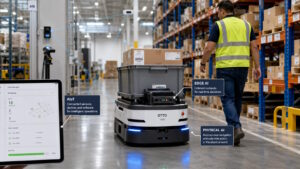
A smart camera might detect motion on the device. It could send a short alert instead of uploading hours of empty footage. A factory sensor might share unusual readings while ignoring normal activity.
Edge computing offers another option. It places processing resources closer to the device, such as within a factory or local network. Shorter journeys can improve response times and reduce reliance on distant infrastructure.
Many future systems will probably combine local, edge, and cloud processing. Routine work can happen nearby, while harder tasks reach larger cloud models. This hybrid approach can control bandwidth without cutting the application off from online services.
Edge processing does not remove the need for uploads. It changes what travels, how often it moves, and how quickly it must arrive. Nokia expects edge processing to play an important role in latency-sensitive physical AI applications.
How Connectivity Could Adapt
Better balance will become more useful than a simple race for higher download numbers. Homes and businesses may examine upload capacity more closely when choosing broadband or mobile services.
Mobile networks can also improve upstream performance as 5G develops. Providers are exploring stronger uplinks, nearby computing, and services built around consistent performance. Ericsson expects near-term 5G improvements and longer-term network changes to address heavier uplink demand.
Businesses may also combine several types of connectivity. Fiber can support a main site, while cellular provides mobility or backup coverage. Wi-Fi connects nearby devices, and satellite can reach certain remote locations.
The goal is not maximum speed everywhere. Each application needs a connection that fits its actual workload. A warehouse camera, mobile assistant, and office chatbot will not share identical requirements.
What Should Businesses Check Before Launching Connected AI?
A polished demonstration can hide weak connectivity. Office Wi-Fi may support an application that later struggles inside a factory, vehicle, rural site, or crowded venue.
Before a wider rollout, a business should understand what the tool sends. Does it upload short text, occasional images, continuous video, or sensor data? Does activity remain steady, or does it arrive in sudden bursts?
The location of processing also shapes network demand. Local processing can protect privacy and reduce traffic. Cloud processing can provide access to larger models and shared services.
Teams should also consider what happens when the connection weakens. Can the tool continue with limited features? Does it store information and upload later? Will a delay create inconvenience, lost work, or a safety concern?
These questions help teams judge readiness without turning every project into a telecommunications exercise. They connect the network to the experience users will actually receive.
What Will Everyday Users Notice?
Most people will not talk about uplinks, latency, or network architecture. They will notice whether a service responds quickly and works where they need it.
Better uploads could support smoother visual assistants, clearer video collaboration, and faster cloud backups. They could also improve connected cameras, wearables, live translation, and remote support.
The change may feel subtle. A tool opens faster, maintains its video quality, or keeps working while the user moves. Behind that simple experience sits a connection carrying information in both directions.
Conclusion: Uploads Belong in the Conversation
Today’s networks are not suddenly obsolete, and artificial intelligence is not overwhelming them. However, download speed no longer tells the whole connectivity story.
As digital tools become more visual and responsive, devices will send richer information to online services. Upload speed, latency, reliability, and local processing will shape how well those experiences work.
The next stage of connected technology needs a more balanced view of network performance. If you enjoy exploring how artificial intelligence, connectivity, and other emerging technologies are reshaping the world around us, join the conversation at Tech Scope Connect. Through our live newscasts, expert discussions, and global technology summits, we bring together the ideas and insights driving the future of innovation.
Sources:
- Mobile Net Zero Report 2026 | view.gsma.com
- Explainer: Network Traffic Is Fundamentally Changing in the AI Supercycle | nokia.com
- AI Will Drive Future Uplink – Ericsson Mobility Report | ericsson.com
- Mobile Net Zero Report 2026 | view.gsma.com
- Analysis of Traffic Profiles – Mobility Report | ericsson.com
- GenAI Data Traffic Today – Ericsson Mobility Report | ericsson.com
- EMR – India’s 5G Subscriptions to Reach 1.1 Billion by 2031 | ericsson.com