Quick Answer: Yes, an AIoT device can become less accurate even while its hardware continues working normally. In many cases, the AI model has not failed—the environment, data, or operating conditions have changed since the model was trained. This gradual shift, known as model drift, is a normal part of the AI lifecycle. With monitoring, updated data, careful retraining, and controlled model updates, organizations can maintain performance and keep intelligent devices delivering reliable results over time.
When Smart Stops Meaning Static
An AIoT device can become less accurate over time, even while its hardware continues working normally. This smart connected product combines artificial intelligence with networked sensors, often processing data near where it is created. The same issue can affect an edge AI system or intelligent sensor. Each device may still collect data and return answers, but those answers may fit the surrounding world less well.
So, can an intelligent product really get worse with age? Yes, although the model rarely wears out like a battery. More often, the model stays unchanged while its operating conditions move in a new direction.
This gradual mismatch is known as model drift. It can affect cameras, industrial sensors, building systems, wearables, and many other connected products. Drift does not mean AIoT is unreliable. Instead, it shows why intelligent products benefit from thoughtful care after deployment.
A Working AIoT Device Can Still Lose Its Edge
A connected product can remain online without remaining equally accurate. Traditional monitoring may confirm its power, connectivity, storage, and software status. Those checks show whether the system operates, but they may not reveal whether its model still makes useful decisions.
Think of the model as a skilled employee whose workplace keeps evolving. New equipment arrives, products change, and customers develop different habits. The employee remains capable, but updated information helps their expertise stay relevant.
A deployed model works in much the same way. Its earlier training may still hold value, although new conditions require fresh evaluation. Edge AI lifecycle guidance includes maintenance alongside data collection, testing, deployment, and model updates. It also highlights version control, which helps teams track changes and restore earlier versions when necessary.
Model Drift Begins When the World Moves On
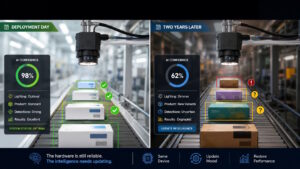
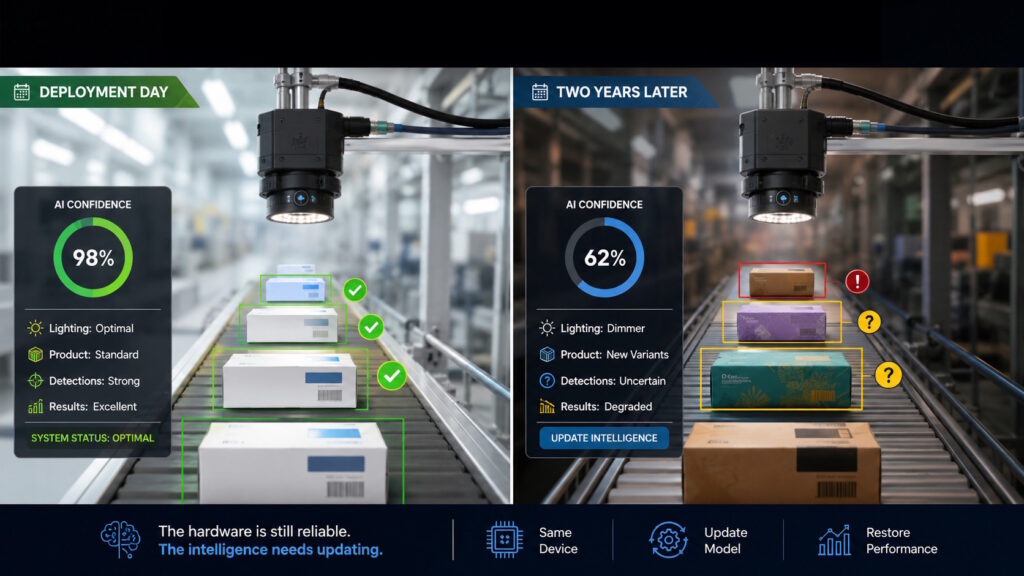
What is model drift in everyday language? It begins when current conditions move away from patterns the model learned earlier. Within an AIoT device, that mismatch can affect decisions without interrupting basic operation. The gap may widen slowly, or one major change may create it.
Imagine a quality-control camera trained under bright factory lights. The factory later installs different bulbs and introduces reflective packaging. The camera still captures images, yet those images differ from its original training examples.
Several types of change can sit behind this problem, and their differences suggest different responses.
Data drift changes what the model sees
Data drift occurs when incoming information changes. A camera may encounter new colors, angles, materials, or lighting. A microphone may hear more background noise after nearby machinery moves.
Seasons can also reshape sensor data. Temperature, humidity, sunlight, dust, and human activity often follow changing patterns. A model trained during one period may eventually face a much broader range.
A data shift does not automatically prove that accuracy has declined. It acts as an early clue that deserves closer attention.
Concept drift changes what the data means
Concept drift reaches beyond the appearance of the input. The information may look familiar, while its connection to the correct answer changes.
Consider a predictive-maintenance model that studies machine vibration. One pattern may initially suggest a failing component. After an equipment upgrade, that same pattern could become normal.
Human behavior can create similar changes. New work schedules may alter building occupancy without changing the building itself. A system trained on older routines may then misread newer patterns.
Data drift changes what a model receives. Concept drift changes the relationship between that input and the desired result. AWS guidance uses this distinction when describing production model monitoring.
Sensor drift can point somewhere else
Sometimes the model is not the main issue. A physical sensor can slowly begin producing different readings.
A camera lens may gather dust, while a temperature sensor may lose calibration. An accelerometer can loosen after months of vibration. Each problem may make healthy software appear less reliable.
An automatic retraining response could hide the real fault. The model might learn to accept inaccurate measurements instead. Hardware and data-pipeline checks can reveal whether a repair offers the better solution.
Why Drift Can Hide in Plain Sight
You might expect an inaccurate system to display an error message. Many intelligent products do not fail so neatly. They continue returning predictions, even after conditions move beyond familiar territory.
Some applications also lack immediate proof. A maintenance warning may take weeks to confirm. A missed defect might appear later in the supply chain. An occupancy estimate may never receive a manual review.
People sometimes adjust before the dashboard does. An operator may ignore noisy alerts or correct results without reporting every mistake. Fleet-wide averages can also hide trouble within one location or hardware version.
One factory may use different lighting, while one region faces harsher weather. A broad performance average can conceal those local changes.
In March 2026, NIST highlighted performance degradation, drift, fragmented logging, and monitoring cadence as post-deployment challenges. NIST also noted the need to balance automated monitoring with human validation.
Model Health Requires More Than an Uptime Check
How do companies know when a model starts drifting? Monitoring an AIoT device requires more than an uptime dashboard. Most teams combine several signals instead of trusting one number.
They may compare current inputs with the original training data. They may also watch prediction patterns, confirmed errors, and operator overrides. Comparisons across locations, seasons, and device versions can reveal differences hidden by a fleet-wide average.
Human feedback adds context that dashboards may miss. Operators often notice environmental changes before an automated alert becomes obvious. Confirmed outcomes can then show whether the model still supports its intended task.
The right monitoring schedule depends on the product and its consequences. A low-risk consumer feature may need occasional review. A safety-related industrial system may require closer attention and faster escalation.
More monitoring does not always mean collecting every raw input. Privacy, bandwidth, storage, and battery limits shape what edge systems can report. Useful monitoring focuses on meaningful signals and assigns clear responsibility for responding.
Diagnosis Should Come Before Retraining
A drift alert should begin an investigation rather than trigger an instant update. The first question is straightforward: what actually changed?
The sensor may need cleaning or calibration. Firmware may have altered how the device processes data. A seasonal event may have created unusual readings. The business process itself may now follow different rules.
Once teams identify the cause, they can choose a fitting response. The AIoT device may need a repair, a data update, or both. Other situations may require new field data, updated testing, or a revised model.
This approach protects the strengths of the existing system. It also keeps temporary noise from becoming part of a new definition of normal.
From Warning Signs to Better Performance
Model drift can sound negative, yet it also reveals an opportunity. Real deployment exposes conditions that developers could not fully recreate beforehand.
Field data may uncover new environments, rare events, and overlooked behavior. Carefully selected examples can strengthen the next model version. The product may then work better across a wider range of situations.
How an AIoT Device Can Improve After Launch
A thoughtful update process begins with representative data from the changed environment. Teams review that material before retraining and testing the model.
Testing should cover both current and earlier conditions. This step helps prevent a new version from solving today’s issue while weakening yesterday’s performance.
A limited rollout can reduce uncertainty. Teams might begin with one site, device group, or customer segment. They can compare results before expanding the release across the fleet.
Version tracking and rollback create another safety net. Edge Impulse recommends identifying the source of change, retraining when appropriate, then testing before deployment.
This lifecycle approach can turn maintenance into improvement. The model benefits from real experience without treating every unusual event as a permanent lesson.
When a Refresh Is No Longer Enough
Retraining can help when the task remains similar and existing sensors still suit the job. Larger changes may call for a redesigned system.
Perhaps the sensor no longer captures enough information. The production process may have changed completely. The original model may also lack the flexibility required by the new environment.
Sometimes retirement becomes the sensible choice. The use case may disappear, support may become impractical, or newer hardware may offer a stronger path.
An intelligent product can therefore have two different lifespans. Its physical components have one, while its model has another. Planning for both gives buyers a clearer view of long-term value.
Better Questions Before and After Deployment
Initial accuracy remains important, but it does not tell the whole story. Buyers can also ask how the product will stay useful.
How will the provider monitor performance after launch? Can teams compare results across locations and device versions? How will they separate sensor faults from model drift?
Update procedures deserve attention as well. Buyers may ask whether releases begin with a limited group and whether rollback remains available. Support terms should also explain who responds when operating conditions change.
These questions do not show distrust in AI. They reflect the same maturity buyers expect from software, cybersecurity, maintenance, and connected hardware.
Conclusion: Intelligence Works Best as a Living Capability
An intelligent product does not enter a frozen world. Seasons change, equipment ages, products evolve, and people develop new routines. A model may need fresh information as those conditions shift.
Model drift does not make AIoT a poor investment. It shows that intelligence has a lifecycle. Monitoring, diagnosis, field data, and controlled updates can preserve performance and support better future versions.
The strongest systems may not promise permanent perfection on launch day. They recognize change, learn from real use, and improve with careful oversight.
Want to stay current on how AIoT, edge AI, and other emerging technologies are evolving? Join the conversation at Tech Scope Connect, where our live newscasts, expert discussions, and global summits explore the trends shaping the future of intelligent connected systems.
Sources:
- What Is Edge MLOps? | docs.edgeimpulse.com
- Lifecycle Management | docs.edgeimpulse.com
- MLOPS01-BP03 Monitor Model Adherence to Business Requirements | docs.aws.amazon.com
- New Report: Challenges to the Monitoring of Deployed AI Systems | nist.gov
- Challenges to the Monitoring of Deployed AI Systems: Center for AI Standards and Innovation | nist.gov
- OTA Model Updates | docs.edgeimpulse.com