Key Takeaway: Small language models could make edge AI more practical by bringing focused generative capabilities to devices, vehicles, machines, and local systems with limited power, memory, or connectivity. Rather than replacing large cloud models, they can handle routine, privacy-sensitive, and time-critical tasks close to where data is created. More complex requests can still move to the cloud. The real breakthrough may be choosing the right-sized model for each job, not simply the largest one available.
A Smaller Model, a Bigger Opportunity
Edge AI is entering a new phase, and small language models may help move it beyond the cloud. These compact models can bring on-device AI into factories, vehicles, computers, robots, and other connected systems. Local AI can then respond near the place where people and machines create data.
For years, the AI conversation focused heavily on size. Larger models offered broader knowledge, stronger writing, and more flexible reasoning. Yet many edge environments do not need a model that can discuss almost any topic. They need one that understands a specific device, task, or workflow.
A factory robot does not need to write an essay about ancient history. It may need to explain an alert or locate an approved maintenance step. That narrower job changes what “powerful AI” can mean.
The next breakthrough may not come from placing the largest possible model on every device. It may come from choosing the smallest model that can perform the job well.
What Is a Small Language Model?
A small language model, often called an SLM, uses fewer parameters and less computing power than a large language model. There is no single size that separates the two categories.
The meaning of “small” depends on the hardware. A model may feel small on an office computer but remain too demanding for a camera. An industrial gateway also offers more resources than a battery-powered sensor.
Small language models differ from many traditional edge models. Earlier systems often detected an object, recognized a keyword, or flagged an unusual pattern. An SLM can add language and context to those results.
For example, a vision system might detect missing safety equipment. A language model could explain the issue and prepare a short incident note. The combination turns a simple alert into something people can understand and act upon.
Why Edge AI Needs Right-Sized Intelligence
Large models succeed because they can handle many subjects and requests. That flexibility also demands substantial memory, processing power, energy, and cooling.
Edge environments usually face stricter limits. A vehicle, retail system, robot, or factory gateway cannot operate like a cloud data center. It may also need to respond immediately, even when the network becomes unreliable.
A smaller model can focus on the knowledge that matters most. An industrial assistant may understand equipment terms, maintenance records, approved manuals, and common technician questions. It does not need broad expertise in unrelated subjects.
This creates a useful shift in thinking. The goal becomes sufficient intelligence, not maximum intelligence. A focused model can support one machine, one application, or one group of workers.
Relevance can matter more than breadth at the edge. A model that knows the local workflow may offer more value than a larger generalist.
How Do These Models Fit on Smaller Devices?
Developers use several methods to reduce the resources a model needs. You do not need to understand the mathematics to grasp the basic idea.
Quantization stores model information with lower numerical precision. It resembles saving an image with fewer shades. The file becomes smaller, although excessive reduction can remove useful detail.
Knowledge distillation trains a smaller model with help from a larger teacher model. The student learns useful behaviors without carrying the teacher’s full size.
Pruning removes model parts that contribute little to the intended task. Domain-specific training then helps the remaining model understand relevant language, examples, and output formats.
Hardware also plays an important role. CPUs manage general application work, while GPUs handle many calculations in parallel. Neural processing units, or NPUs, specialize in efficient AI tasks.
A device may use all three together. The processor mix depends on the model, the application, and the available power.
From Alerts to Answers: What Changes at the Edge?
Traditional edge systems often detect and report events. Small language models can help interpret those events in plain language.
Imagine a machine that reports unusual vibration. A local model could connect that alert with a manual and recent maintenance notes. It might suggest that a technician inspect a bearing during the next planned shutdown.
The model should not replace safety controls or qualified experts. It can make existing information easier to find, understand, and document.
The same pattern can support many everyday interactions. A field technician could ask for a troubleshooting procedure without a reliable internet connection. A workplace assistant could summarize local documents without uploading every file.
Where Edge AI Could Use Small Language Models
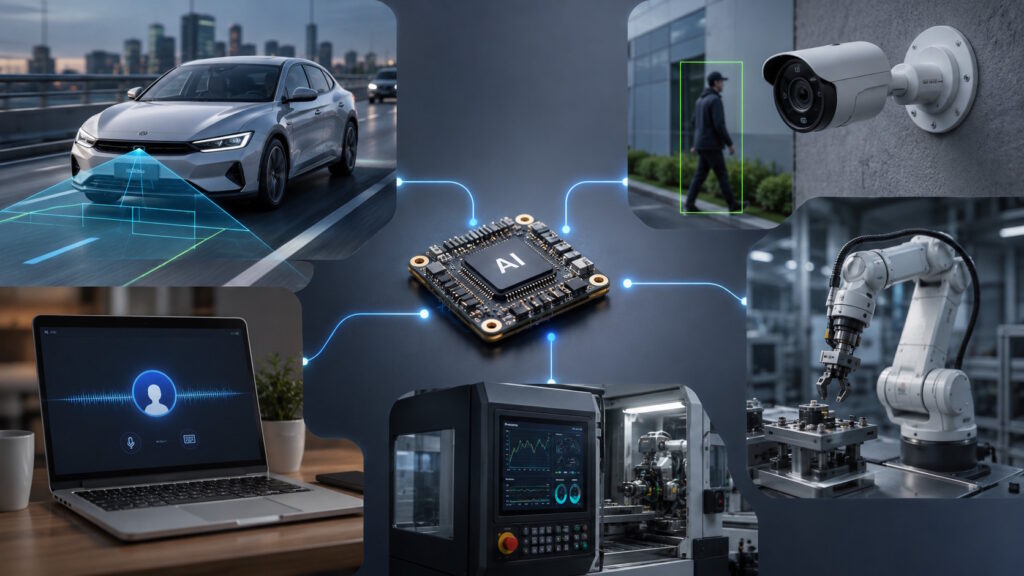
Local voice interfaces offer one clear opportunity. A model could translate spoken instructions into approved actions inside a device or application. It might create a service ticket, open a map, or find a maintenance record.
Smart cameras could also gain a more useful voice. A vision model might identify an event, while the SLM explains the context. The system could then produce a structured note for review.
Vehicles present another natural setting. A local assistant could explain dashboard warnings, answer questions about controls, or retrieve instructions during poor cellular coverage.
Factories, stores, and remote worksites may benefit as well. Each location creates data that often needs an immediate response. Small models can help people work with that information without sending every interaction elsewhere.
Will Small Models Replace Large Cloud Models?
Probably not. Small and large models serve different needs, and many useful systems will combine them.
A local model can handle common questions, private information, device controls, and routine summaries. It can also keep working when connectivity disappears.
A larger cloud model can handle broader research, difficult reasoning, current external information, and complex creative work. It also has access to more computing power.
A hybrid system can begin locally and escalate only when necessary. Think of the local model as an experienced employee on site. The cloud model acts like a specialist at headquarters.
This arrangement can reduce delays and unnecessary cloud requests. It also lets organizations choose where data and processing should go.
What Could Hold Small Language Models Back?
Smaller models still have clear limits. They may struggle with ambiguous requests, unfamiliar topics, broad knowledge, or difficult reasoning.
Local information can also become outdated. A disconnected model will not automatically know about a new policy or product update. Organizations need a reliable way to refresh models, documents, and approved instructions.
Hardware differences create another challenge. A model that works well on one processor may perform poorly on another. Developers must test the full system on the devices people will actually use.
Security also remains essential. Local processing can reduce data transfers, but it does not protect a device by itself. Teams still need access controls, secure updates, monitoring, and model integrity checks.
Extra safeguards become necessary when a model can take action. High-risk functions may require confirmation, clear permissions, and fixed safety rules.
Conclusion: The Breakthrough May Be Better Fit, Not Bigger Scale
Large language models showed the world how flexible generative AI could become. Small language models may help place those abilities inside everyday systems.
Their appeal comes from fit rather than raw scale. A focused model can support faster responses, local control, and operation during weak connectivity. It can also make machine data easier for people to understand.
The strongest future will likely combine local and cloud intelligence. Routine work can remain near the user, while difficult requests move to larger systems.
Small language models will not make every device intelligent overnight. However, they could make practical intelligence available in far more places. Join Tech Scope Connect as we explore how edge AI and other emerging technologies are moving from promising ideas into real-world applications.