Key Takeaway: Managing 10,000 edge devices is challenging because organizations must maintain thousands of distributed systems across different hardware, networks, and locations. Successful edge operations depend on reliable provisioning, remote updates, observability, configuration management, rollback, and local autonomy. As fleets grow, managing exceptions throughout the device lifecycle becomes just as important as deploying the technology itself.
The Pilot Is the Easy Part
Edge devices can look easy to manage when a pilot includes one gateway or smart camera. Yet distributed endpoints create a different challenge once they spread across factories, stores, vehicles, and remote sites. Each edge node becomes a small operating environment with its own hardware, network, and local conditions.
A successful demonstration proves that an application can work in one place. It does not prove that the organization can support 10,000 installations for several years. Running a data center is certainly difficult. This comparison focuses on a different problem: controlling technology that sits far beyond one managed facility.
The edge conversation is now moving from pilots toward lifecycle management. Open Horizon reached LF Edge’s highest maturity stage on June 17, 2026. Its roadmap now emphasizes edge AI deployment and lifecycle management. Its documentation also includes configuration guidance for environments with more than 10,000 edge nodes.
Why Edge Devices Create a Different Kind of Scale
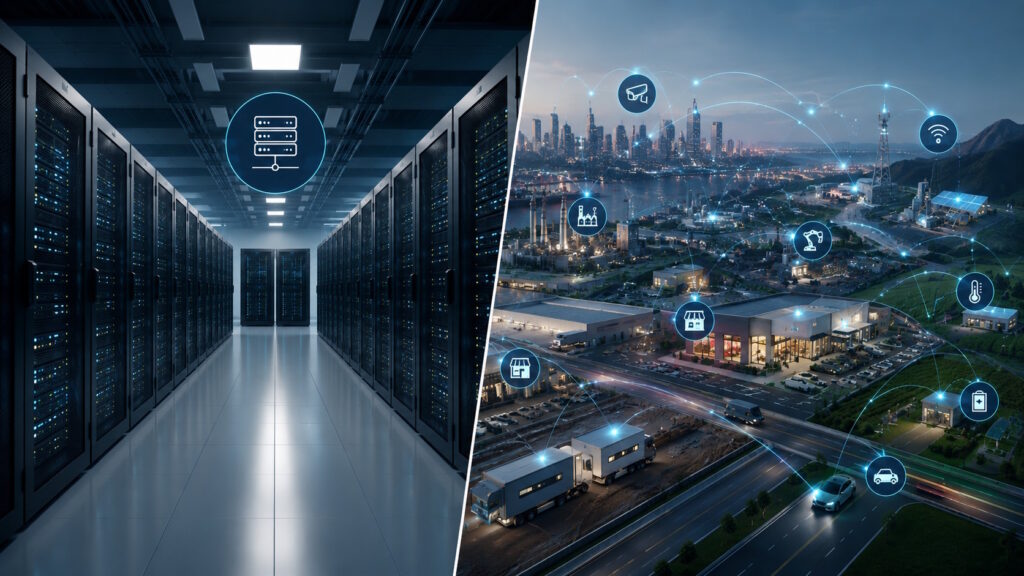
A data center concentrates servers, networking, power, security, and support staff in one controlled environment. An edge fleet spreads those responsibilities across many partially controlled environments.
Some systems may sit behind customer firewalls. Others may depend on cellular service or a weak rural connection. A factory gateway may face heat, dust, vibration, and strict production schedules. A retail server may share space with equipment that the IT team cannot easily access.
Open Horizon’s development guidance highlights these differences. It notes that edge networks can be slower and less reliable than cloud networks. Edge nodes also often operate remotely, behind firewalls, and without local operations staff.
You may be wondering, “Why not manage them like ordinary cloud servers?” Cloud tools still help, but the operating assumptions change. The control system cannot assume every device is online, identical, or ready for the next command.
A Fleet Never Stays Identical
A company may purchase 10,000 units under one product name. Those units can still contain different processors, storage capacities, sensors, or network modules. Suppliers change parts, new generations arrive, and older equipment remains in service.
Software creates another layer of variation. Some locations may miss an update during a network outage. A technician may change a local setting during troubleshooting. Another site may run an older operating system because a business application still depends on it.
Over time, the fleet begins to drift from its approved configuration. This configuration drift makes a simple question surprisingly difficult: What is actually running at each location?
Fleet management tries to maintain a reliable answer. Operators need to know the intended state, the current state, and the gap between them. At 10,000 locations, spreadsheets and manual checks quickly lose the race.
One Update Can Create One Hundred Exceptions
Remote software updates sound simple until the fleet becomes large. Suppose an update succeeds on 99 percent of 10,000 systems. The rollout still leaves 100 exceptions.
Those devices may fail for completely different reasons. One lacks storage. Another loses power halfway through installation. A third uses an older processor that cannot run the new version. Several others may not reconnect until the following week.
Strong fleet operations therefore rely on staged rollouts. A company may start with a small test group, study the results, and then expand deployment. It also needs a reliable rollback path when the new version fails.
Open Horizon, for example, lets administrators define earlier service versions for automatic rollback after a deployment failure. Its policies can also target subsets of nodes based on their characteristics.
Zero-touch provisioning addresses the beginning of the same lifecycle. A new device can establish its identity and receive the correct workload with little local effort. Open Horizon includes zero-touch onboarding among its remote fleet-management capabilities.
Without that automation, every new installation can become a separate technical project. That approach may work for ten locations. It rarely works well for ten thousand.
Kubernetes and GitOps Bring Order, Not Magic
Kubernetes can provide a common way to deploy and manage containerized workloads across cloud and capable edge infrastructure. However, it does not belong on every connected sensor or small embedded controller.
It fits more naturally on gateways, industrial computers, edge servers, and small clusters with enough computing power. Even there, teams must adapt it to unreliable networks, limited resources, and remote locations.
Kubernetes has become important across the wider AI infrastructure market. CNCF reported that 66 percent of organizations hosting generative AI models use Kubernetes for some inference management. That survey covers broader AI infrastructure, so the figure does not represent an edge adoption rate.
GitOps adds a useful operating idea. Teams record the approved system state in a versioned source. Software agents then compare the real environment with that desired state. They attempt to reconcile any difference.
The OpenGitOps principles describe this approach as declarative, versioned, automatically pulled, and continuously reconciled.
This model improves consistency and traceability. Yet an offline device cannot reconcile immediately. Edge operations still need policies for delayed updates, missed changes, and devices that return after long absences.
Kubernetes and GitOps can bring order to the fleet. They cannot make network outages, old hardware, or physical damage disappear.
When the Cloud Cannot Reach the Site
What happens when an edge location loses its internet connection? The local system may still need to inspect products, control equipment, or process transactions.
This requirement creates a balance between centralized governance and local autonomy. The central platform defines what should run. The local system must continue its work when that platform becomes temporarily unavailable.
KubeEdge presents edge autonomy as a core capability. Its project site describes local operation during cloud disconnection, along with synchronization between cloud and edge.
Local autonomy does not mean every device makes unrestricted decisions. It means the application has enough approved logic, data, and resources to handle expected interruptions safely.
Once connectivity returns, the system can report its status and receive pending changes. The management platform must then determine what happened during the interruption.
Did the application continue normally? Did the configuration change? Did the device miss several updates? Those questions become routine when thousands of locations connect at different times.
Edge AI Adds Another Moving Part
Traditional fleet management already tracks firmware, operating systems, applications, credentials, and configuration. Edge AI adds models, which can follow a separate release schedule.
A company may update a model without changing the application around it. It may also use different models for different cameras, regions, product lines, or hardware accelerators.
The fleet manager must know which model belongs where. The operator also needs to ask practical questions.
Did the model download correctly? Can the device load it? Does the new version consume too much memory? Can the previous model return quickly?
Open Horizon’s model-management documentation describes asynchronous model updates across edge nodes. It also supports model placement through deployment policies.
This is where a successful edge AI pilot can become deceptive. The model may work beautifully on one carefully prepared gateway.
Production brings hardware variation, intermittent connections, repeated updates, and thousands of opportunities for something unusual to happen. Model management therefore becomes part of fleet management, not a separate afterthought.
How Edge Devices Stay Manageable After Deployment
Technology teams often focus on Day 1. They choose hardware, install software, connect data, and prove the intended use case.
Day 2 begins after the launch. Teams must patch vulnerabilities, rotate credentials, renew certificates, update applications, monitor health, and replace equipment. Edge AI teams must also track model versions and performance.
These tasks continue for the fleet’s entire working life. A project can succeed technically and still struggle economically when every exception requires a site visit.
Consider a retailer with computer-vision systems in thousands of stores. A minor update may work everywhere during testing. Yet older cameras at several locations might produce unexpected results.
The retailer now needs to identify those locations, stop the rollout, and restore the previous version. It must do so without disrupting every other store.
The real purchasing question therefore extends beyond features. Buyers should ask how the platform provisions, monitors, updates, recovers, and eventually decommissions a large fleet.
They should also ask how much local intervention normal operations require. A system that depends on frequent technician visits may carry a hidden cost.
Day 2 operations reveal whether an edge project can scale as a business system. The initial demonstration only proves that the technology can work.
Observability Turns Noise Into a Fleet-Wide Picture
An unreachable server inside a data center usually points to a limited set of problems. An unreachable edge system has a wider range of possible explanations.
The site may have lost power. A firewall rule may have changed. A cellular plan may have expired. Someone may have unplugged the equipment. The device might also be moving through a dead zone.
Operators need more than a wall of red and green status lights. They need to see patterns across locations, hardware types, software versions, and recent changes.
Good observability can reveal that one hardware generation fails more often after a certain update. It can show that several regions share the same connectivity issue.
It can also separate an isolated problem from a growing fleet-wide trend. This view turns thousands of individual alerts into a more useful operational picture.
Without fleet-level context, a team may investigate the same root problem hundreds of times. With that context, it can treat related failures as one coordinated incident.
Where AIOps Can Help
AIOps can help teams analyze large volumes of fleet data. It may group related failures, highlight unusual behavior, and identify systems that deserve investigation.
For example, 500 alerts may look like 500 separate incidents. A pattern-detection system could reveal that most began after one software release.
That finding gives operators a better starting point. They can pause the rollout, examine the affected systems, and decide whether a rollback makes sense.
AIOps should not become a promise of fully autonomous repair. Edge environments contain physical equipment, local business rules, and safety concerns. Human judgment still belongs in consequential decisions.
The practical opportunity lies in prioritization. Automation can reduce noise and suggest likely relationships. Experienced operators can then choose the safest response.
Conclusion: Scale Lives in the Exceptions
The first successful gateway proves that an edge application can run. The ten-thousandth deployment proves that the organization can operate a fleet.
At that scale, the main challenge shifts from installation to lifecycle management. Teams must handle hardware diversity, configuration drift, unreliable networks, software updates, model changes, and unexpected exceptions.
Kubernetes, GitOps, observability, local autonomy, and AIOps can each support that work. None removes the need for clear policies, staged changes, and reliable recovery.
The real test arrives when the next update reaches 10,000 edge devices and 100 respond differently. Want to keep exploring how edge computing and other emerging technologies are evolving? Join the conversation at Tech Scope Connect for insights, expert discussions, and live events on the technologies shaping what comes next.
Sources:
- Open Horizon Reaches LF Edge Impact Stage 3: What It Means for Edge AI | lfedge.org
- Configuring Open Horizon for High Scale Environments | open-horizon.github.io
- Best Practices | open-horizon.github.io
- Automatically Updating an Edge Service With Rollback | open-horizon.github.io
- Deployment Policy Use Cases | open-horizon.github.io
- Open Horizon Demonstration Video and Code | open-horizon.github.io
- Kubernetes Established as the De Facto ‘Operating System’ for AI as Production Use Hits 82% in 2025 CNCF Annual Cloud Native Survey | cncf.io
- OpenGitOps | opengitops.dev
- KubeEdge | kubeedge.io
- Edge Services for Devices | open-horizon.github.io