Quick Answer: In AIoT, “autonomous” describes how much authority a system has to perform a specific task without human approval. That can range from monitoring conditions and recommending actions to coordinating workflows or changing the physical environment. Autonomy is therefore a spectrum, not an on-or-off capability. The right level depends on the task, its risks, and how much control people should retain.
Why AIoT Autonomy Needs a Clearer Meaning
AIoT is making the word “autonomous” harder to define. The artificial intelligence of things combines AI with connected sensors, devices, and machines. These intelligent connected systems can observe conditions, suggest actions, coordinate work, or alter the physical world. Yet the same label often covers every one of those behaviors. The broad wording hides more than it explains.
The conversation around industrial AI is already moving beyond dashboards and simple question-and-answer assistants. At Hannover Messe 2026, one official session focused on turning industrial insights into coordinated action within explicit constraints. The language points toward an important shift. AI systems may no longer stop after producing an answer. Some can also organize what happens next.
Automation and Autonomy Are Not the Same Thing
Automation has existed in factories, buildings, vehicles, and homes for decades. A thermostat adjusts temperature according to rules. A controller shuts down equipment when an interlock trips. Neither system needs generative AI.
Traditional automation usually follows a predefined path. When a known condition appears, the system performs a known response. The system may act independently, but it has little freedom to choose another approach.
Autonomy adds discretion. The system can interpret a situation, compare options, and choose among permitted actions. Its freedom may still remain narrow. In many cases, designers deliberately keep it narrow.
This distinction prevents a common misunderstanding. Adding AI does not automatically make a system autonomous. Likewise, a system can act automatically without using AI at all.
Autonomy Works Better as a Spectrum
So, is a system autonomous if it only sends an alert? It may show autonomy in monitoring, but not in decision-making. Another system might diagnose the problem yet still require human approval.
A single connected operation can contain several degrees of autonomy. The monitoring function may run independently. The maintenance function may ask for approval. The control function may remain completely restricted.
This task-by-task view gives buyers and operators a clearer picture. It also avoids giving one sweeping label to a complex system.
Four practical levels of AIoT autonomy
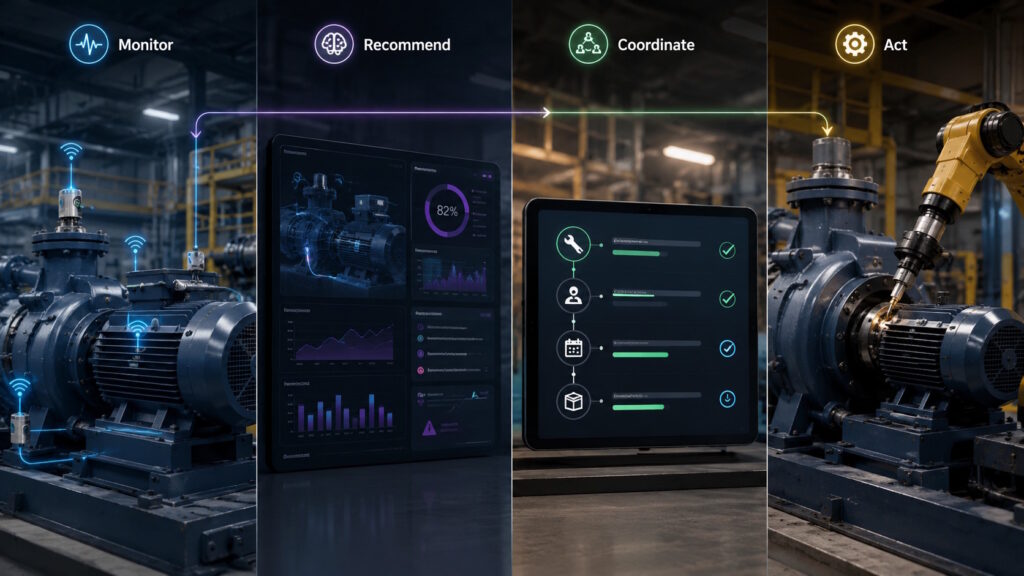
A simple four-level model can help explain the differences. The levels are monitor, recommend, coordinate, and act. They describe growing authority, not a required path toward full independence.
Level 1: monitor what is happening
At the first level, the system observes conditions and reports what it finds. Sensors may track vibration, temperature, pressure, location, energy use, or equipment status.
AI can help identify patterns that a fixed threshold might miss. It may flag unusual behavior or highlight a developing change. A person still decides what the information means operationally.
Imagine a pump that begins vibrating differently. The system notices the change and sends an alert. It does not diagnose the cause or start maintenance.
This level can still create real value. Earlier awareness may help teams investigate problems before they become larger disruptions.
Level 2: recommend the next step
At the second level, the system moves from observation to advice. It may identify a likely cause and suggest a response.
The pump example now becomes more useful. The system might suggest inspecting a bearing within three days. It may also explain which sensor readings shaped that recommendation.
A human still reviews the suggestion. The technician may accept it, change it, or ignore it. The AI supports the decision but does not control the outcome.
Many organizations may find this balance attractive. They gain faster analysis while preserving human judgment over operational choices.
Level 3: coordinate the response
The third level introduces a broader type of action. The system can organize work across digital platforms and business processes.
It might check maintenance records, confirm spare-part availability, create a work order, and suggest an available technician. An AI agent could perform those steps across several approved systems.
This level goes beyond offering advice. The system starts moving work forward, although it may not touch the machine itself.
Here, “autonomous” describes workflow authority. The agent can complete certain administrative steps without requesting approval each time. People still set the boundaries and handle exceptions.
Level 4: change the physical environment
The fourth level crosses from digital coordination into physical action. The system can change a setting, slow equipment, move a robot, or close a valve.
That boundary deserves special attention. Operational technology interacts directly with physical processes and must address safety, reliability, and performance needs. A mistaken digital update can cause inconvenience. A mistaken physical action can interrupt production or damage equipment.
Consider the same pump again. A highly autonomous system might reduce its operating speed after detecting dangerous vibration. It could protect the equipment while alerting the operator.
However, the system should not receive unlimited freedom. Operators may allow small adjustments while reserving shutdown decisions for trained personnel.
More Autonomy Is Not Always Better
The four levels should not look like a ladder that every organization must climb. Level 4 is not automatically better than Level 2.
The right level depends on the task, the environment, and the possible consequences. A building may safely adjust lighting without approval. A chemical process may require stricter control.
Sometimes monitoring solves the immediate problem. In other cases, digital coordination removes the most frustrating delays. Physical action may add little value compared with its risk.
A mature strategy therefore seeks appropriate autonomy. It does not chase maximum autonomy for its own sake.
Capability Tells Only Half the Story
An AI system may know what to do without having permission to do it. Capability describes what the technology can perform. Authority describes what the organization allows.
This difference leads to the idea of bounded autonomy. The system receives freedom inside a clearly defined operating space. Outside that space, it stops or escalates.
A company might allow an AI agent to create maintenance tickets below a certain cost. It might require approval before ordering parts. It may prohibit direct equipment changes.
Those limits do not make the system less useful. They make its role clearer and easier to trust.
What Happens When the System Is Unsure?
Real environments rarely follow the script every time. Sensors fail, data arrives late, and unfamiliar conditions appear. An autonomous system needs a safe response for uncertainty.
Confidence thresholds can help. A system might act only when its confidence exceeds an agreed level. Lower confidence could trigger a human review.
NIST’s AI guidance emphasizes context, human judgment, oversight, and appropriate threshold choices when organizations manage AI risks. Those ideas fit AIoT especially well near physical operations.
Exception handling also shapes autonomy. What happens when two sensors disagree? What happens when the recommended action falls outside normal limits?
A reliable system should know when to stop, escalate, or return to a safer setting. Knowing when not to act may prove as important as acting quickly.
Reversibility Changes the Decision
Not every autonomous action carries the same weight. Creating a work order is easy to undo. Rescheduling a technician may cause inconvenience, but teams can reverse it.
Changing a machine setting may have immediate effects. Scrapping a product or closing a critical valve may create lasting consequences.
The harder an action is to reverse, the stronger the controls should become. Organizations may require higher confidence, tighter limits, or human approval.
This approach keeps the conversation practical. The goal is not to eliminate all risk. The goal is to match authority with consequence.
Humans May Stay Involved in Different Ways
Autonomy does not always remove people from the process. It often changes where they participate.
A person may approve every action before execution. In another setup, the system acts within limits while a person supervises. A third design may involve people only when exceptions occur.
Each model can work under the right conditions. The best choice depends on speed, risk, staffing, and operational complexity.
Human oversight should also have a clear purpose. A tired operator who approves every alert adds little protection. Oversight works best when people receive useful context and genuine authority.
From Sensing to Real-World Action
AIoT connects four basic activities: sensing, understanding, deciding, and acting. Each step can involve a different level of independence.
Sensors show what is happening. AI helps interpret the data. Agents can organize a response. Actuators can change the physical environment.
The final step makes this topic distinct from many office-based AI applications. An email can usually wait. A machine condition may demand a faster response.
Still, speed should not erase boundaries. The strongest systems combine timely action with clear limits, escalation paths, and human accountability.
Conclusion: Autonomy Means Permission, Not Just Intelligence
“Autonomous” tells you very little by itself. A useful description should explain the task, the authority, and the limits.
Ask what the system can observe, recommend, coordinate, and physically change. Then ask when it must pause or involve a person.
The future may not belong to machines with unlimited independence. It may favor systems that earn greater authority within carefully designed boundaries.
That is a more realistic way to understand autonomy in AIoT. Want to keep exploring how AI is changing connected systems and the physical world? Join the conversation at Tech Scope Connect, where we examine emerging technology through expert insights, live discussions, and global summits.
Sources:
- Technical Paper ITU-T YSTP.AIoT (09/2023) – Challenges of and Guidelines to Standardization on Artificial Intelligence of Things | itu.int
- HANNOVER MESSE Event 2026: Agentic AI: Turning Industrial Insights into Coordinated Action | hannovermesse.de
- SP 800-82 Rev. 3, Guide to Operational Technology (OT) Security | csrc.nist.gov
- AI Risks and Trustworthiness | airc.nist.gov