
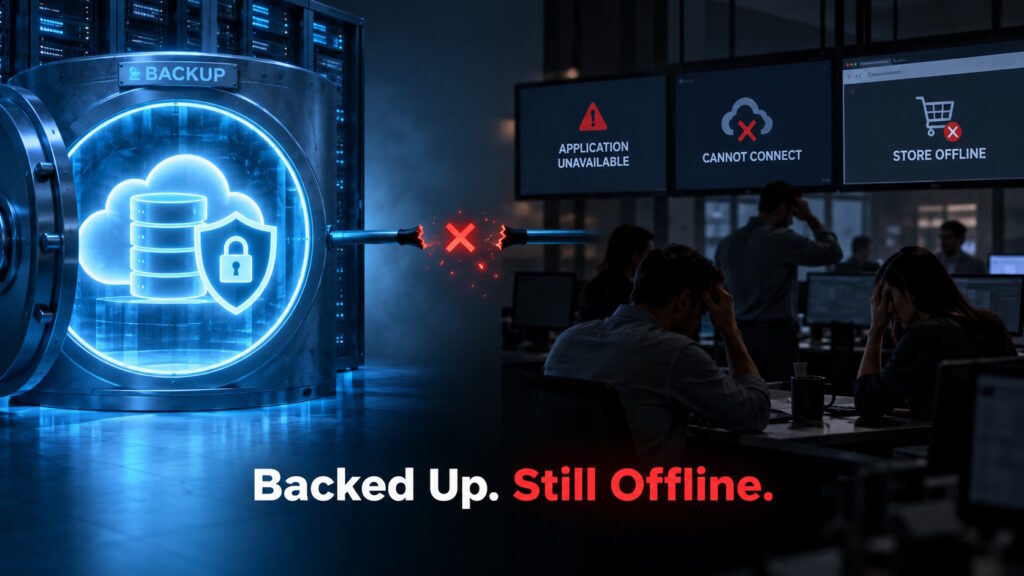
Quick Answer: Yes, your backups can survive a cyberattack while your business still struggles to recover. Restoring operations also depends on secure access, working infrastructure, clear recovery priorities, and tested procedures. A successful recovery means getting essential business services running again, not simply restoring data.
Cybersecurity planning needs to cover what happens after an attack, including how your business gets back to work. Data protection helps preserve important records, but those records cannot run your business alone. Effective digital security also considers how employees will regain access to the services they need.
Consider a hypothetical supplier whose online ordering service goes down on Monday morning. The IT team confirms that last night’s backups survived, and the owner expects orders to resume soon.
An hour later, customers still cannot buy anything. “We have the data,” the owner says. “Why aren’t we back online?”
Mandiant’s M-Trends 2026 describes ransomware operators targeting backup infrastructure, identity services, and systems managing virtual servers. Those findings come from investigations conducted in 2025, highlighting attacks against the tools organizations may need for recovery.
Saved Data Is Not a Restored Business
What’s the difference between a backup and business recovery?
A backup preserves copies of information. Some backups also capture applications and system settings, giving teams more material to restore. However, business recovery requires the systems and people needed to make that information useful again.
For our supplier, saved order records solve only part of the problem. Customers still need a functioning storefront, and employees need a way to process purchases. Restoring the database would not reopen sales if nobody could access the ordering application.
You can apply the same distinction to your workplace. Could staff issue invoices, schedule deliveries, or answer customer questions using the restored service? A folder full of recovered records would not necessarily let them complete those tasks.
The data surviving and the business operating are different milestones.
What Does Cybersecurity Recovery Need Besides Backups?
Secure access presents one potential obstacle. Suppose our supplier’s administrators normally sign in through the company’s central login system. Attackers have compromised it, so staff need another protected way to reach the recovery tools.
Mandiant recommends separating backup environments from the company’s normal identity infrastructure. That separation helps prevent compromised corporate accounts from exposing the systems reserved for recovery.
The ordering application also needs a safe environment to run in. Restoring its records cannot fix an unavailable server or a broken network connection.
Meanwhile, the team needs its instructions and a reliable way to communicate. A recovery plan stored only inside an inaccessible company portal offers little help.
Mandiant’s 2026 hardening guidance recommends mapping recovery dependencies and establishing communications independent of the corporate identity system. These arrangements let teams coordinate when their everyday tools fail.
Another question deserves attention: “Is this backup safe to restore?” An intact copy does not automatically establish that its contents are clean. Federal ransomware guidance recommends checking backup integrity and warns against reinfecting clean systems during recovery.
Which Part of the Business Comes Back First?
For our supplier, restoring online ordering might take priority over bringing an internal analytics dashboard back online. Yet the login and database services supporting orders may need to return before customers can make purchases.
This creates two connected decisions: which business activity matters most, and what must work to support it?
The Cybersecurity and Infrastructure Security Agency, or CISA, recommends prioritizing critical services and the systems they depend on. Its guidance identifies health and safety, revenue generation, and other essential services as considerations.
Your cybersecurity recovery plan can begin with a practical question: “Which interruption would hurt our customers most today?” IT can then identify the technical dependencies behind that answer.
An operations manager might prioritize dispatching orders already promised to customers. A sales manager might focus on accepting new ones. Discussing those competing needs beforehand gives the recovery team a clearer target than “bring everything back.”
What Should a Cybersecurity Recovery Test Prove?
A successful backup notification answers a narrow question about a completed job. A recovery exercise asks whether the business can actually resume a critical service. Mandiant recommends testing restoration from beginning to end, including recovery timing and team communications.
For our hypothetical supplier, that could mean following a test order through the restored service. A customer submits it, an employee retrieves it, and the warehouse receives the correct fulfillment details.
The exercise could also assume that the usual company login and messaging tools remain unavailable. Can the recovery team still coordinate and complete the process?
Accuracy deserves attention alongside speed. NIST’s guidance on recovering from destructive events emphasizes the need to trust recovered information. Getting a service online quickly offers limited reassurance if employees cannot rely on its records.
For example, the supplier could compare restored order details against known test records. It could also measure how long the exercise takes against its agreed recovery expectations.
That produces a more useful result than “the backup worked.” It shows what the team restored, what remained unavailable, and where the process stalled.
Conclusion: Recovery Means Getting Back to Work
Our supplier’s real milestone isn’t locating last night’s backup. It’s reaching the point where customers can place orders and employees can fulfill them safely.
Backups remain essential, but they belong within a broader cybersecurity recovery plan. That plan connects business priorities with secure access, supporting systems, and practiced restoration procedures. No exercise guarantees a trouble-free recovery, but testing provides evidence that a stored copy alone cannot offer.
The question for your next planning meeting goes beyond “Do we have backups?” It becomes: “Have we shown that we can use them to get back to work?”
Want to stay informed about cybersecurity and the technologies shaping how businesses prepare for disruption? Join the conversation at Tech Scope Connect, where we explore emerging technology trends through expert insights, live newscasts, and global summits.
Sources:
- #StopRansomware Guide | cisa.gov
- M-Trends 2026: Data, Insights, and Strategies From the Frontlines | cloud.google.com
- Proactive Preparation and Hardening Against Destructive Attacks: 2026 Edition | cloud.google.com
- Data Integrity Recovering from Ransomware and Other Destructive Events | nist.gov