Key Takeaway: Europe’s recent freezer cyberattacks reveal how vulnerabilities in connected refrigeration systems can disrupt physical business operations. By targeting digital controllers, hackers can interfere with equipment settings and potentially threaten temperature-sensitive inventory. These incidents highlight the importance of IoT security and operational technology protection, reminding businesses that cybersecurity extends beyond computers and data to the connected equipment they rely on every day.
Trouble in the Frozen Food Aisle
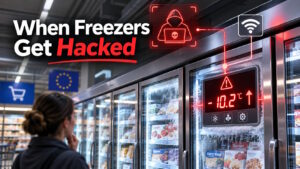
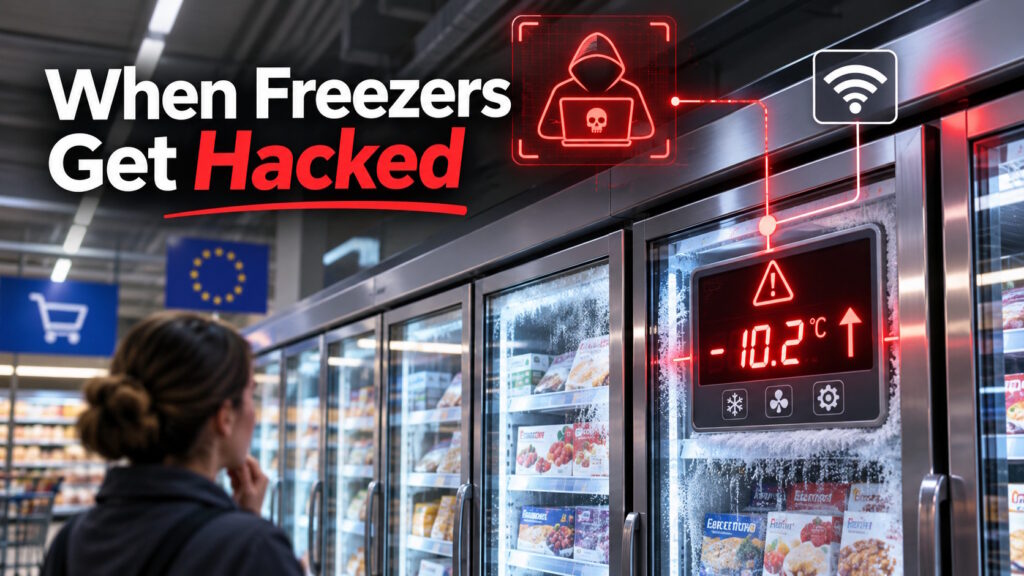
IoT security becomes much less abstract when a cyberattack reaches the supermarket’s frozen food aisle. Europe’s recent refrigeration attacks offer a striking lesson in connected device security, with consequences beyond a computer screen.
Imagine opening your store and discovering that someone changed its refrigeration settings overnight. Instead of preparing for customers, you’re checking stock and calling technicians. The freezer looks familiar, but the technology managing it may never have entered your cybersecurity conversation.
That gap deserves attention, even if your business has nothing to do with frozen food.
What Happened to Europe’s Refrigeration Systems?
On October 12, 2026, France’s CERT-FR issued an alert about numerous compromised remote refrigeration controllers. The agency updated its warning on October 16 and advised against exposing management interfaces directly to the internet.
The incidents soon extended far beyond France. On November 2, retailers across Belgium, Estonia, Finland, Ireland, Italy, Luxembourg, the Netherlands, Portugal, and Sweden reported refrigeration problems linked to suspected cyberattacks. Together with France, that brought the reported geographical reach to 10 European countries.
Sweden’s crisis-information service subsequently confirmed a November 2 attack on retail refrigeration systems. According to its November 3 notice, the incident raised temperatures in several freezers and refrigerators. Together, these incidents show how interference with connected controls can affect equipment that businesses depend on throughout the day.
However, similar incidents do not automatically mean identical attacks. Censys researchers noted similarities between the French incidents and the November wave, but said a common attacker remained unconfirmed.
Why Would a Freezer Need a Network Connection?
For a retailer, remote access offers practical benefits. Technicians can review operating conditions without visiting every location, while managers can receive temperature information and alarms. Danfoss, a refrigeration-control manufacturer, describes systems that coordinate temperature data, alarms, and defrosting. Its remote interfaces let authorized users access equipment through a browser.
Think of this technology as a control panel that staff can reach from elsewhere. The connection makes maintenance more convenient, but the business must protect access to that panel.
Someone who gains unauthorized control may interfere with settings that govern refrigeration. CERT-FR’s response guidance specifically tells operators to check their configurations, including defrost schedules. Its recommendations also call for protected remote access, rather than publicly exposed controls.
The goal is to preserve useful connectivity while restricting who can reach and operate the equipment.
Where IoT Security Meets the Physical World
“So, is a commercial freezer really an IoT device?”
The Internet of Things connects devices that interact with the physical world to digital networks. NIST’s definition includes devices with sensors or actuators, plus a network interface. An actuator is simply a component that makes something happen physically.
A connected refrigeration installation can combine sensors, controllers, and networked management tools. That makes IoT security relevant, although it does not mean every component connects directly to the internet.
Operational technology, or OT, provides the more precise context here: systems that monitor or control physical processes. Sweden’s National Cyber Security Centre explicitly framed the refrigeration incidents as an OT security issue. A network connection raises digital security questions, while the equipment’s physical function shapes what could go wrong.
Why This Story Reaches Beyond Supermarkets
A business does not need a freezer aisle to recognize the underlying concern. Building systems and other operational equipment also belong in conversations about cybersecurity. Sweden’s cybersecurity centre highlights systems controlling physical processes across buildings, industry, and essential services.
Consider what a temperature-control failure could mean for a small food retailer. Staff might spend hours checking products, arranging repairs, and replacing inventory instead of serving customers. Those are possible consequences, not a confirmed account of every affected store.
In that situation, nobody needs to steal a customer database to disrupt the business. The store depends on equipment behaving correctly, not just on information remaining private.
Older equipment adds another complication. Sweden’s cybersecurity centre warns that aging technology can make security updates harder as organizations connect more systems to networks.
Three Questions That Deserve Clear Answers
A useful starting point is asking, “What equipment is connected, and who can access it?” Sweden’s cybersecurity centre recommends identifying internet-connected devices and assessing whether they need that connection.
The next question follows naturally: “Who handles updates and checks whether the manufacturer still supports the equipment?” A machine can continue working physically while its outdated software creates security concerns. CERT-FR warns that unsupported equipment remains especially vulnerable when organizations leave it exposed online.
Finally, “Would someone notice an unexpected change, and who would respond?” Temperature alarms can support monitoring, while a clear incident-response routine helps staff know whom to contact.
These conversations should include the people responsible for equipment, technology, and maintenance. Any changes to operational systems need coordination, rather than an improvised decision to disconnect everything.
The aim is not to make every store manager a cybersecurity specialist. It is to ensure that responsibility extends beyond installation day.
Conclusion: Familiar Equipment Deserves a Second Look
Europe’s freezer attacks give an unusually tangible face to cybersecurity. Behind an ordinary piece of equipment, connected controls can influence something a business depends on every day.
The useful takeaway is not to fear every connected appliance. It is to ask which systems support your operations, who maintains their protection, and how your team would handle disruption.
Which essential device might your next security conversation be overlooking?
Want to stay informed about the evolving risks and opportunities of connected technology? Join the conversation at Tech Scope Connect, where our live newscasts, expert discussions, and global summits explore the trends shaping our increasingly connected world.
Sources:
- Security Incident Targeting Remote Controllers of Refrigeration Systems | cert.cyber.gouv.fr
- Cyberattacks on Freezing and Refrigeration Systems | krisinformation.se
- European Refrigerator Controller Redux: A New Wave of Refrigeration Attacks | censys.com
- System Manager Components | danfoss.com
- IoT Device – Glossary | csrc.nist.gov
- Cyberattacks Against Connected Freezing and Cooling Systems | ncsc.se
- Which Countries in Europe Have Been Hit by Supermarket Fridge Cyber Incidents? | euronews.com