Key Takeaway: Smart homes can do more than monitor electricity use. With compatible equipment and energy services, they can adjust when devices consume power based on grid conditions, electricity costs, and household needs. The goal is to make electricity use more flexible without disrupting everyday routines.
Smart homes with compatible equipment and services can coordinate electricity use around household routines and power-grid conditions. For connected homes, the aim is to respond to outside energy signals without losing sight of everyday needs.
Suppose you plug in an electric vehicle at 6:00 p.m., although you won’t drive again until the following morning. You need enough charge for your commute, but charging doesn’t necessarily need to start immediately. Could your home find a better window without changing your plans?
How Smart Homes Move Beyond Energy Monitoring
An energy dashboard answers a useful question: “How much electricity am I using?” It doesn’t necessarily answer, “Could this task happen at a better time?”
Monitoring shows consumption, while efficiency reduces the energy needed to do a job. Demand flexibility adds another option: adjusting, reducing, or shifting electricity use as conditions change. Moving a charging session, for instance, doesn’t automatically mean the car needs less electricity. It changes when the car draws that power.
Even a timer and a grid-responsive service do different jobs. A timer follows a preset schedule, while a responsive service can adjust operation when an outside request arrives. Austin Energy’s EV program, for example, can temporarily slow or delay charging during periods of high demand.
Why the Clock Matters to Your Electricity Bill
Electricity demand rises and falls, and utilities must manage busy periods as well as quieter ones. Moving flexible consumption away from a demand peak can reduce pressure on the grid.
For your household, the financial benefit depends on how you pay for electricity. Under a time-of-use plan, prices vary across different periods of the day. Shifting consumption into a cheaper period can lower the cost of running an appliance. However, the cheapest hours depend on your actual plan and location, not a universal rule about nighttime.
Demand-response programs offer a different arrangement: rewards for letting a utility temporarily adjust eligible equipment. For example, Austin Energy offers bill credits to customers participating in its Power Partner thermostat program. These incentives are separate from savings that changing your consumption schedule might produce.
A Different Schedule, the Same Morning Routine
Back in our hypothetical home, your instruction might be, “I need enough charge for my commute by 7:00 a.m.” A suitable system could delay charging during a busy period, then resume later. That only works when sufficient time and charging capacity remain before your deadline.
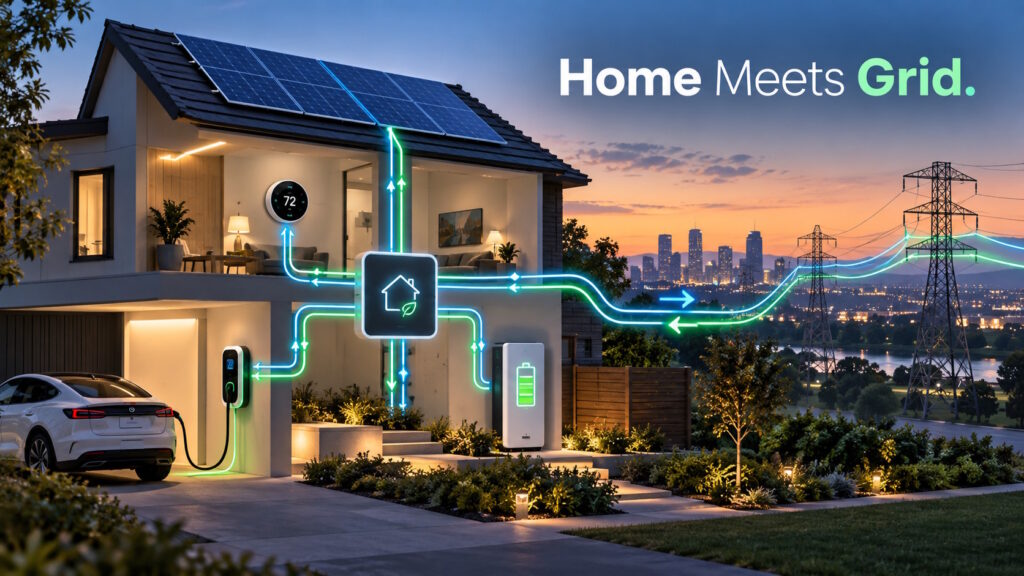
Other equipment can contribute in different ways. A participating thermostat might briefly adjust cooling, while a home battery supplies stored electricity during a demand peak. Austin Energy already offers separate thermostat and battery programs with these kinds of functions.
These examples illustrate individual services, rather than a complete home coordinating every device through one controller. The broader ambition for smart homes involves connecting those household capabilities with energy information from outside.
How Do Smart Homes Hear From the Grid?
On May 11, 2026, the Connectivity Standards Alliance and OpenADR Alliance announced a liaison agreement on grid-connected energy management. Their collaboration aims to improve communication between household equipment and the electricity grid.
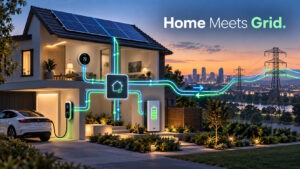
In the approach they describe, Matter handles communication between compatible household devices and a home energy gateway. OpenADR 3 handles communication between that gateway, utilities, and grid operators. Think of the gateway as the connection point between conversations inside and outside your home. A home energy-management system would then translate those signals into actions that its supported devices can perform.
The collaboration addresses an important connection, but it does not establish universal compatibility. A standards agreement is not proof that every utility and appliance already work together. The agreement supports development; actual products and programs still need to deliver that experience.
Can You Change Your Mind During an Event?
A charging deadline or comfortable temperature should guide the automation, not become an afterthought. In our example, an unexpected evening trip would change what you need from your charger.
Practical control depends on the program and device. Austin Energy lets EV participants opt out of an event through the relevant app without a penalty. Its thermostat program also allows participants to override adjustments.
Battery participation illustrates why the details deserve attention. Austin Energy notes that skipping battery events can affect annual performance payments, and override timing varies by manufacturer.
Before joining, you would want to understand what can change, how notifications work, and how to take control again. These are household decisions, not details to discover when you suddenly need the car.
Will It Work Where You Live?
A smart label alone doesn’t establish whether equipment can join a particular utility program. Austin Energy’s battery program, for example, specifies eligible equipment and requires installation within its service territory.
Local electricity pricing also shapes the financial case. Time-of-use plans are not available everywhere, and shifting consumption only reduces usage charges when the relevant rates differ. Helping the grid and lowering your bill are related possibilities, not automatically the same outcome.
If you’re considering participating, start with the equipment you already own and the services available in your area. What adjustments would that service make? What would the household receive in return, and what would participation cost?
Those answers offer a clearer starting point than the promise of a fully coordinated home.
Conclusion
The homeowner from our opening example still needs a car ready for the morning. The opportunity lies in meeting that need without assuming charging must begin the moment the cable connects.
Seeing electricity consumption and coordinating it are different capabilities. A useful system would find flexibility within your routine, rather than ask you to organize your life around electricity.
Perhaps the most useful question is, “Does this need power now, or does it just need to finish on time?”
As smart homes become more connected to the wider energy ecosystem, new possibilities will continue to emerge. Join Tech Scope Connect for conversations, newscasts, and summits exploring connected technologies and the trends shaping what comes next.
Sources:
- Grid-Interactive Efficient Buildings for Federal Agencies | energy.gov
- FAQs | austinenergy.com
- What is a Grid-Interactive Efficient Building? | connectedcommunities.lbl.gov
- What Are Electricity Peak Prices? | energymadeeasy.gov.au
- Tips to Use Energy When It’s Cheap and Save Money | energy.nsw.gov.au
- Power Partner Thermostats | austinenergy.com
- Power Partner℠ Battery | austinenergy.com
- Connectivity Standards Alliance and OpenADR Alliance Announce Liaison Agreement | csa-iot.org