Key Takeaway: AI dubbing can help videos reach audiences in different languages, but effective localization takes more than translating words. Technical terminology, tone, timing, speaker identity, and on-screen content can all shape how viewers understand the message. The goal is not simply to create convincing translated audio, but to preserve what the original speaker intended to communicate.
A New Audience, the Same Message
AI dubbing can help your webinars, interviews, and product demonstrations reach people who speak another language. However, automated dubbing raises a question that goes beyond producing new audio: will those viewers understand the same message?
Imagine sharing a product webinar with viewers who cannot follow its original audio. They need the explanation and context that made the original worth watching, including the details behind the speaker’s words.
What Does AI Dubbing Actually Do?
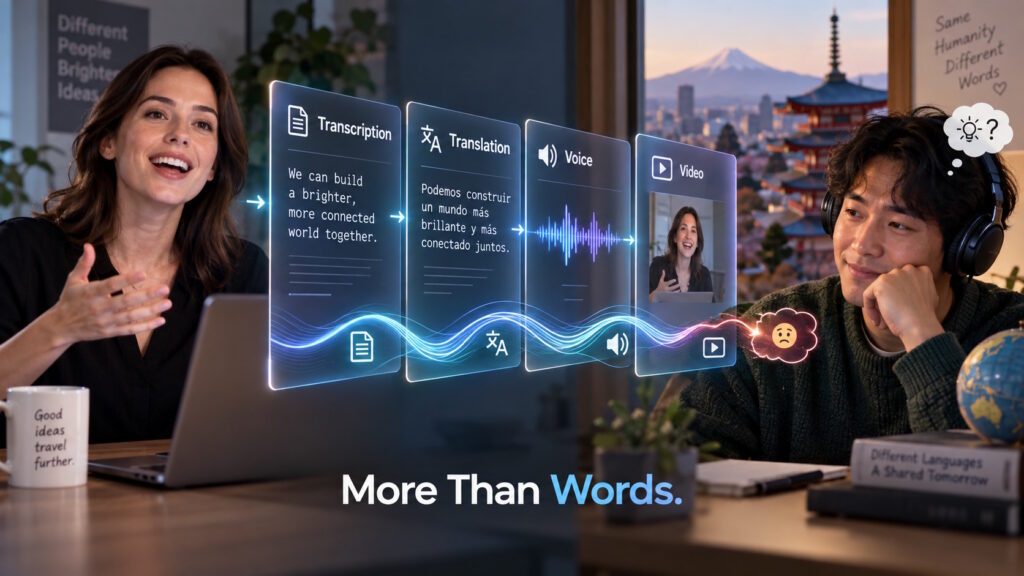
AI dubbing uses artificial intelligence to generate replacement speech for a video, often in another language. Transcription turns speech into text, while translation expresses that content in the target language. Dubbing delivers the translated words as spoken audio. Adobe describes these as distinct stages, although its tools can combine them into one process.
But is dubbing the same as video localization? Localization has a broader purpose: adapting content for an audience’s language and cultural expectations. Dubbing addresses the audio within that larger task, rather than every element a viewer encounters.
When the Words Arrive but the Joke Doesn’t
Consider this example from a technology webinar:
“If your edge device waits for the cloud before every decision, well … good luck with that.”
Here, the speaker criticizes a device’s reliance on remote servers for every decision. “Good luck” expresses skepticism, not genuine encouragement.
A literal translation could make the advice sound sincere. Meanwhile, removing the pause might flatten the joke or make the speaker sound dismissive.
An editor might choose a different expression that carries the same skepticism in the target language. The wording changes, but the intended point should not.
One Technical Term Can Change the Explanation
In that sentence, “edge device” belongs to a technical discussion. Treating “edge” as an ordinary boundary would send the translation in the wrong direction. A fluent voice could then deliver the wrong concept without any audible sign of confusion.
AI dubbing systems also encounter acronyms, product names, and specialist vocabulary. YouTube specifically warns that automatic dubbing can struggle with proper nouns, idioms, and jargon.
For this webinar, a reviewer would check the technical term’s meaning and pronunciation, not just whether the sentence sounds natural. Numbers and qualifying words deserve attention, too. Changing “may reduce downtime” to “will prevent downtime” creates a promise the presenter never made.
The Pause Is Part of the Point
In our example, the pause gives the audience time to anticipate the speaker’s skeptical ending. Losing that rhythm could change how the joke lands, even when the translation contains the right words.
A longer translation may also need different phrasing to avoid rushed delivery. Netflix’s nonfiction dubbing guidance explicitly considers tone, rhythm, speed, and the time a translation needs.
Technology providers are working on these aspects of delivery. YouTube says its Expressive Speech feature aims to retain more of a creator’s original emotion and energy. That describes the feature’s goal, not a guarantee that every translated passage preserves its intended tone.
When a Panel Becomes a Voice-Matching Puzzle
Now imagine a host interrupting a guest before another panelist answers. The localized version needs to make clear who asked the question and who disagreed.
Adobe’s documentation acknowledges speaker mismatches and warns that overlapping speech can produce weaker results.
Assigning an answer to the wrong voice could make a participant appear to support someone else’s opinion. For panel recordings, checking speaker changes deserves attention alongside the translation itself.
The Slides Need to Speak Your Audience’s Language, Too
In a localized demonstration, translated narration might explain a chart whose labels still confuse the intended audience. A tutorial could also describe a button differently from the interface viewers see.
Video localization can extend to subtitles, slides, graphics, and relevant on-screen instructions. NVIDIA’s localization announcement reflects this broader approach, combining captions, translated audio, synchronized video, and localized graphics.
Regional conventions may also call for different date formats, number formats, or currency displays. Your goal is not to change every visible detail. It is to ensure the visuals and narration support the same explanation.
Recorded Video Gives Editors Room to Listen
With a recording, your team can review a transcript and translation before releasing the finished video. Adobe supports dubbing from edited transcripts, which gives editors a way to influence the resulting audio.
However, review controls differ between tools. YouTube offers review before publication but says creators cannot directly edit its automatic dubs. Checking a version and correcting it are not always the same operation.
What Changes with Live AI Dubbing?
A live broadcast offers far less time to catch an error before viewers hear it.
NVIDIA describes an NDI integration for real-time translation and lip-synced dubbing inside broadcast workflows. This vendor announcement describes capabilities, not independent evidence of translation accuracy.
For a live webinar, preparation therefore deserves extra attention. Speaker names, recurring terminology, and a plan for handling unclear passages belong in that conversation.
Human Review Protects More Than Grammar
Can a fluent translation still misrepresent your speaker? In our fictional webinar, it could, simply by turning skepticism into encouragement.
For technical content, a useful reviewer understands both the target language and the subject. Netflix’s nonfiction guidance similarly emphasizes subject knowledge and research into specialized terms and their pronunciation.
Review should reflect the consequences of an error. A casual event recap and a detailed product demonstration may warrant different levels of scrutiny. Product claims, numbers, speaker assignments, and ambiguous statements make sensible priorities.
Speaker approval deserves a separate conversation, particularly for voice imitation or changes to visible mouth movements. Permission to publish a recording should not automatically become an assumption about permission for every transformation.
Your Next Audience May Be Waiting in Your Video Library
Your next multilingual project might already exist. A useful webinar, customer interview, or product explanation could offer value beyond its original audience.
For content marketing teams, AI dubbing creates an opportunity to revisit existing recordings rather than automatically commissioning new productions. However, another language track does not guarantee another audience. The subject still needs local relevance, and viewers need a way to discover it.
A focused pilot could offer a manageable starting point. One relevant recording lets your team assess audience response and editorial effort before tackling a larger video library.
Does the Message Survive the Trip?
Return to our fictional webinar speaker. The localized version should preserve the technical point, the skepticism, and the relationship between them.
Lip synchronization addresses a different task: matching visible mouth movements to translated audio. It does not establish that the translation accurately expresses the original meaning.
For this example, the editorial question becomes more useful than the visual one. Would a viewer understand the speaker’s warning, or mistake it for encouragement?
Conclusion: A Different Language, Not a Different Message
Multilingual video deserves the same care you gave the original presentation. New voices and convincing visuals should support your explanation, not distract from changes in meaning.
AI can help create another language version, while editorial judgment helps determine whether that version serves its audience. The strongest result gives people access to your ideas without asking them to untangle an unfamiliar delivery.
Curious about how AI is changing the way we create, adapt, and share content? Join the conversation at Tech Scope Connect, where we explore emerging technology through expert discussions, live events, and industry insights.
Sources:
- Use Automatic Dubbing | support.google.com
- How to Transcribe and Dub Audio/Video | developer.adobe.com
- Localization vs. Internationalization | w3.org
- Dubbing Creative Guidelines – Nonfiction/Unscripted | partnerhelp.netflixstudios.com
- Unlocking a Global Audience With Auto Dubbing | blog.youtube
- FireflyAudio/Video API Usage Notes | developer.adobe.com
- NVIDIA Brings Real-Time AI to Broadcast, Sports and Global Streaming at IBC | blogs.nvidia.com