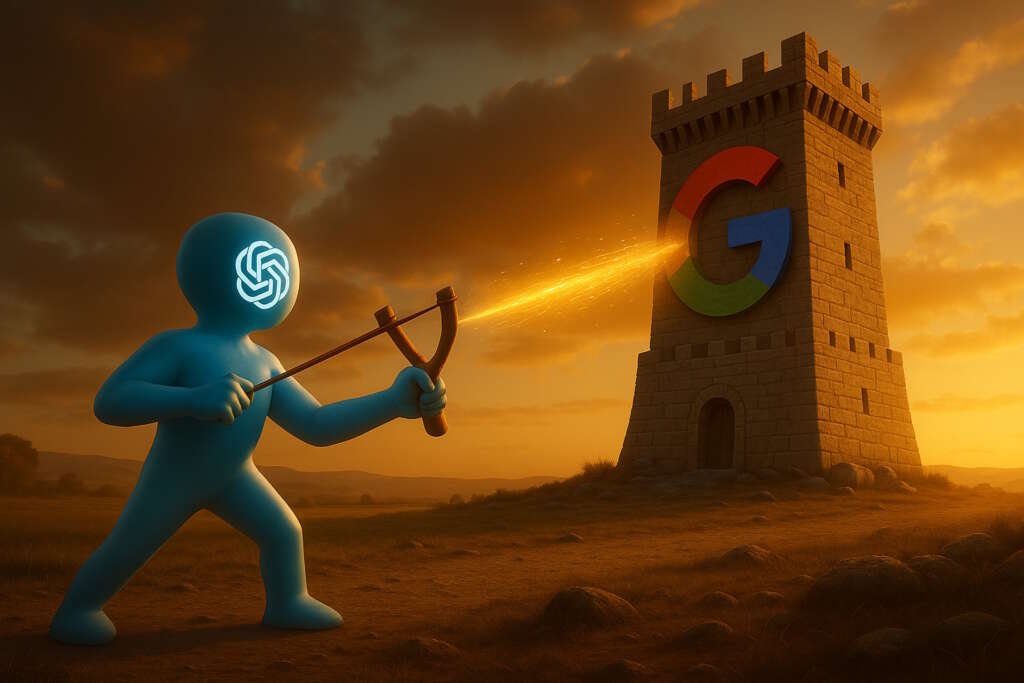
Key Takeaway: ChatGPT’s usage has surged ~150% in eight months to ~2.5 billion prompts per day, yet Google still processes ~14 billion daily queries—signaling not a replacement but a fast-forming hybrid of chat + classic search. Google’s AI Overviews and similar features aim to keep users engaged amid rising “zero-click” answers, while publishers face traffic shifts as more intent is resolved in-chat. For teams that create or market content, the winning play is dual optimization: keep SEO fundamentals while adding AEO/GEO tactics—clear Q&A structures, step-by-steps, and robust schema—so your expertise appears in both links and AI summaries. For everyday users, combine engines: use Google for breadth and authority, and AI chat for quick synthesis and personalized follow-ups.
Search 2.0: Why ChatGPT’s Rise Matters to Every Google User
In under a year, AI chatbots have reshaped how we seek information—are we witnessing a paradigm shift? Once the sleepy domain of academic labs, conversational agents like ChatGPT now handle billions of queries every week, challenging the way we hunt for facts, compare options, and solve problems online. Meanwhile, Google—long the unassailable gatekeeper of the world’s questions—continues to process more than 14 billion searches each day, a staggering figure that nonetheless grows more slowly than ChatGPT’s. In this post, we’ll dig into the numbers behind ChatGPT’s meteoric rise and Google’s steady expansion, explore what these trends mean for the future of search—both for the company in Mountain View and for you, the end user—and finally offer a sneak peek at our upcoming AI Search Survival Guide. Ready to navigate the evolving landscape? Let’s dive in.
Data Duel: Charting ChatGPT’s Rapid Rise vs. Google’s Steady Surge
How GPT 4o and Agents Fueled a 150 % Usage Surge
ChatGPT’s usage has exploded in less than a year. In December 2024, OpenAI CEO Sam Altman revealed at the New York Times’ DealBook Summit that users were already sending over 1 billion messages per day to ChatGPT—an astonishing milestone for a product barely two years old . By July 2025, that daily volume had swelled to 2.5 billion prompts, marking a 150 percent increase in just eight months . This surge aligns with several key developments: the rollout of GPT 4o, the introduction of “agents” that perform tasks for users, and tighter integrations into enterprise workflows and third party platforms, all of which have driven deeper and more frequent interactions.
Google’s Steady Increase in Search Volume: From 3.3 B to 14 B Queries per Day
Meanwhile, Google’s search engine continues its own long term growth trajectory. In 2012, Google processed roughly 1.2 trillion searches per year, equivalent to about 3.3 billion searches per day . Four years later, by 2016, that annual figure had doubled to at least 2 trillion searches—or 5.5 billion per day . By 2024, Google crossed the 5 trillion searches per year threshold, translating to about 14 billion daily queries—a 21.6 percent increase over the previous year .
Despite ChatGPT’s rapid ascent, Google still handles roughly five times as many daily information requests as ChatGPT does. This side by side comparison highlights both the sheer scale of Google’s enduring dominance and the remarkable speed at which conversational AI is gaining traction.
Google at a Crossroads: Adapting to AI Overviews and Zero Click Threats
Should Google Be Worried?
On the one hand, Google’s core search business remains healthy: overall query volume is still growing at a double digit pace. In 2024 alone, Google saw a 21.6 percent increase in total searches year over year, rising from approximately 11.5 billion queries per day in 2023 to about 14 billion per day by the end of 2024 . Even more encouraging, Google’s own AI Overviews feature appears to spur additional usage rather than cannibalize it—users who engage with Overviews tend to run more follow up searches, suggesting that AI enhanced snippets are driving deeper exploration, not fewer clicks .
Yet on the other hand, the rapid ascent of conversational AI tools presents real risks. As ChatGPT and its peers handle increasingly complex, multi step prompts, a growing share of user intent is resolved within the chat interface itself. Early studies indicate that AI summaries and “instant answers” reduce downstream traffic by up to 60 percent on traditional search results pages, leading to significant click through declines for publishers and advertisers alike . Put simply, if users get exactly what they need in a chat window, they have less incentive to click through to Google’s organic listings or ads.
Strategic Imperatives for Google
To stay ahead, Google must continue to evolve its ecosystem in three key ways:
- Deepen AI Integration. Expand and refine AI Overviews, Lens, and the new Circle to Search feature so that these tools not only provide instant answers but also smoothly bridge into full page results when the user wants more detail. By weaving conversational and visual AI capabilities directly into the main search experience, Google can retain user engagement within its own properties rather than ceding ground to external chatbots.
- Enhance Monetization of “Zero Click” Queries. As more queries end without a click, Google needs new revenue models. This could include sponsored AI Overviews, partnerships with content providers for premium summary placement, or ad formats integrated into AI snippets. By turning otherwise “no click” interactions into monetizable moments, Google can protect its ad business even as user behavior shifts.
- Foster Hybrid Search/Chat Experiences. Rather than viewing chat based AI as competition, Google can embrace hybrid models: for example, enabling seamless hand offs between Bard (or its next gen AI assistant) and classic search results. By offering a unified interface where conversational prompts and link based searches coexist, Google can cater to a broader range of user preferences and use cases—ensuring that regardless of how someone asks their question, Google remains the default gateway.
Together, these strategies can help Google reinforce its position at the center of the information ecosystem, even as AI chatbots grow ever more capable.
Adapt or Fade: Your Guide to Thriving in a Hybrid Search World
Should You Be Worried?
If you create content or manage marketing campaigns, prepare for shifting traffic patterns and changing click through dynamics. As AI agents like ChatGPT resolve more user queries in app—summarizing articles, answering FAQs, even drafting emails—your organic listings may see fewer clicks, even if overall visibility holds steady. Monitor your referral sources closely, and be ready to adapt headlines and meta descriptions to entice users still inclined to click through.
For practitioners who rely on traditional SEO, now is the time to broaden your skill set toward AI Engine Optimization (AEO) and Generative Engine Optimization (GEO). Structured data and schema markup will help ensure that your content surfaces not only in link based results but also within AI generated summaries and overviews. Start experimenting with prompt friendly formats—clear questions, step by step answers, and concise definitions—to make your expertise more discoverable to conversational bots.
Even if you’re simply an end user seeking information, the rise of hybrid search tools means you have more options than ever for richer, faster answers. Don’t hesitate to try both classic search engines and conversational interfaces: use Google for broad research and authoritative sources, and turn to AI chatbots for quick synthesis, personalized explanations, or exploratory brainstorming. Combining both approaches can save time and deepen your understanding.
Actionable Takeaways
- Embrace versatility. Maintain a visible presence across both traditional search and AI platforms. Publish blog posts optimized for search engines, then repurpose key insights into prompt friendly FAQs or conversational snippets that AI agents can draw upon.
- Invest in conversational optimization. Think like a chatbot user. Craft content and landing page copy around common question and answer pairs, bullet list “how to” sequences, and clear definitions. This will increase your chances of being included in AI generated overviews.
- Leverage analytics. Set up robust tracking to detect changes in organic clicks, dwell time, and engagement whenever you roll out new AI friendly content. Use A/B tests to compare traditional SEO headlines against “prompt optimized” titles, and adjust your strategy based on real user behavior.
By proactively adapting your content and search strategies now, you’ll be well positioned to thrive whether users prefer links, chat, or a blend of both.
Beyond the Numbers: Why Google Still Wins—and How You Can Too
Even as AI chatbots carve out a growing share of our information workflows, remember that Google’s position remains remarkably secure. Its daily search volume continues to climb—rising from roughly 11.5 billion queries per day in 2023 to about 14 billion in 2024—underscoring that users still turn to classic search when they need comprehensive results, trusted sources, or in depth answers. ChatGPT’s rapid growth reflects an evolution in user preferences—demanding more conversational, hands on interactions—rather than wholesale abandonment of link based search.
Looking ahead, we’re putting the finishing touches on an “AI Search Engine Survival Guide” designed to help you thrive in this hybrid landscape. You’ll find best practices for optimizing content across both traditional and AI driven platforms, head to head tool comparisons, prompt engineering checklists, and strategic frameworks for balancing SEO, AEO, and GEO. Whether you’re a developer, marketer, or simply a curious user, this guide will equip you to navigate the shifting terrain with confidence.
Stay tuned: we’ll share the full guide in our content hub. If you haven’t already, subscribe to our newsletter for the latest insights and early access. Here’s to mastering search—no matter how the technology evolves.
Sources: