
Key Takeaway: AI cybersecurity is becoming more important as attackers begin using AI to find weaknesses, automate threats, and move faster than traditional security teams can respond. Businesses do not need to panic, but they should prepare for an AI-vs.-AI security landscape where defense also relies on smarter tools, better visibility, stronger governance, and faster threat detection. The goal is not to replace human judgment, but to give security teams the speed and support they need as cyber risks evolve.
The Security Race Is Getting Faster
AI cybersecurity is becoming one of the most important business conversations of the next few years. As AI security tools, automated cyber defense, and AI-powered threat detection improve, attackers may also gain faster ways to search for weak spots. For business leaders, the issue is not science fiction. It is a practical question: what happens when both defenders and attackers start using smarter machines?
For years, cybersecurity has felt like a race between people. Security teams watched networks, reviewed alerts, investigated suspicious activity, and patched known issues. Attackers looked for open doors, weak passwords, exposed systems, and distracted employees. The basic pattern stayed familiar, even as the tools improved.
AI changes the rhythm. It can read code, summarize patterns, sort large amounts of information, and automate routine steps. Those strengths can help defenders. They can also help attackers move faster. That is why the idea of AI versus AI no longer feels like a movie plot. It feels like a future many companies need to prepare for now.
AI Cybersecurity Is Becoming a Business Priority
When someone asks, “Why should my company care about AI in cybersecurity?” the answer starts with scale. Most organizations already manage more apps, devices, cloud tools, and data flows than they can easily see. A missed configuration, a forgotten account, or an unpatched system can create an opening.
AI can help security teams make sense of that complexity. It can support threat detection, prioritize alerts, and help analysts spot unusual activity. It can also assist with code review or vulnerability research. CISA has framed AI as a tool for improving cybersecurity capabilities and as a technology that needs secure adoption. Its guidance also emphasizes secure-by-design thinking for AI systems.
This is where the business angle becomes clear. AI does not only change the security team’s toolkit. It changes expectations around speed, visibility, and responsibility. Executives may not need to understand every technical detail. They do need to understand how AI could alter the balance between attack and defense.
In simple terms, AI cybersecurity gives defenders a way to work closer to machine speed. It does not make every risk disappear. It can help teams see more, sort faster, and respond with better context.
The Same Tools Can Serve Both Sides
AI does not have a moral compass. People decide how to use it. A tool that helps one team review software for vulnerabilities could help another group search for targets. A model that summarizes security logs could also summarize stolen data. A system that drafts safe employee training content could also help create more convincing phishing messages.
This dual-use problem sits at the center of the conversation. The more capable AI becomes at understanding software, the more relevant it becomes to cybersecurity. OpenAI’s preparedness framework lists cybersecurity capabilities as a tracked risk category for frontier AI systems. It also links those capabilities to both safeguards and dual-use benefits.
For businesses, this means AI risk should not sit in a separate innovation folder. It belongs in the same conversation as data protection, access control, vendor management, and incident response. AI adoption and cybersecurity planning now overlap.
Claude Mythos as a Cultural Warning Light
The phrase “Claude Mythos” works best here as a cultural signal, showing how quickly public awareness around AI security is changing.
Anthropic describes Claude Mythos Preview as part of Project Glasswing, an effort focused on securing critical software. The company says Mythos Preview is a frontier model with strong coding and cybersecurity capabilities. Anthropic also says it has identified zero-day vulnerabilities across critical infrastructure.
The access detail matters for the business conversation. Anthropic’s own model documentation says Claude Mythos Preview is offered separately for defensive cybersecurity workflows. It also says access is invitation-only, with no self-serve sign-up.
That does not mean every company faces a Mythos-level attacker tomorrow. It does show why the conversation has shifted. Frontier AI systems may already perform cybersecurity tasks that many businesses assumed required elite human expertise. The main lesson is not about one model. It is about the direction of travel.
If advanced AI can find weaknesses faster, companies need a faster way to find their own weaknesses first. Waiting until a problem becomes public may leave too much time for attackers.
Why Human-Speed Security May Feel Too Slow
Many security programs still depend on human-speed workflows. An alert appears. A person reviews it. Someone checks the asset owner. Another team decides whether the issue is urgent. Then the fix enters a queue.
That approach can work, but it strains under volume. Digital environments now change constantly. New employees join. Vendors connect. Cloud services expand. Developers ship updates. Devices move in and out of networks. Security teams try to watch all of it.
AI attackers could increase that pressure. They may scan more broadly, customize attempts more quickly, and adjust tactics with less manual effort. Even basic automation can raise the tempo. More advanced AI could make that tempo harder to match.
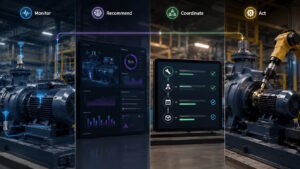
This does not mean humans disappear from security. It means humans may need better copilots. The goal is not to hand the keys to a machine. The goal is to give people faster ways to see, decide, and respond.
The AI cybersecurity question: can defense move at machine speed?
A simple question captures the challenge: can your defense keep up with an AI-assisted attacker? For many companies, the honest answer may be, “Not yet.”
Machine-speed defense does not mean panic-driven automation. It means security systems can surface the right signals quickly. It means analysts can focus on judgment instead of drowning in noise. It also means businesses can shorten the time between detection and response.
AI can support this shift through anomaly detection, alert triage, access monitoring, code scanning, and security analytics. These tools do not replace the need for strategy. They make strategy more realistic in a fast-moving environment.
Should Businesses Fight Fire with Fire?
If you are asking, “Should businesses fight AI attacks with AI defense?” the safer answer is yes, but carefully. Fighting fire with fire should mean defensive automation, better monitoring, faster triage, and smarter testing. It should not mean reckless retaliation or unsupervised systems making high-impact decisions.
An AI cybersecurity strategy does not need to start with exotic tools. It can begin with clearer visibility, stronger access controls, and better alert prioritization. Then companies can layer in AI-assisted security where it supports real business needs.
This approach keeps the conversation grounded. Businesses do not need to chase every new tool. They need to understand where AI can reduce delay, confusion, and blind spots.
Governance Is the Seat Belt
Businesses should not rush into defensive AI without structure. A powerful tool can create new risks when teams connect it to sensitive systems without clear limits. Bad permissions, poor oversight, or blind trust in model outputs can create fresh problems.
NIST’s AI Risk Management Framework and its generative AI profile focus on helping organizations identify AI risks. They also help organizations choose risk-management actions that fit their goals. NIST released a 2026 concept note for trustworthy AI in critical infrastructure, showing how AI risk management keeps moving into operational settings.
OWASP’s GenAI Security Project also identifies security risks for AI applications. These include prompt injection, insecure outputs, excessive agency, and overreliance.
The practical takeaway is straightforward. AI governance and cybersecurity governance need to meet. Businesses need clear ownership, access rules, audit trails, vendor checks, and human review. Without those basics, AI can magnify confusion.
Where Businesses Can Start Without Getting Lost
A good starting point is visibility. You cannot protect what you cannot see. Businesses need a clearer picture of their systems, vendors, data, identities, and connected devices. That foundation makes every later security decision more useful.
Next comes prioritization. Not every risk deserves the same response. AI can help sort alerts and surface patterns, but leaders still need business context. A minor issue in a low-value system differs from a weak point in customer data, operations, or payment workflows.
Companies should also review how employees use AI tools. Some teams may already paste code, documents, or customer information into tools without a policy. That habit can create data exposure risks. A practical AI policy should feel usable, not buried in legal language.
The final step is preparation. Security teams can explore AI-assisted monitoring, vulnerability management, and incident response planning. Leaders can ask better questions of vendors. Boards can treat AI security as part of operational resilience, not a distant technology trend.
Conclusion: The Next Security Era May Be a Team Sport
AI-powered attacks may not look dramatic at first. They may look like faster scanning, sharper phishing, better reconnaissance, or quicker vulnerability discovery. Over time, those small gains could change the economics of cyber risk.
AI-powered defense offers a counterweight. It can help companies notice strange behavior sooner, review complex systems faster, and support teams under pressure. The strongest approach will likely combine people, process, and technology. Human judgment still matters. So do clear policies, trained teams, and strong security basics.
The bigger shift is cultural. Businesses can no longer treat AI as only a productivity tool. It is becoming part of the security landscape itself. Attackers will look for leverage wherever they can find it. Defenders need to do the same, with stronger guardrails and better intent.
AI cybersecurity is not about replacing people with machines. It is about giving businesses a better chance to defend themselves as threats accelerate. To keep exploring how AI, cybersecurity, and emerging technologies are reshaping business, join the conversation at Tech Scope Connect through our live newscasts, expert discussions, and global summits.
Sources:
- CISA Releases Roadmap for Artificial Intelligence Adoption | cisa.gov
- Software Must Be Secure by Design, and Artificial Intelligence Is No Exception | cisa.gov
- Our updated Preparedness Framework | openai.com
- Project Glasswing | anthropic.com
- Project Glasswing: Securing Critical Software for the AI Era | anthropic.com
- Models overview – Claude API Docs | platform.claude.com
- AI Risk Management Framework | nist.gov
- OWASP Top 10 for Large Language Model Applications | owasp.org