Key Takeaway: AIoT can refer to two different technologies depending on the context. Traditionally, it stands for Artificial Intelligence of Things, where AI helps connected systems analyze data and support better decisions. More recently, it has also been used to describe Ambient IoT, which focuses on ultra-low-power, energy-harvesting connected devices. While the two concepts solve different challenges, they can work together to create smarter, more scalable IoT solutions.
One Acronym, Two Technology Stories
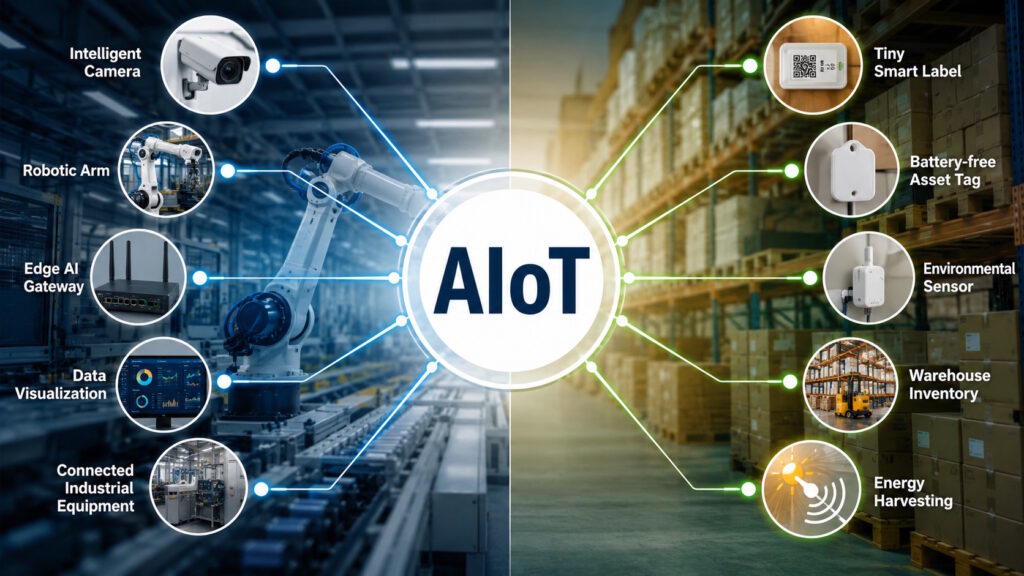
AIoT now appears in two distinct technology conversations, and each meaning points toward a different future for connected devices. For many readers, it means Artificial Intelligence of Things, where AI helps IoT systems interpret data and make decisions. In telecom and low-power device discussions, the same letters can also mean Ambient IoT. One term emphasizes intelligence, while the other emphasizes energy, size, cost, and maintenance.
This overlap can make a product announcement sound more mysterious than it really is. A smart camera, an energy-harvesting label, and a predictive maintenance platform may all appear beside the same acronym. Yet they solve very different problems. Understanding the context helps you see what a vendor, researcher, or standards group actually describes.
How AIoT Became a Shared Acronym
Artificial Intelligence of Things has an established place in research and industry. It brings AI capabilities into systems built around sensors, connected devices, networks, edge computing, and cloud platforms. Recent research describes the field as an intersection of modern AI and IoT across sensing, computing, and communications.
Ambient IoT developed from another industry challenge. Organizations want to connect far more objects without managing large fleets of conventional batteries. These devices may gather energy from radio waves, light, motion, or heat. Some operate without batteries, while others use limited storage, such as a capacitor.
The naming collision became harder to ignore as technical work adopted the shorter form. A 3GPP Release 19 security specification defines “AIoT” as “Ambient Internet of Things.” That usage now appears beside the established Artificial Intelligence of Things definition.
So, what does the acronym stand for today? The honest answer depends on the conversation around it.
Smarter Things, Faster Decisions
Artificial Intelligence of Things is the definition many people already recognize when they see AIoT. Instead of focusing only on connecting devices, it combines AI with IoT to help systems interpret information, identify patterns, and support better decisions. This approach is transforming connected environments across industries, from manufacturing and logistics to smart buildings and healthcare.
AIoT in practice: intelligence meets connectivity
In one established sense, the term describes connected systems that use AI to understand data and support action. The intelligence may run on a device, at an edge gateway, in the cloud, or across several layers.
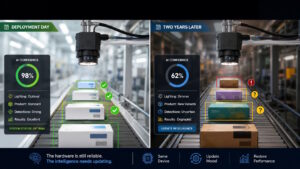
Consider a factory motor with vibration and temperature sensors. A basic IoT system can collect and display those readings. An AI-enabled system can detect unusual patterns and flag possible equipment trouble. It may also estimate when maintenance should happen.
The same idea applies in other settings. Cameras can recognize events instead of merely recording video. Buildings can adjust operations using occupancy patterns. Logistics systems can spot delays or changing demand. Farms can combine field data with models that support irrigation decisions.
This meaning focuses on a simple question: Can connected data lead to a better decision?
The answer does not require every device to carry a powerful processor. A small sensor may only collect data. A nearby gateway or cloud service can handle the heavier analysis. What defines the concept is the connection between sensing and machine intelligence.
Tiny Devices That Live on Their Surroundings
Ambient IoT starts with a different question: How can organizations connect more objects without creating a maintenance burden?
The category includes small, low-complexity devices that rely primarily on harvested energy. A Bluetooth SIG research note identifies radio waves, light, motion, and heat as possible sources. 3GPP also describes devices with no battery or limited energy storage.
Imagine a smart label attached to a package, medicine carton, tool, or retail item. It might report identity, location, temperature, or another simple condition. Its value comes from reaching places where conventional sensors may cost too much or require too much upkeep.
That could open new possibilities for inventory visibility, asset tracking, cold-chain monitoring, and building operations. The device itself may perform only a narrow task. Its low power needs and small form factor make large deployments more practical. Bluetooth SIG and 3GPP materials identify sensing, location, identification, inventory, and tracking among relevant functions.
Does Ambient IoT always mean battery-free? No. Some devices may include limited storage while still relying on harvested energy.
Does it automatically include artificial intelligence? No again. Intelligence may enter elsewhere in the system, but it does not define the device category.
Why the Confusion Feels New
The Artificial Intelligence of Things meaning did not suddenly disappear. Instead, Ambient IoT gained visibility within Bluetooth, cellular, and energy-harvesting discussions. Standards work gave the newer usage greater technical weight.
A hyphen can create a helpful visual distinction. Several 3GPP radio specifications use “A-IoT” for Ambient IoT. Yet another Release 19 specification lists “AIoT” without the hyphen. Official documents therefore do not provide one visually consistent shortcut.
Context usually provides the answer. Mentions of machine learning, inference, computer vision, predictive analytics, or automated decisions suggest Artificial Intelligence of Things. References to energy harvesting, passive tags, tiny sensors, or limited storage usually point toward Ambient IoT.
The surrounding industry also offers clues. An edge computing article will probably use the first meaning. A cellular standards document or battery-free tracking discussion may use the second.
Different Jobs, One Connected System
These concepts do not compete for the same role. In many cases, they can work together.
Picture a warehouse filled with low-power tags. Those tags collect basic information from pallets, packages, or individual products. Readers and gateways gather the signals. An intelligent platform then searches for missing inventory, unusual movement, or temperature risks.
The tags represent Ambient IoT. The analysis represents Artificial Intelligence of Things. The complete system connects inexpensive sensing with smarter decisions.
This combination could become one of the more interesting directions for connected technology. Organizations often need broader visibility and better interpretation at the same time. Low-maintenance sensing expands the available data. AI helps people understand what that larger data stream means.
Still, the pairing is not automatic. An intelligent camera can operate without ambient energy. An energy-harvesting label can deliver useful data without any AI model. Each concept stands on its own.
Reading the Context Without a Decoder Ring
When you encounter the acronym, start with the problem under discussion.
Is the system trying to recognize, predict, optimize, or automate something? The speaker probably means Artificial Intelligence of Things. Is the device trying to survive on tiny amounts of harvested energy? Ambient IoT is the more likely meaning.
The product description can offer another clue. Words such as “model,” “inference,” and “learning” point toward intelligence. Words such as “battery-free,” “passive,” and “energy harvesting” point toward power efficiency.
You can also ask one direct question: Where does the intelligence live? If nobody mentions intelligence, the term may describe the ambient device category instead.
This quick check prevents a common misunderstanding. “Smart” does not always mean AI-powered. Likewise, “ambient” does not necessarily describe an invisible computing experience. Here, ambient primarily describes the device’s relationship with available energy.
Two Paths Toward a More Invisible Internet
Both meanings reveal how the Internet of Things is changing.
One path gives connected systems more awareness. Sensors no longer provide only readings; they can support recognition, prediction, and faster responses. The other path strips devices down. It reduces power needs, maintenance demands, and physical size.
Those directions may seem opposite. One adds intelligence and computational capability. The other removes hardware and energy overhead. Together, they could make connected systems more useful and less noticeable.
The terminology may eventually settle into clearer conventions. Until then, readers will need context, especially when technical communities overlap. The ambiguity is inconvenient, but it also captures two important ambitions within IoT.
Conclusion: One Set of Letters, Two Useful Ideas
The acronym no longer guarantees a single definition. Artificial Intelligence of Things focuses on what connected systems can understand and decide. Ambient IoT focuses on how small connected devices can operate with minimal energy and maintenance.
Knowing the distinction makes product claims, standards discussions, and technology news easier to follow. It also reveals where the two ideas could meet in future deployments. As both technologies continue to evolve, understanding their different roles will become increasingly valuable.
If you enjoy exploring emerging technologies like AIoT, join the conversation at Tech Scope Connect. Through our expert insights, live newscasts, and global virtual summits, we examine the trends shaping the future of AI, IoT, connectivity, and digital innovation.
Sources:
- Artificial Intelligence of Things: A Survey | arxiv.org
- 5G; Security Aspects of Ambient Internet of Things (AIoT) Services for Isolated Private Networks | etsi.org
- Working Groups – IEEE Internet of Things | iot.ieee.org
- MRN_Ambient-IOT.pdf | bluetooth.com
- 5G; Service Requirements for Ambient Power-Enabled IoT | etsi.org
- A Survey on Cloud-Edge-Terminal Collaborative Intelligence in AIoT Networks | arxiv.org
- The Role of Bluetooth Technology in the Ambient IoT | bluetooth.com
- Release 19 Ambient IoT | 3gpp.org
- 5G; NR; Ambient IoT Physical Layer | etsi.org