
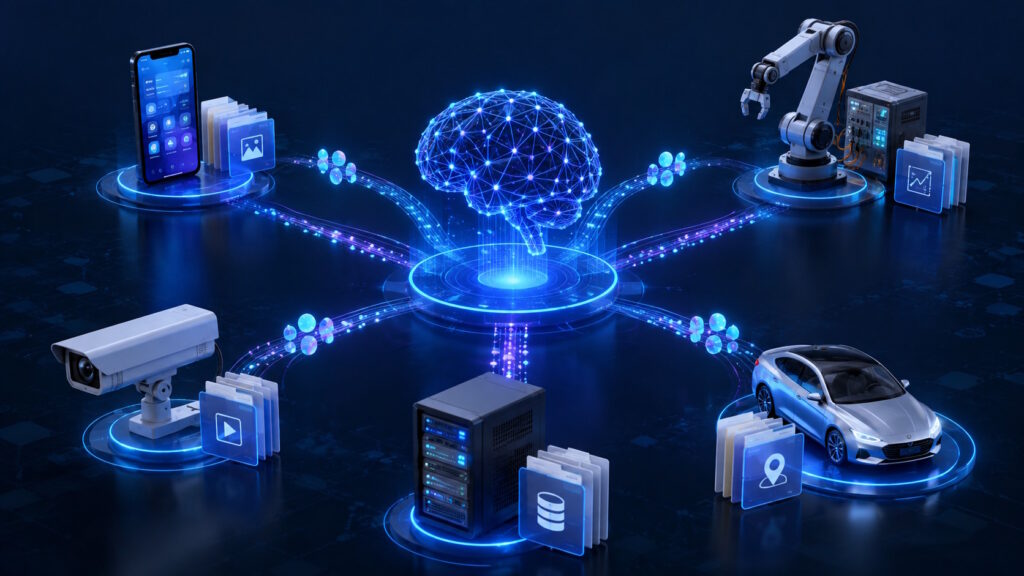
Quick Answer: Yes. Edge computing can help AI learn across distributed devices and locations without sending all their raw data to the cloud. Through federated learning, participants can train a shared AI model locally and send model updates instead of the underlying data. This approach can reduce data centralization, although it still requires strong privacy, security, and data-quality safeguards.
When AI Training Meets Distributed Data
Edge computing already helps AI process information near the phones, cameras, machines, and vehicles that create it. By placing compute near the source, this local processing model reduces dependence on constant cloud connections. It can also limit unnecessary data movement while supporting faster responses.
Most edge AI stories end with inference, when a trained model reaches a device and makes a prediction. A camera spots a defect, a phone suggests the next word, or a machine notices unusual vibration. The device uses intelligence that the model learned somewhere else.
Yet what if those devices could help improve the model too? That possibility leads to federated learning, which lets distributed participants contribute to AI training while keeping raw data local. Edge computing could give that learning process a practical place to happen.
How Edge Computing Changes the Training Question
Traditional AI training usually flows inward, as data from many sources moves into one central environment. A team trains the model there, then sends the finished version outward to devices and facilities.
Those systems apply what the model already learned, but they do not usually shape its training. Federated learning turns that flow around by sending a shared model toward distributed data. The device no longer serves only as a place where AI runs. It can become one of the places where AI learns.
Not every tiny sensor will train a sophisticated model, since many lack enough power, memory, or battery capacity. Training may instead happen on a phone, vehicle computer, gateway, local server, or nearby edge platform.
The central idea remains simple: Local experience can improve shared intelligence without creating one enormous pool of raw information.
What Is Federated Learning, in Plain English?
Federated learning trains a shared AI model across several participants without collecting their raw datasets in one place. Those participants might include devices, factories, hospitals, companies, or research organizations.
A coordinating system starts with a common model and sends a copy to selected participants. Each participant trains that copy using local data, then returns a focused model update.
The coordinator combines those contributions and produces a new shared model. It receives what the participants learned rather than the original examples behind those lessons.
NIST describes the same contrast between centralized and federated learning. Centralized training gathers data in one location, while federation shares model updates across distributed participants.
Google described the approach publicly through its work with mobile devices. Phones could improve a shared model locally, then send summarized changes for aggregation.
One sentence captures the difference: Centralized learning moves data to the model; federated learning moves the model to the data.
From a Phone to a Factory
Phones offer an easy starting point because every user creates different typing patterns, phrases, corrections, and preferences. With federated learning, selected phones can improve local model copies through those interactions.
They then send summarized changes without uploading the original typing data. Google has applied this approach to mobile features, including keyboard and text-selection models.
Now picture a manufacturer with five factories, each using AI-powered cameras to inspect products. Every site still sees a slightly different world.
One factory has older cameras, while another uses different lighting. A third encounters rare defects that never appear elsewhere. A single central model may miss those local variations.
Sending every high-resolution image to headquarters may also create storage, bandwidth, and governance concerns. Instead, edge computing infrastructure could update the shared model using each factory’s inspection images.
The factories could contribute model updates while keeping the original images on-site. Each location would then benefit from useful patterns discovered elsewhere.
Where Edge Computing Fits Into Federated Learning
Federated learning provides the training method, while edge computing supplies processing resources near the distributed data. Sometimes a capable device can handle local training, although a gateway or on-site server may take that role.
The best location depends on the model, hardware, energy limits, and data volume. This arrangement expands the familiar edge story beyond quick local decisions. Local systems may do more than apply a finished model. They may also participate in improving it.
NVIDIA’s work with FLARE and Meta’s ExecuTorch reflects this direction. Their integration supports training across mobile and edge devices while local data stays in place. However, a central platform often remains involved. It may choose participants, coordinate training rounds, combine updates, test results, and distribute new models.
This is not an edge-versus-cloud contest. It creates a different division of labor between local and central resources.
Why Keep the Raw Data Where It Is?
Some of the most valuable AI training data is also the hardest data to centralize. Health records may carry privacy concerns, while factory information may reveal production methods or trade secrets.
Vehicles can produce enormous streams of sensor information. Consumer devices may hold personal details that users never expect to leave their control.
Distance creates another obstacle when organizations operate across countries, companies, or facilities with different rules. Federated learning offers a way to collaborate without placing every raw dataset in one shared repository. It can also reduce the need to transfer large files solely for training. However, it does not erase disagreements about the data itself.
Participants still need compatible labels, definitions, and quality standards. Five factories cannot improve one defect model effectively when each factory defines “defect” differently.
Does Keeping Data Local Guarantee Privacy?
No. Local raw data can reduce one form of exposure, but it does not create automatic privacy. Model updates still reflect what a participant learned from its data. Under some conditions, attackers may infer information from those updates or the finished model.
NIST warns that federated learning alone cannot prevent every privacy attack. Researchers have demonstrated attacks against both shared updates and trained models. Organizations may add secure aggregation, encryption, and differential privacy. Secure aggregation combines many contributions without exposing each update separately, an approach Google has developed for federated systems.
These protections bring trade-offs involving computing, communication, testing, and coordination. Federated learning can reduce raw-data centralization, but it cannot replace privacy engineering or cybersecurity.
What If Every Participant Sees a Different World?
Distributed data rarely looks neat or uniform. A vehicle in Tokyo sees different roads than one in Helsinki, while two hospitals may serve very different populations. Factories may also use different sensors, labels, or operating settings. Those differences can broaden what a model learns, but they can pull training in competing directions.
A participant with much more data may influence the shared model heavily. Faulty sensors can produce misleading updates, while weak labels can reduce accuracy for everyone. A model that performs well on average may still fail at one location. Some systems may need personalized models, regional versions, or groups of similar participants.
More devices do not automatically create better AI. Their contributions still need context, quality checks, and careful evaluation.
Could One Bad Participant Harm the Shared Model?
Yes. A compromised device or dishonest participant could submit updates designed to weaken or manipulate the model. Honest participants can also create problems through broken sensors, outdated software, or poor local data. From the coordinator’s perspective, those updates may all look suspicious.
A federated system needs ways to authenticate participants, detect unusual contributions, and test new models before wide distribution. Teams also need records that help them trace changes and reverse weak model versions.
No organization sees every raw dataset, which makes some problems harder to investigate. The same architecture that limits data sharing can reduce visibility during troubleshooting. Federated learning distributes the training process, but it also distributes part of the operational risk.
Does This Mean AI No Longer Needs the Cloud?
Usually, no. The cloud can still coordinate participants, combine model updates, evaluate results, and manage deployment across large fleets. What changes is the amount and type of information that travels. Instead of uploading every image or sensor record, a participant may send a focused model update.
For many organizations, the likely future remains hybrid. Edge computing handles selected training work, while cloud systems manage the shared model. The cloud does not disappear. It stops acting as the required destination for every useful piece of raw data.
Conclusion: A New Place for AI to Learn
Edge AI has already changed where machines can make decisions. Federated learning could now change where AI improves those decisions. A phone, factory, hospital, or vehicle does not have to remain only an endpoint. It may also contribute local experience to a shared model.
The idea carries clear appeal. Organizations could learn from distributed information while keeping more raw data under local control. Their models could also reflect a wider range of real-world conditions. Yet federated learning does not remove privacy, security, quality, or governance challenges. It changes how organizations manage them, while the cloud remains useful as a coordinator.
Curious about how edge computing and AI are changing where intelligence lives and learns? Join Tech Scope Connect for expert discussions, live events, and insights into the technologies shaping what comes next.
Sources:
- The UK-US Blog Series on Privacy-Preserving Federated Learning: Introduction | nist.gov
- Federated Learning: Collaborative Machine Learning without Centralized Training | research.google
- Predicting Text Selections with Federated Learning | research.google
- Effortless Federated Learning on Mobile with NVIDIA FLARE and Meta ExecuTorch | developer.nvidia.com
- Privacy Attacks in Federated Learning | nist.gov
- Practical Secure Aggregation for Federated Learning on User-Held Data | research.google