Quick Answer: Yes, an AI sensor can run without a conventional battery by harvesting small amounts of energy from sources such as light, heat, motion, or radio signals. With TinyML, it can use that energy to perform a focused task locally, such as detecting an unusual vibration or recognizing a simple pattern. However, batteryless AI sensors may operate intermittently and must carefully balance the energy needed for sensing, processing, and communication.
Intelligence on Almost No Power
An AI sensor can run without a conventional battery, but it still needs energy from somewhere. A batteryless smart sensor may collect power from light, heat, movement, or nearby radio waves. A TinyML device can then use that small supply to recognize a simple pattern. Researchers already explore this combination on devices with extremely limited power and memory.
The idea attracts attention for a practical reason. Batteries create maintenance work, especially when sensors sit in remote, sealed, or awkward locations. A device that gathers its own energy could reduce some of that routine burden.
So, can a sensor really “think” without a battery? In a limited way, yes. It can collect energy, take a reading, run a small model, and share a result. However, it may complete those steps only when enough energy becomes available.
This is not a tiny version of a generative AI platform. It is a focused device that answers one useful question with very little power.
What Does “Batteryless” Really Mean?
Batteryless does not mean powerless. The device still needs electricity, but it gathers that electricity from its surroundings. Light may support a small solar cell. Machine movement can provide vibration energy. Heat differences and radio signals may also contribute in suitable environments. 3GPP includes these sources in its description of highly constrained Ambient IoT devices.
The sensor may use incoming energy immediately. It may also collect a small amount inside a capacitor before it wakes. Can it operate continuously? Usually, it cannot. The device may stay quiet, gather energy, perform one task, and return to sleep. Picture it living from one small sip of energy to the next.
Removing the battery therefore changes more than the power source. It changes how the device senses, computes, and communicates.
How Can an AI Sensor Work on Harvested Energy?
The answer starts with TinyML. TinyML brings compact machine-learning models to processors with limited memory, computing capacity, and energy. These models do not need broad knowledge. They usually perform one narrow task tied to a specific sensor.
A vibration model might recognize an unusual machine pattern. An acoustic model could identify a familiar fault sound. An occupancy model might distinguish an empty room from an active one. The model may produce only a few possible answers. That focus keeps the computing task small enough for constrained hardware.
An ordinary sensor may send every reading to a gateway or cloud platform. A batteryless AI sensor can sometimes examine the data first. It may send only a label, confidence score, or alert.
That local decision can reduce network traffic and avoid transmitting data that carries little value. Research prototypes also show that zero-energy devices can choose models according to available energy and timing limits.
The device does not need enough energy to understand everything. It needs enough energy to answer one carefully chosen question.
The Sensor Has an Intelligence Budget
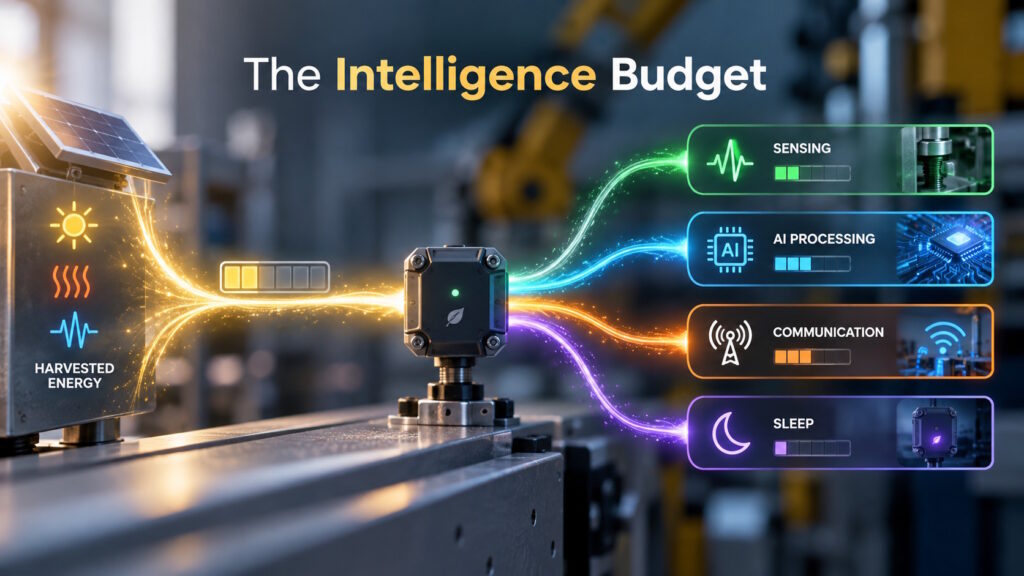
Every wake cycle creates choices. The device needs energy to sense, process, save, and transmit information. Those actions compete for the same limited supply. The sensor may not afford all of them during every cycle.
Imagine a device monitoring vibration from a motor. Should it analyze the signal locally, transmit the full reading, or wait? A smart system can choose according to current conditions. It may run a smaller model when energy remains scarce. It may choose a larger model after collecting more power.
Researchers have explored systems that select among local models or send data for remote analysis. Those choices consider energy, accuracy, and response time. The device therefore manages more than data. It also decides how much computation it can afford at that moment.
When Computing Happens in Short Bursts
Harvested energy can rise and fall throughout the day. A solar-powered device may receive strong light at noon and very little later. The sensor could wake, begin an inference, and lose power before reaching an answer. It must continue carefully after gathering more energy.
Researchers call this intermittent computing. The device performs work in short bursts instead of assuming that power will remain available. Software can divide a job into smaller pieces and preserve useful progress between shutdowns. This approach helps the device avoid repeating the entire task after every interruption. Research systems have demonstrated machine-learning inference across multiple power cycles.
In plain terms, one decision may unfold across several brief periods of activity. This also changes how we judge performance. Model accuracy still counts, but availability and completion time deserve attention too. A highly accurate model offers little value when the sensor rarely gathers enough energy to finish.
Local Answer or Trip to the Cloud?
Local processing can make sense when the sensor collects a rich signal. It can examine that signal and transmit only a short result. For example, a machine sensor might send “normal” instead of a complete vibration recording. That choice can reduce the communication burden.
The cloud can still support a larger model or a more detailed analysis. Remote processing may help when the sensor has enough energy for transmission. The best choice may change from moment to moment. A device could handle obvious cases locally and send uncertain cases elsewhere.
Energy-aware TinyML research examines this flexible approach. The sensor weighs energy, timing, and accuracy before choosing local or remote inference. So, is local AI always more efficient? No. The answer depends on the data, network, model, and available power.
Ambient IoT Is the Neighbor, Not the Twin
Ambient IoT and batteryless intelligence share a common foundation. Both involve devices that operate with extremely small amounts of harvested energy. However, Ambient IoT primarily focuses on identification, sensing, and communication for highly constrained endpoints. It does not require every device to run machine learning.
A batteryless tag might simply report its identity or a temperature reading. It can provide real value without making a local prediction. Batteryless intelligence adds another layer. The endpoint interprets at least part of its sensor data before sharing the result.
Our earlier Ambient IoT article explains how nearly powerless objects can connect and communicate. This article asks what happens when one also needs to compute. The technologies can overlap, but neither one automatically includes the other.
Where Could an AI Sensor Make Sense?
The strongest applications need a small decision rather than continuous, advanced analysis.
Industrial monitoring offers an easy example. A sensor could listen for a familiar fault sound or watch for unusual vibration. It might remain quiet until the model detects something worth reporting.
Environmental monitoring offers another possibility. A device could recognize an unusual temperature, moisture, or air-quality pattern. It would send an alert instead of a steady stream of raw readings.
Agriculture, buildings, infrastructure, and logistics may also provide suitable settings. These environments often include locations where battery replacement becomes inconvenient.
The most promising uses tolerate pauses, require narrow predictions, and benefit from smaller data transmissions. Research has explored batteryless machine learning for presence, vibration, air quality, and gesture recognition.
Batteryless intelligence fits poorly when every second counts. Safety-critical controls, continuous video, and high-bandwidth analysis usually need dependable power.
The energy source must also suit the location. A solar-powered sensor will struggle in persistent darkness, while vibration harvesting needs meaningful movement.
Batteryless does not mean maintenance-free. Sensors can drift, harvesting surfaces can collect dirt, and communications equipment still requires power.
Conclusion: A Different Kind of Edge Intelligence
Can intelligent sensing work without a conventional battery? Yes, within clear limits. A device can harvest energy, store a small amount, and perform a focused machine-learning task. It may operate intermittently and adjust its behavior as available energy changes. The result is not an always-on digital brain. It is a modest decision-maker that wakes when conditions allow and spends energy carefully.
Batteryless connectivity asks whether a device can sense and communicate. Batteryless intelligence asks whether it can also interpret what it senses. The field currently suits narrow tasks and forgiving environments best. Even so, it offers a fresh direction for edge computing and connected products.
The future may depend less on computing power and more on choosing each computation wisely. Curious about where AI and connected technologies are headed next? Join Tech Scope Connect for conversations and insights on the technologies shaping the future of connected devices.
Sources:
- Release 19 Ambient IoT | 3gpp.org
- Towards Energy-Aware TinyML on Battery-Less Iot Devices | sciencedirect.com
- Energy-Aware TinyML Model Selection on Zero Energy Devices | famaey.eu
- Intelligence Beyond the Edge: Inference on Intermittent Embedded Systems | arxiv.org
- 3GPP Rel-19 Summary: A Presentation Version of 3GPP TR 21.919 | 3gpp.org
- [2004.11293] Intermittent Inference with Nonuniformly Compressed Multi-Exit Neural Network for Energy Harvesting Powered Devices | arxiv.org
- [1904.09644] Intermittent Learning: On-Device Machine Learning on Intermittently Powered System | arxiv.org