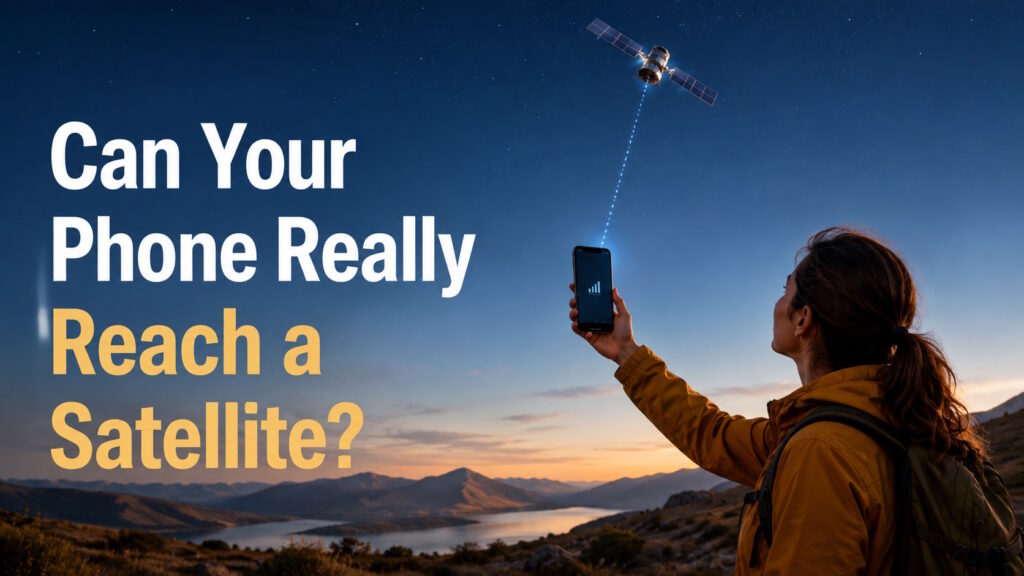
Quick Answer: Yes, some ordinary smartphones can connect directly to satellites when cellular and Wi-Fi coverage disappear. Depending on the phone, carrier, country, and service, users may send emergency alerts, exchange texts, share locations, or access selected apps. However, a smartphone does not automatically become a full satellite phone. Most services require compatible devices, eligible plans, and a clear view of the sky. Voice, video, and broadband remain limited or uneven, so satellite phone service currently complements mobile towers rather than replacing them.
Satellite Phone Service Moves Beyond the Rugged Handset
Satellite phone service is no longer limited to rugged handsets built for ships, expeditions, and remote job sites. Mobile carriers now use direct-to-device networks to bring satellite connectivity to ordinary smartphones. This shift could redefine “no service” for travelers, rural communities, businesses, and emergency responders.
For decades, connecting from a remote location usually required specialized equipment and a separate subscription. That model still exists, and traditional satellite phones remain valuable in demanding environments. However, newer services are bringing basic satellite access into familiar consumer devices.
The phrase “connect to a satellite” can describe several very different experiences. One service may send an emergency message, while another supports texts, maps, or selected apps. Some networks can even carry app-based calls under the right conditions.
The technology is real, but the experience remains uneven. Your phone, carrier, location, and surroundings all influence what works. The promise is exciting, although it is not yet the same as full mobile internet everywhere.
So, Can a Regular Phone Reach a Satellite?
Yes, some regular smartphones can establish a direct radio link with a satellite. They do not need a nearby terrestrial tower for that first connection.
However, “direct” does not mean your phone sends a message straight to another person’s device. The signal usually moves through a wider network before reaching its destination.
A typical path looks like this: your phone reaches a satellite, which routes the traffic into communications infrastructure. The network then delivers the message, app request, or emergency alert.
Starlink Mobile describes its satellites as cellular towers in space. The service can connect with existing LTE phones through participating mobile operators. Users still need compatible service and a clear view of the sky.
Other systems rely on satellite features built into specific phones and operating systems. Apple, for example, supports satellite messaging and emergency features on iPhone 14 or later in supported markets.
Telecom standards are also helping these networks work more like familiar mobile systems. The 3GPP Release 17 standard added support for non-terrestrial networks, often shortened to NTN.
Is Your Smartphone Now a Satellite Phone?
Not quite. A traditional satellite phone is designed primarily for satellite communication. It may offer dedicated voice service, rugged construction, and stronger performance in remote settings.
An ordinary smartphone still relies mainly on terrestrial cellular networks and Wi-Fi. Its satellite connection usually serves as a fallback when those networks disappear.
The available features may also be narrower. A smartphone might support emergency alerts, ordinary texts, location sharing, or light data. A specialized handset may provide services tailored for frequent use at sea or across isolated worksites.
The distinction helps set realistic expectations. Your smartphone may perform several jobs once reserved for dedicated equipment. That does not make both devices interchangeable.
The bigger change sits within the network itself. Satellites are becoming another coverage layer that a familiar phone can use when towers cannot reach it.
A Cell Tower in the Sky, Without the Science Lecture
A small phone cannot simply increase its power and shout into orbit. The network must make the connection possible.
Many direct-to-phone systems use satellites in low-Earth orbit. Their closer position reduces the distance compared with satellites in much higher orbits. These networks also use groups of satellites to maintain wider coverage.
The satellites carry sensitive antennas and signal-processing equipment designed to detect weak phone signals. Some systems aim to communicate with standard, unmodified smartphones.
When your phone loses terrestrial coverage, it may search for an available satellite network. Some devices guide you toward the satellite, while others try to connect automatically.
The satellite receives the signal and routes it through the provider’s network. That network may include ground stations, satellite links, and your mobile carrier’s systems.
From your perspective, the process can feel surprisingly ordinary. You open a messaging app, request help, check a map, or share your location. Behind the screen, the connection has taken a much longer trip.
Carrier partnerships play a central role here. The satellite network needs suitable spectrum and integration with the mobile operator. That relationship also explains why one carrier may support a service that another does not.
What Can You Actually Do When the Bars Disappear?
Messaging remains the most common starting point for direct-to-phone satellite service. Short messages use far less network capacity than continuous video or large downloads.
Apple lets supported iPhones exchange iMessages and SMS messages outside cellular and Wi-Fi coverage. Users must go outdoors and maintain a clear view of the sky and horizon.
T-Mobile’s T-Satellite supports texting, location sharing, and selected satellite-ready apps on compatible devices. Its current service also supports picture and audio messages, plus WhatsApp calling in eligible situations.
In the Philippines, Globe Starlink supports texts and light data on compatible Android phones. Users can access selected messaging, mapping, and weather services. Streaming, gaming, and heavy downloads are not supported.
These examples reveal an important truth. Satellite data does not automatically mean unrestricted broadband. Providers often prioritize useful, low-bandwidth services that can work across limited capacity.
What About Voice, Video, and Full Internet?
Some services now support app-based calling, while others still focus on messaging and light data. Globe, for example, has demonstrated a WhatsApp call, but its commercial service does not currently support calls.
Vodafone and AST SpaceMobile also demonstrated a video call from an ordinary smartphone outside terrestrial coverage. The test showed that direct-to-phone mobile broadband can support richer services.
A successful demonstration proves technical capability, not universal availability. Commercial service must also handle coverage, capacity, devices, subscriptions, and local approvals.
So, can your phone stream video through a satellite? In some demonstrations and services, yes. For most users, messaging and selected apps remain the more realistic expectation.
Why “Internet Anywhere” Still Gets Ahead of Reality
The phrase sounds simple, but satellite coverage comes with practical limits.
First, your phone usually needs open sky. Buildings, tunnels, mountains, dense trees, and vehicle structures can weaken or block the connection. Apple, T-Mobile, and Globe all emphasize outdoor use with sky visibility.
Second, capacity remains shared. A satellite beam may cover a large area and serve many users. Providers often manage that demand by supporting messages and selected apps before heavy data use.
Third, compatibility involves more than owning a recent smartphone. Your phone model, software, carrier, SIM, plan, country, and satellite partner all need to align.
A device that works with one service may not connect through another. Support can also change across countries, even when the same satellites pass overhead.
Finally, satellite communication may feel slower than ordinary cellular service. Messages can take longer, especially when trees or other objects partly block the sky.
None of these limits makes the technology unimportant. They simply show why “full internet anywhere” remains a promise with several footnotes.
Where Could This Make the Biggest Difference?
The strongest use cases begin where terrestrial coverage becomes difficult, unreliable, or too expensive to build.
Remote communities could gain access to basic communications without waiting for a nearby tower. Outdoor travelers could send a message after leaving cellular coverage. Field crews could share updates from isolated roads, farms, forests, or infrastructure sites.
Disaster response offers another powerful example. Earthquakes, storms, fires, and power failures can damage terrestrial networks or overwhelm remaining capacity. A satellite connection can create another path for messages, location sharing, and emergency coordination.
The Philippines shows why this option attracts attention. Its thousands of islands and frequent natural disasters complicate continuous terrestrial coverage. Globe has positioned satellite-to-mobile service as a connection for remote and disaster-affected areas.
The same idea also extends beyond personal phones. Connected sensors, trackers, vehicles, and equipment could report from places beyond normal cellular reach. Those uses may support agriculture, logistics, maritime operations, and remote infrastructure.
Why Satellites Will Complement Mobile Towers
Satellites can cover enormous areas, but mobile towers still handle dense demand more efficiently. Cities need strong indoor coverage, low delays, and enough capacity for thousands of nearby users.
Terrestrial networks also support heavy streaming, cloud applications, gaming, and constant background traffic. Current satellite-to-phone services often limit those activities or prioritize lighter applications.
Satellites shine when distance matters more than density. They can fill remote gaps, support emergency communications, and extend a carrier’s reach beyond practical tower locations.
The likely future is not a contest between satellites and towers. Your phone may move between both networks according to availability, location, and service needs.
That blended approach fits the broader direction of non-terrestrial network standards. It treats space-based coverage as part of the mobile ecosystem, rather than a completely separate world.
Conclusion: The Dead Zone Is Changing, Not Disappearing
Ordinary smartphones can now reach satellites, but the experience depends on the service. Some users can send emergency alerts or texts. Others can access selected apps, share locations, or make app-based calls.
The capabilities will continue to expand, yet practical limits will remain. Clear sky, compatible devices, carrier support, capacity, and regional availability still shape every connection.
The real shift is quieter than the marketing suggests. People may not replace their smartphones with specialized handsets. Instead, their existing phones may gain another network to try when the nearest tower disappears.
The next time your screen shows no bars, your phone may still have somewhere else to look. To explore how satellite phone service and other connectivity advances are reshaping communications, join us at Tech Scope Connect.
Sources:
- About Messages Via Satellite | support.apple.com
- T-Satellite With Starlink: Direct to Cell Satellite Phone Service | t-mobile.com
- Globe Starlink Philippines: Satellite-To-Mobile Service | globe.com.ph
- Starlink Business | starlink.com
- Use Emergency SOS Via Satellite on Your iPhone | support.apple.com
- Non-Terrestrial Networks (NTN) | 3gpp.org
- Release 17 | 3gpp.org
- ESA – Types of Orbits | esa.int
- ESA – Low Earth Orbit | esa.int
- How It Works – AST SpaceMobile | ast-science.com
- Home – AST SpaceMobile | ast-science.com
- We Don’t Just Build Networks | t-mobile.com
- Why Spectrum Matters for Connecting the World | ast-science.com
- T-Satellite Is Here: and Now It’s Powering Apps! | t-mobile.com
- Globe Starlink Satellite to Mobile Service FAQs | globe.com.ph
- First Globe Starlink Satellite-To-Mobile Video Call | globe.com.ph
- Vodafone Makes World’s First Space Video Call From an Area of No Coverage Using a Standard Mobile Phone and Commercial Satellites Built to Offer a Full Mobile Broadband Experience | vodafone.com
- Vodafone Rewind: Our Highlights From 2025 | vodafone.com
- Globe Launches Starlink Satellite-To-Mobile in PH | globe.com.ph
- Globe Deploys Starlink Satellite Tech in Mindanao | globe.com.ph
- 5G Non-Terrestrial Networks | 3gpp.org