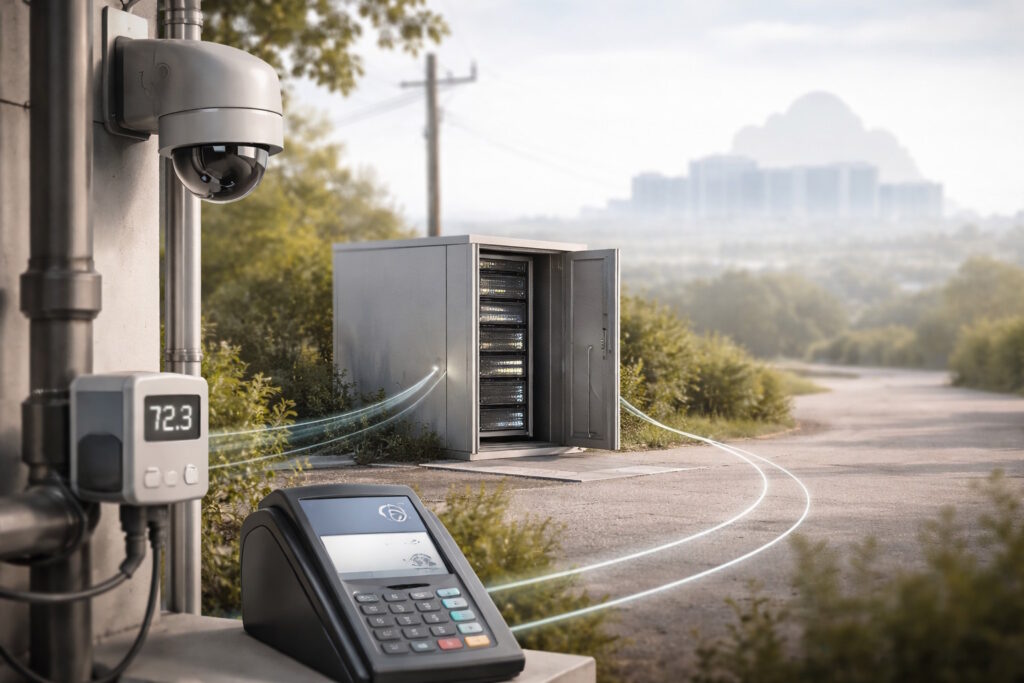
Key Takeaway: The edge cloud shifts computing closer to where data is created, allowing systems to respond faster, operate more reliably, and reduce dependence on distant data centers. By processing time-sensitive information near the source while still connecting to centralized cloud services for broader analysis and coordination, organizations can support real-time experiences, manage growing data volumes, and maintain continuity even when network conditions are unpredictable.
When “Instant” Starts to Feel Slow
Edge cloud is changing how digital services respond when you need them most. You may also hear it called edge computing, a distributed cloud model, or “cloud at the edge.” The labels vary, yet the idea stays simple. Computing moves nearer to where data begins, not only where it ends.
If you have ever watched a video buffer at the wrong moment, you already understand the problem. Distance adds delay. That delay can feel small, yet it shapes the experience. As more work happens in real time, the old habit of sending everything far away starts to look dated.
So why is this shift happening now, and what does it mean for you? Let’s walk through it in plain language.
The New Map of Digital Life
For years, the cloud felt like a single place. It lived “somewhere out there,” and that was enough. Your phone, factory sensor, camera, or checkout terminal sent data away. A distant server processed it, then sent something back.
That approach still works for many tasks. Email, backups, and large reports do not demand split-second responses. Yet modern systems often do. Many experiences now depend on speed, steady connections, and local context.
Here is the pressure that keeps building.
- First, data volumes keep rising. Devices create streams, not snapshots. Sending every stream to a distant region can strain networks and budgets.
- Second, expectations changed. People expect voice assistants to respond quickly. They expect cars to react safely. They expect screens to update without hesitation.
- Third, connectivity varies. Even strong networks have weak moments. A remote job site, a busy stadium, or a stormy afternoon can disrupt service. When the connection dips, you still want operations to continue.
- Finally, data rules matter more. Many organizations prefer to keep certain data close to home. They may do that for privacy, regulation, or trust.
In that environment, “closer” starts to look like a practical advantage, not a novelty.
Edge Cloud in Plain English: Closer Decisions, Fewer Delays
Think of the edge cloud as the cloud spreading out. Instead of placing most computing power in a few large centers, organizations place some capability nearer to devices and users. That “nearer” point might be a local facility, a telecom site, or a small regional hub.
You can picture it like this. A traditional model asks every question in a faraway office. The closer model adds a local desk that can answer common questions fast. When the question needs deeper work, it still goes to the main office.
This approach can reduce delay because data travels less. It can also reduce traffic because systems filter and summarize before sending information onward. In many cases, it improves resilience, since local services can keep running during network trouble.
Edge Cloud And The Everyday Moments You Already Notice
You may not see this shift directly, yet you can feel it. When a security camera flags an event quickly, local computing helps. When a store personalizes a display without lag, nearby processing plays a role. When a machine shuts down before damage spreads, local response time can matter.
Readers often ask, “Is this only for big companies?” Not necessarily. The pattern fits any situation where delay, bandwidth, or reliability affects results. The scale can vary, yet the principle stays stable.
Another common question is, “Does it replace the cloud?” In most cases, it complements it. Central cloud services still handle large analysis, long-term storage, and broad coordination. The closer layer handles time-sensitive work and immediate decisions.
Where You Will See the Impact First
The best way to understand the shift is to notice where time matters. Some settings simply cannot wait for round trips to distant regions.
- In manufacturing, machines generate constant signals. Local systems can detect anomalies sooner and keep operations steady. In energy and utilities, teams monitor wide networks of equipment. Local processing can help them respond to changes without delay.
- Retail also fits the story. Stores rely on connected devices, from payment systems to digital signage. When networks slow down, operations can suffer. A closer computing layer can support smoother experiences and more consistent service.
- Healthcare and public services face a different set of needs. They often handle sensitive data and strict rules. Keeping more processing close to the source can support privacy goals. It can also help maintain service during outages.
- Transportation adds another dimension. Vehicles, ports, and logistics centers generate fast-moving data. Local decision-making can support safety, routing, and smoother operations.
In each case, the pattern remains clear. When the environment demands speed and steadiness, placing computing closer can help.
What Changes for Security, Reliability, and Trust
Whenever computing spreads out, people ask about risk. That reaction makes sense. More locations can feel like more exposure.
Yet the picture is not only about added risk. It is about shifting controls to match the environment. Local processing can reduce how much sensitive data travels across networks. It can also limit what leaves a site in the first place.
Reliability often improves in practical ways. If a local site can keep critical functions running, a short outage becomes less disruptive. That matters in settings where downtime carries real costs.
Still, the basics remain important. Organizations need clear ownership of devices and software. They need consistent updates, monitoring, and access controls. They also need strong policies for what stays local versus what moves outward.
If you evaluate solutions, you will want plain answers. Ask who manages updates, how data moves, and what happens during failures. If the explanation sounds vague, that is a signal to probe further.
Conclusion: A Closer Cloud for a Faster World
Computing is moving closer to the source because modern systems demand speed, continuity, and context. As data volumes grow and expectations rise, the edge cloud offers a practical way to respond faster while staying connected to broader cloud infrastructure.
What matters now is not just where computing happens, but how those choices shape systems over time. Tech Scope Connect follows these shifts closely, examining how architectures like the edge cloud are influencing real-world systems through ongoing discussion and shared perspective. Join us!