Key Takeaway: Edge AI delivers more value when local processing is paired with data that has clear meaning, context, and governance. Unified namespaces, semantic models, data fabrics, and MCP can help AI systems find, interpret, and use distributed operational information more effectively. These technologies do not replace edge computing; they strengthen it by turning isolated readings into useful, trustworthy insights.
The Edge Is Learning, but Does It Understand?
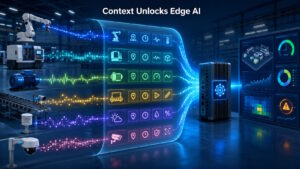
Edge AI can bring faster, more responsive decisions closer to machines, cameras, vehicles, buildings, and other connected systems. Artificial intelligence at the edge can reduce delays while supporting action near the source. Even so, local intelligence must understand the information surrounding each event.
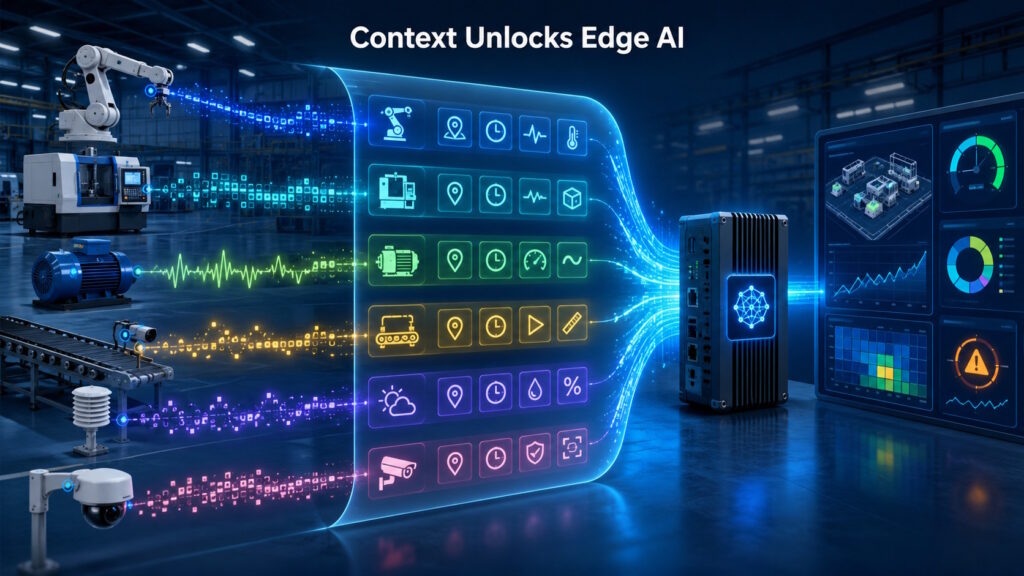
A sensor may report temperature, pressure, vibration, or energy use in real time. The reading can be accurate and still lack meaning. An application may need the asset name, unit, timestamp, operating state, and expected range before reaching a useful conclusion.
As organizations connect more equipment, this challenge becomes harder to ignore. Computing power remains essential, but better data context can make that power far more useful.
Why Edge AI Needs More Than Fast Decisions
Much of the edge computing conversation focuses on hardware, connectivity, model size, and response time. Those concerns remain important, since a local application needs enough processing capacity to meet its performance requirements.
However, speed does not settle questions about meaning when a machine reports a bare value such as “82.” Is that a temperature, a percentage, or a vibration measurement? Does it show normal production, or has something changed?
A faster processor can assess the number sooner, but it cannot resolve an undocumented unit or conflicting asset names. Once local processing works, missing context can become the next practical obstacle.
The issue is not whether compute or context matters more everywhere. Useful systems need both for timely action and sound interpretation.
What Does Data Context Actually Mean?
Data context explains how information fits into the wider operation. It links a reading to the equipment, location, process, event, or business activity behind it.
Consider a temperature of 82 degrees, which needs both a unit and a reference point. It may be normal for an industrial oven and alarming for a storage room. The machine’s operating mode can change the interpretation again.
Identity creates a similar problem when one platform says “Motor 4” and another says “A-104.” An application may miss the repair history unless someone connects those identities.
Time and quality also shape the answer, since current measurements differ from old values or faulty sensor readings.
In everyday language, context answers familiar questions: What is this information, where did it come from, and when did it happen? It also reveals what else was happening.
When Connected Systems Speak Different Languages
Operational information often sits across controllers, gateways, historical databases, maintenance platforms, cloud services, and vendor applications. Each system may describe the same operation differently.
Names can change between platforms, units may vary, and data can arrive at different speeds. Live readings and historical records may also remain separate. Connecting these systems creates access, but access alone does not create shared understanding.
Industrial information models can help applications represent equipment, measurements, types, and relationships more consistently. OPC UA provides an industrial interoperability framework with information-modeling capabilities. Its models can represent information as connected objects rather than isolated values.
This approach cannot guarantee perfect agreement across every system. It does give applications a stronger foundation for interpreting what a value represents.
The Layers That Turn Raw Readings into a Useful Picture
No single technology creates complete context, although several architectural layers can contribute in different ways.
Unified namespaces create a common place to look
A unified namespace organizes information from machines, controllers, applications, and business systems within a shared structure. Think of it as a common directory for operational data.
The information may still come from many sources, but applications gain a clearer way to find it. OPC Foundation materials describe unified namespaces as structured layers that bring information from multiple systems together.
A namespace cannot automatically correct inconsistent units, duplicate assets, or unclear definitions; it creates order, not instant perfection.
Semantic models add the missing meaning
A semantic model describes what an asset is, which measurements belong to it, and how it relates to other assets. It gives applications more than a field name and value.
For example, the model can connect a temperature reading with a specific motor, measurement unit, and operating condition. Different applications can then interpret that information more consistently.
Data fabrics connect the wider environment
A data fabric helps organizations connect, manage, and govern information across different systems and locations. It may combine catalogs, integration services, metadata, security controls, and access tools.
The data does not always need to live in one physical repository. IBM describes data fabrics as architectures that improve access, integration, metadata, and governance across scattered sources.
This wider layer can reduce the need to rebuild every connection for every new application.
MCP gives AI a doorway
MCP offers AI applications a standard way to connect with external data sources and tools. An MCP server can expose a database query, API call, or approved calculation.
The official specification describes tools that models can discover and invoke. Those tools can query databases, call APIs, or perform computations.
MCP provides a doorway, not an automatic understanding of the room behind it. It cannot repair a mislabeled sensor or match every maintenance record. Reliable answers still depend on reliable data and clear context.
Could You Really Ask a Factory a Question?
Imagine an operations manager asking, “Which machines are running above their normal temperature range today?”
A useful answer needs current readings, machine identities, expected ranges, and operating states. Maintenance history or production schedules may also affect the result.
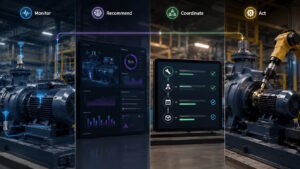
With suitable connections, an AI assistant could gather those details through approved tools. It could then present the findings in everyday language. The manager might spend less time moving among separate dashboards and databases.
Someone must still define “normal,” since the range may change by product, load, season, or operating mode. Natural-language access makes the question easier to ask, but it does not remove operational judgment.
Better context makes the conversation more useful by connecting a simple question with the conditions behind a meaningful answer.
Why EdgeLake Is Worth Watching
A recent LF Edge development shows how these ideas are beginning to meet. In February 2026, LF Edge announced that EdgeLake had advanced to Stage 2.
LF Edge describes EdgeLake as managing data across distributed nodes while presenting a unified view for queries. Its MCP implementation supports interaction through natural language, SQL, and unified namespace hierarchies.
This example points toward an interesting direction: organizations may not need one central platform before asking a useful question.
Data still moves when systems exchange queries, records, summaries, or results. Cloud platforms and traditional data pipelines also retain important roles. The opportunity lies in deciding where data should remain and where processing should occur.
Trust Still Needs Governance
Broader access creates new responsibilities, including clear rules for viewers, approved sources, and recorded access.
Freshness deserves special attention because an answer can look complete while relying on uneven information. Nineteen sites may provide current readings, while one site provides data from last week.
A trustworthy application should expose missing coverage, delayed sources, and uncertain measurements. It should also preserve the link between an answer and its supporting information.
Permissions need firm boundaries, since authority to read equipment data should not automatically permit changes to equipment settings. MCP guidance treats authorization and security as important concerns for protected resources and operations.
Context therefore extends beyond technical metadata to include ownership, access, quality, and accountability.
What Better Context Could Unlock for Edge AI
Better context could make many operational applications more useful. Teams might investigate abnormal conditions faster or compare facilities with fewer hidden differences. They could also connect maintenance records with current equipment behavior.
Natural-language questions may become more practical when users ask about energy use, production slowdowns, or unusual pressure readings. The system could retrieve related information without requiring knowledge of every database and field name.
These results depend on accurate identities, useful models, suitable permissions, and clear operational definitions. Even so, contextualized data offers a logical next step for connected operations.
The broader lesson is straightforward: compute helps a system respond quickly, while context clarifies what deserves a response.
Conclusion: Compute Creates the Opportunity; Context Builds Understanding
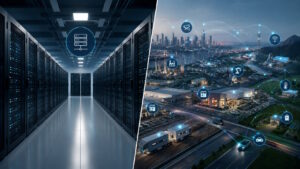
Edge computing has created new ways to process information near devices, equipment, and real-world activity. This approach forms an essential foundation for responsive applications.
The next stage involves helping local intelligence understand the information around it. Unified namespaces can organize access, while semantic models clarify meaning. Data fabrics connect wider environments, and MCP provides a standard route to approved data and tools.
No single layer solves every challenge, but together they can turn scattered readings into a more coherent operational picture.
Curious how better data context could shape the next stage of edge AI? Join the conversation at Tech Scope Connect, where we explore how AI, IoT, and connected technologies are changing real-world operations.
Sources:
- Maritime & Smart Ports | estimed.etsi.org
- Introduction to OPC Unified Architecture | reference.opcfoundation.org
- General information to OPC 40560: OPC UA for Mining | reference.opcfoundation.org
- OPC UA Solutions for Unified Namespaces: Bridging Brownfield and the Digital Factory | opcconnect.opcfoundation.org
- What Is a Data Fabric? | ibm.com
- Tools | modelcontextprotocol.io
- Specification | modelcontextprotocol.io
- EdgeLake Advances to LF Edge Stage 2, Redefining How AI Interacts with Edge Data Through MCP | lfedge.org
- EdgeLake | lfedge.org
- Security Best Practices | modelcontextprotocol.io
- Understanding Authorization in MCP | modelcontextprotocol.io