
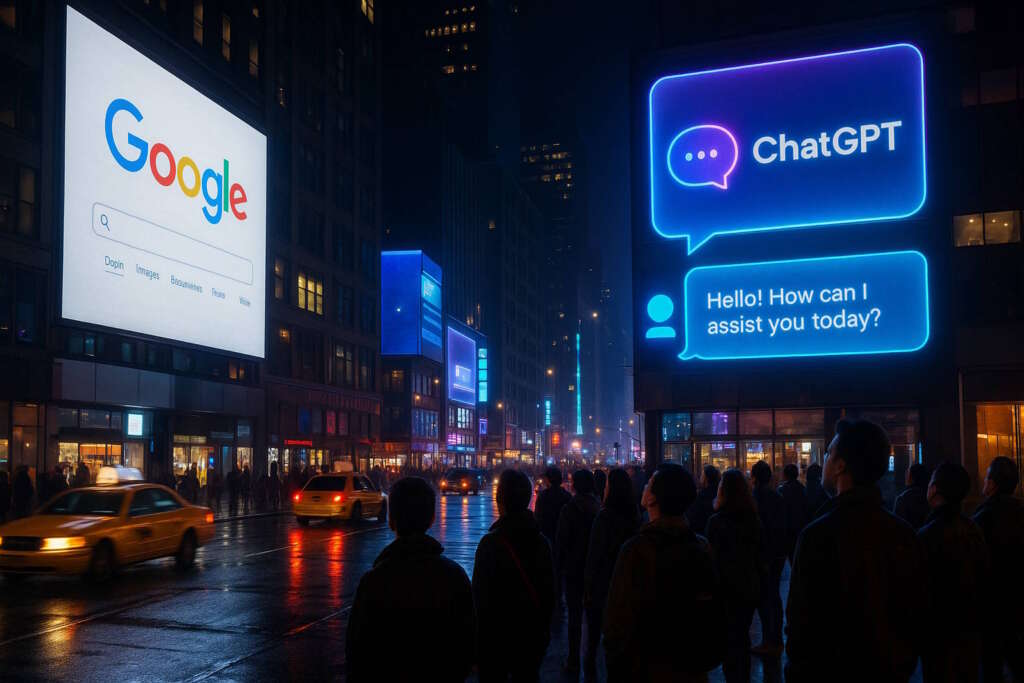
What It Means: People are quietly shifting from Google to AI answers because conversational tools deliver faster, more tailored results with less friction. The trade-off: reduced transparency, breadth, and at-a-glance trust signals, which means users must verify sources and ask sharper, layered questions. For businesses, visibility now depends less on classic SEO and more on Answer/Generative Engine Optimization (AEO/GEO) so content can be found, interpreted, and surfaced inside AI responses. In short, search is becoming “ask → answer,” and success requires new habits for users and new publishing strategies for brands.
Why Did I Stop Googling and Start Using AI Instead?
Over the past month, I’ve been writing a lot about Answer Engine Optimization. In the process, I began noticing something about my own habits. More and more, I was opening ChatGPT instead of Google. It wasn’t deliberate. But yesterday it struck me: I hadn’t used Google in weeks. At some point, without even thinking about it, I had stopped Googling.
That realization gave me pause. For nearly twenty years, “Googling” has been the default way to find anything online. The word itself became shorthand for searching, much like “Kleenex” stands in for tissues. If we wanted to settle an argument, check a fact, or track down background information, the instinct was automatic: just Google it. Now that reflex is shifting, and that shift raises bigger questions: what happens when we stop Googling, and what does it mean for the way we search, learn, and trust information?
What Makes Google Searches So Frustrating Today?
We’ve all lived in Google’s world for the past twenty-five years, and most of us have had the same experience: ads crowding the top of the page, SEO-driven fluff filling the results, and endless clicking to find what we actually need. Whether it’s tracking down a cheesecake recipe you vaguely remember or trying to locate a replacement hanger for a sliding door, the process is always the same. You start by tweaking your search terms—hoping to land in the right ballpark—before sifting through page after page of results. Sometimes you eventually find what you’re looking for; other times you just give up. Either way, it’s slow and often frustrating.
AI tools felt different the first time I tried them. With the latest generation of AI search engines, the interaction isn’t a hunt—it’s a conversation. You ask a question, and the AI gives you an answer. If it’s not quite what you need, you can clarify or go deeper with a follow-up. There’s less friction, and the answer feels tailored to the question you’re actually asking. Want a cheesecake recipe with the specific ingredients you already have in your kitchen? The chatbot will generate it for you. Need an alternative part number when the original is discontinued? It will point you toward options without forcing you to dig through a dozen forums. Each time, you’re working with an answer instead of chasing one down.
That’s how my habits changed. It wasn’t a conscious decision to abandon Google; it happened little by little. I realized that every time I reached for an AI tool, I got something useful right away and spent less time scrolling. The combination of immediacy, relevance, and the ability to shape the answer in real time gradually pulled me away from Google. In the end, the shift was simple: I stayed where the answers were.
And staying there brought some unexpected benefits. Beyond saving time, I found that the way I engage with information has changed—and in some ways, improved.
What Do AI Search Engines Offer That Google Doesn’t?
One of the biggest gains has been focus. With Google, it was easy to drift—clicking headlines designed more to grab attention than to provide real substance. What started as a simple search often ended in a rabbit hole. With AI, that noise is stripped away. I get a direct answer to the question I asked, and I decide when to branch out.
The other gain is depth of engagement. Instead of juggling ten separate links, I receive a single, contextual response that connects ideas together. When I want to go further, I can guide the conversation in that direction. Searching no longer feels like wandering through clutter; it feels like moving with intention. But the gains came with trade-offs, and I soon began to notice what was missing.
What Do You Miss When You Stop Using Google?
Walking away from Google hasn’t been all gain. I notice the gaps most in three areas: transparency, breadth, and trust.
The first is transparency. With Google, it’s always clear where information comes from—whether it’s a respected news outlet, a small blog, or a community forum. AI tools, by contrast, often skip that layer. Unless I specifically ask for sources, I just get an answer. And when I do ask, the response usually takes longer and comes back more elaborate. It works, but it adds friction.
The second is breadth. Google’s endless scroll of results, frustrating as it could be, gave me variety. Skimming through different sites often revealed perspectives I hadn’t considered or led me down a useful tangent. AI, by design, cuts through that noise and delivers one clean answer. If I want alternatives or multiple viewpoints, I have to request them directly—and that means waiting longer for a more detailed response.
The third is trust. Google allowed me to size up credibility at a glance: a .gov site carried a different weight than a random domain I’d never seen before. With AI, that judgment is harder. I can prompt it to use only authoritative or named sources, but that requires extra effort. By default, I’m given an answer without the signals that used to help me decide whether to believe it.
These trade-offs don’t outweigh the benefits, but they’re real. They remind me that while AI tools make finding information easier, they also require me to be more intentional about how I verify and use what I’m given. Those trade-offs, small as they seemed in my daily routine, pointed to a bigger shift happening all around us.
How Is AI Changing the Way We Search and Share Information?
My personal shift away from Google reflects a broader cultural change. For two decades, “Googling” was synonymous with searching online. It became a verb embedded in everyday language, much like “to Xerox” or “to Kleenex.” But language follows behavior, and as more people turn to AI tools instead, the dominance of “Googling” is beginning to fade.
The business impact is even more immediate. Millions of websites have built strategies around search traffic, and entire industries grew out of the drive to rank higher on Google. With AI tools delivering answers directly, those clicks are disappearing. Publishers, bloggers, and businesses are starting to ask the same hard question: if fewer people are coming through Google, how do we reach them? This is where Answer Engine Optimization (AEO) and Generative Engine Optimization (GEO) come into play, because the rules of visibility are shifting.
And beyond business lies the information ecosystem itself. AI condenses knowledge into streamlined answers rather than offering pages to explore. That efficiency changes how we discover and share information. Serendipity—the chance of stumbling on something unexpected—becomes rarer. And trust, which I discussed earlier, takes on new complexity because the source of knowledge is hidden inside the synthesis. The way information flows online is being reshaped, and those ripples extend far beyond my own habits.
Which brings us to the practical side: living in a post-Googling world means developing new skills and habits to keep pace with these changes.
What Skills and Habits Do We Need in a World Beyond Google?
If “Googling” once defined how we searched, then living in a post-Googling world will mean building a new set of skills. The first is learning how to ask sharper questions. Conversational AI is powerful, but the quality of the answer depends on the quality of the prompt. A vague query gives you a broad reply; a layered question draws out depth. The ability to refine and follow up has become just as important as knowing the right keywords once was.
Alongside those skills comes a new set of habits. As convenient as AI is, not every answer should be taken at face value. Double-checking facts, especially for important decisions, is essential. Sometimes that means prompting the AI for sources. Other times it means going back to traditional search, looking for the raw material that sits behind the synthesis. Knowing when to trust an AI answer and when to dig deeper has become part of digital literacy.
For businesses, the shift is even more significant. Entire marketing strategies were built on search engine visibility, and for years, success meant ranking high on Google. But as user behavior changes, so do the rules of visibility. Now, as AI tools begin to replace search for many users, the focus is shifting toward Answer Engine Optimization (AEO) and even Generative Engine Optimization (GEO). These approaches are about ensuring that AI systems can find, interpret, and surface your content when someone asks a question. In many ways, it’s SEO rewritten for a new era. For organizations, adapting to this change isn’t optional—it’s the only way to stay visible in a world where fewer people are Googling at all.
Is It Time to Rethink How We Search for Answers Online?
For me, the realization that I had stopped Googling felt small at first, almost like noticing a new shortcut on a familiar commute. But that habit breaking carried a deeper meaning. It showed me that the way I—and many others—find information is shifting under our feet. Where we once relied on links, we now rely on answers. Where we once judged credibility by domain names, we now have to learn new ways of deciding what to trust.
This isn’t just about convenience. It’s about how we learn, how we share knowledge, and how businesses stay visible in a changing landscape. The cultural reflex to “Google it” won’t disappear overnight, but it is fading. And as it fades, the real question isn’t whether you’ll stop Googling too—it’s how ready you’ll be for what comes next.
If you’d like to take a deeper dive into how AEO and GEO are reshaping this new search world, join Tech Scope Connect today!