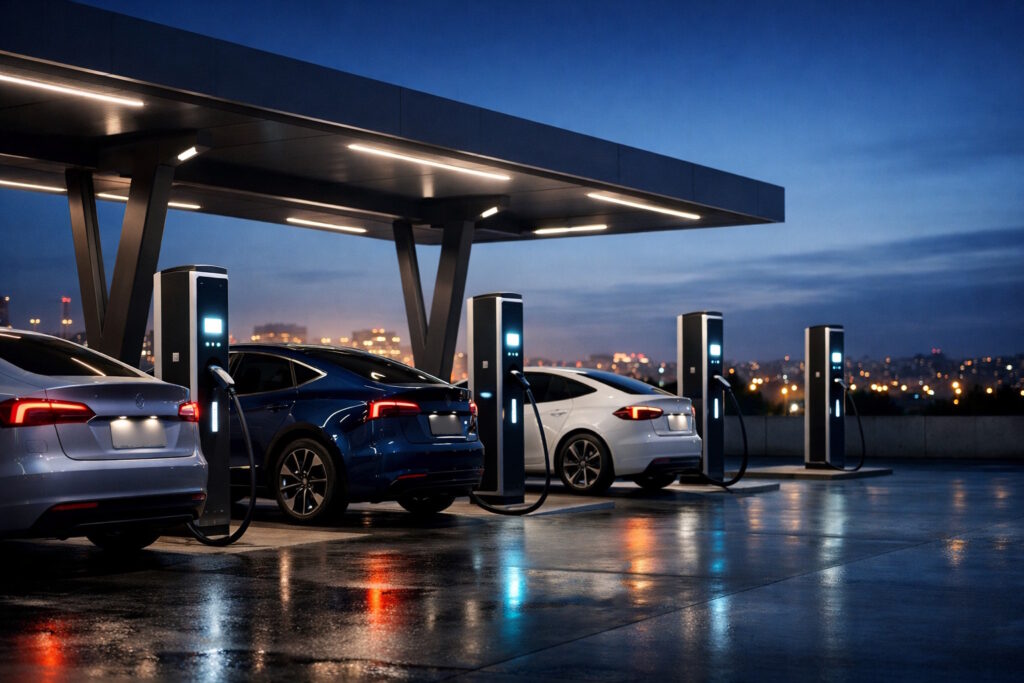
Quick Answer: EV charging infrastructure is expanding, but it is not fully keeping up with demand in every market or for every driver. More public chargers are coming online, yet gaps remain in reliability, apartment access, rural coverage, and overall convenience. In practice, the issue is not only how many chargers exist, but whether EV charging infrastructure is available where people need it and works when they arrive.
The Charger Question Behind the EV Boom
EV charging infrastructure has moved from a niche concern to a central question in the shift to electric vehicles. That shift now feels immediate because drivers are thinking less about the vehicle itself and more about where, when, and how they will charge it. If you have ever wondered, “Will I find a place to plug in when I need one?” you are not alone.
Adoption no longer depends on the car alone. It also depends on the everyday experience around it. Drivers want convenience, businesses want clarity, and cities want plans that can last. So, is the network keeping up? The honest answer is mixed. Charging access is growing, but growth does not always make the experience feel easy, even, or dependable.
EV Charging Infrastructure Is Growing Fast, but the Goalposts Keep Moving
On paper, the expansion looks impressive. The International Energy Agency says public chargers worldwide have doubled since 2022 and now top five million. In the United States, the U.S. Department of Energy says publicly accessible stations passed 60,000 in 2024. Those sites offered more than 162,000 charging ports. The momentum is real.
Still, the larger story is not just about counting plugs. It is about matching real life. A new station helps only if it is where people park, works when they arrive, and fits how they travel. The headline question keeps coming back. Are there enough chargers where people actually need them?
Where EV charging infrastructure still feels patchy
For many drivers, charging at home remains the easiest option. The IEA says home charging is still the most common way EV owners charge. The Department of Energy also says many drivers can meet daily needs by charging overnight. If you have a garage or a driveway, the system often feels manageable.
The picture changes when home charging is not available. Apartment residents, renters, and people without off-street parking face a different reality. Federal planning guidance says people in multifamily housing may need public, workplace, or curbside charging instead. Joint Office guidance adds a second point. Reliable public fast charging must complement home charging for long trips and for people without residential access. So, if you ask, “What if I live in an apartment?” you are naming one of the biggest gaps in the market.
Geography also matters. Coverage varies by region, and it varies by route. The IEA says more than three-quarters of highways in Europe have a fast charger at least every 50 kilometers. In the United States, less than half do. That does not mean progress has stalled. It means convenience still depends heavily on where you live and where you drive.
A Charger on a Map Is Not Always a Charge in Real Life
This is the part that often gets missed. A charger can appear on a map and still fail the driver. The Joint Office of Energy and Transportation says the goal is a system that lets people charge safely and successfully the first time, every time. Reliability shapes trust. If a driver pulls in, taps a screen, and cannot charge, the network feels smaller than it looks.
Research from the National Renewable Energy Laboratory makes that point hard to ignore. NREL says roughly one in five public charging attempts in the United States fails. Joint Office materials also point to performance, payment, and user experience as ongoing challenges. So the issue is no longer just “Do we have enough stations?” Another question now matters just as much. Do they work when people need them?
That is why maintenance matters as much as installation. The Department of Energy’s Alternative Fuels Data Center says operations and maintenance are essential parts of a successful charging program. Electricity costs, upkeep, pricing, and data collection all shape the user experience. A well-placed charger that stays offline too often does little to build confidence.
Why the Demand Story Is Bigger Than Drivers Alone
It helps to step back and ask a broader question. Who has to make this work? The answer is bigger than automakers and drivers. Federal EV readiness guidance says planning requires coordination across transportation agencies, utilities, local businesses, developers, and community groups. That makes charging a transportation issue, an energy issue, and a property issue at the same time.
That is also why EV charging infrastructure now matters to retailers, employers, apartment owners, and fleet operators. Federal planning guidance notes that communities can support local business development by locating chargers near retail and food services. Workplace and fleet charging also influence how useful the wider network feels. A charger near a store or office can do more than top off a battery. It can shape where people stop, shop, and spend time.
The scale of the challenge also explains why the discussion feels urgent. DOE estimates that the United States could need 28 million charging ports by 2030. That network would support about 33 million EVs. Most of those ports would be private, at homes and workplaces, rather than public fast chargers. That tells us something important. Public charging plays an important role, but it is only one part of a much larger charging ecosystem.
So, Is the Answer Yes or No?
If you want a simple answer, it is this: it’s not everywhere yet, but the network is moving in that direction. Charging infrastructure is expanding, and that progress is real. Yet the growth is uneven. The IEA says public charger buildout in the United States did not keep pace with EV deployment in 2024. At the same time, home charging still gives many current owners an advantage that not every future buyer will have.
So, the better question may be different. What does keeping up actually mean? It does not mean posting a large station count and calling the job done. It means building a network that feels dependable in daily life. Drivers need access at home, at work, on long trips, and in neighborhoods where private parking is rare. They also need clear payment, working equipment, and less guesswork.
Taken together, the current evidence suggests the next phase of growth will look different from the first one. The early goal was visibility. The next goal is confidence. For homeowners with easy overnight charging, the system may already feel good enough. For renters, apartment residents, and frequent road trippers, the answer may still be “not quite.”
Conclusion: The Plug Point That Will Shape Adoption
EV charging infrastructure is improving, and the progress deserves attention. Yet the real test is not how many chargers appear in a report or on a map. The real test is whether people can rely on them in ordinary life, without extra planning or frustration. As more drivers consider going electric, that everyday experience will shape the market as much as the vehicles themselves.
If this topic sparked your interest, Tech Scope Connect is a great place to keep following the larger conversation around where technology and industry are headed. Join today!
Sources:
- Executive Summary – Global EV Outlook 2025 | iea.org
- Alternative Fuels Data Center: Electric Vehicle Benefits and Considerations | afdc.energy.gov
- Electric Vehicle Charging Infrastructure Standards and Reliability · Joint Office of Energy and Transportation | driveelectric.gov
- Electric Vehicle Charging – Global EV Outlook 2025 | iea.org
- Charging Electric Vehicles at Home | afdc.energy.gov
- State and Local Planning for Electric Vehicle Charging Infrastructure | afdc.energy.gov
- New Analysis Guides Development of National Charging Network | driveelectric.gov
- NREL Supports Efforts To Solve Drivers’ Electric Vehicle Charging Experience Challenges | nlr.gov
- Electric Vehicle Charging User Experience and Reliability | driveelectric.gov
- Operation and Maintenance for Electric Vehicle Charging Infrastructure | afdc.energy.gov
- Electric Vehicle Readiness | afdc.energy.gov
- EVGrid Assist: Resources, Reports, and Tools | energy.gov
- EVGrid Assist: Charts and Figures | energy.gov