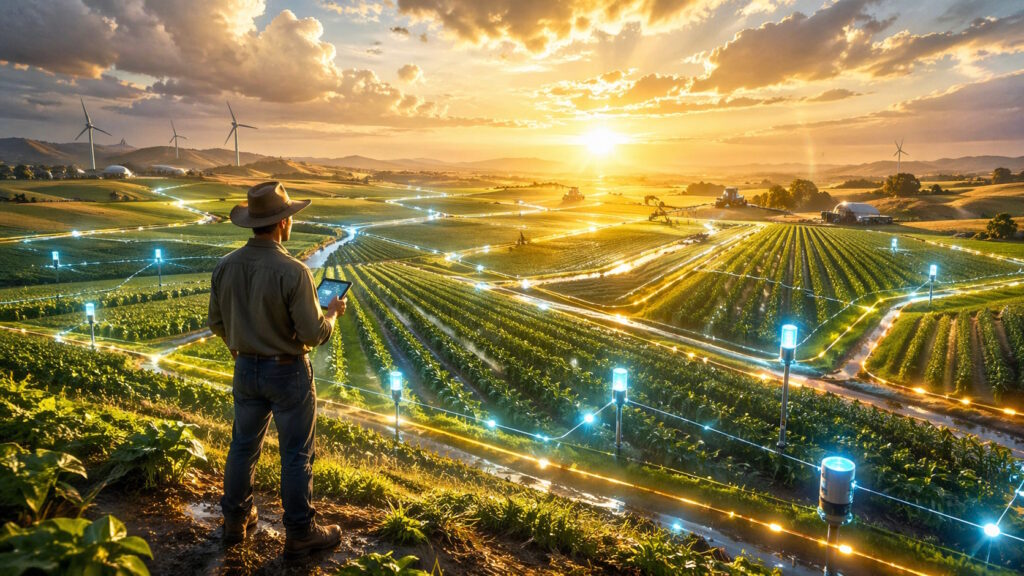
Key Takeaway: Smart farming uses IoT sensors, drones, satellite data, connected equipment, and AI-powered tools to help farms make better decisions with real-time information. Instead of relying only on fixed schedules or manual checks, farmers can monitor soil moisture, crop health, livestock behavior, weather conditions, and equipment performance more closely. This makes agriculture more efficient, less wasteful, and better prepared for climate challenges like drought, heat, flooding, and unpredictable growing seasons.
The Farm Is Starting to Listen
Smart farming is changing how agriculture uses data, sensors, and connected tools to prepare for a tougher climate. In simple terms, it brings connected tools and more precise decision-making into everyday farm decisions. The idea is easy to picture. Soil can report when it is too dry. A drone can spot crop stress before a person sees it from the ground. A livestock tag can flag unusual movement. A pump can send an alert before irrigation fails during a heatwave.
This is not about turning farms into science-fiction labs. It is about giving farmers a clearer view of what is happening across land, water, crops, animals, and equipment. Farming has always required judgment. Now that judgment can be supported by real-time signals, not only memory, field walks, and fixed schedules.
If you are asking, “What is the role of IoT in agriculture?” the answer starts here. IoT helps farms sense conditions and respond faster.
What Smart Farming Looks Like on the Ground
On a traditional farm, decisions often depend on experience, observation, and routine. Those skills still matter. The difference now is that connected tools can add another layer of awareness.
A soil sensor can measure moisture below the surface. A weather station can track wind, heat, rainfall, and humidity. A satellite image can show weak growth across a field. A drone can capture details that are hard to see at ground level. Connected collars can help monitor livestock health and movement.
Together, these tools create a more complete picture of the farm. They do not replace the farmer’s eye. They help that eye look farther, earlier, and more often.
Think of it like a dashboard for the physical world. Instead of wondering whether a field needs water, a farmer can check live soil conditions. Instead of discovering equipment trouble after a breakdown, a pump or tractor can flag warning signs earlier.
The Data Layer Beneath the Dirt
The heart of connected agriculture is simple: farms create signals all the time. Soil changes. Crops react. Animals move. Machines heat up. Weather shifts. Water levels rise and fall.
IoT devices capture some of those signals and turn them into usable information. A farmer may see that one part of a field dries faster than another. Another area may hold too much water after heavy rain. A crop may show signs of stress long before it looks damaged to the human eye.
This is where precision agriculture becomes useful. Instead of treating a whole field as one big average, farmers can manage smaller zones. One section may need more water. Another may need less fertilizer. A third may need closer pest monitoring.
For anyone wondering, “How does IoT help farmers make decisions?” the short answer is visibility. It shows patterns that may stay hidden until the damage grows.
Water, Weather, and the Climate Pressure Point
Water sits at the center of many farm challenges. Too little water can reduce yield. Too much water can damage roots, waste nutrients, and increase disease risk. Unpredictable rainfall makes the job harder.
Smart irrigation systems can help farmers make better choices. These systems can connect soil sensors, weather data, pumps, and valves. The goal is not just to water automatically. The goal is to water with better timing and better context.
A fixed schedule may water a field even after rain. A connected system can notice that the soil already has enough moisture. It may also show when a dry zone needs attention before crops suffer.
As climate patterns become less predictable, farms need more local information. Regional forecasts help, but field-level data gives a closer view. That local view can support stronger decisions during drought, heat, storms, and changing growing seasons.
From Guesswork to Earlier Warnings
A climate-ready farm does not avoid every risk. No tool can control the weather. The value comes from noticing stress sooner.
Drones and satellite imagery can reveal crop health patterns across large areas. Cameras and sensors can support pest and disease monitoring. Livestock trackers can show changes in movement, feeding, or behavior. Equipment sensors can flag performance issues before they interrupt work.
These early warnings give farmers more room to act. A small irrigation problem can get fixed before a field dries out. A disease risk can be checked before it spreads. A weak section of a field can get attention before harvest losses grow.
This also helps with labor. Farmers and workers cannot inspect every acre every hour. Connected systems can point them toward the places that need attention first.
Smart farming technologies farmers are watching
Several technologies are shaping the future of connected agriculture. Soil sensors are among the most practical starting points. They help track moisture, temperature, and sometimes nutrient-related conditions.
Drones bring a bird’s-eye view of fields, especially for crop scouting. Satellite imagery adds wide-area monitoring and long-term field history. Weather stations help farmers understand local conditions, not just regional forecasts.
Livestock wearables support animal health and location tracking. Connected machinery can improve field mapping, fuel use, and maintenance planning. Farm management platforms bring these signals into one place, so the data feels less scattered.
AI may also play a growing role. At a basic level, AI can help spot patterns in crop images, irrigation data, or animal behavior. Farmers still make the call, but software can help organize the clues.
Why This Shift Feels Different
Agriculture has always used tools. The difference now is that many tools can communicate. A sensor does not just sit in the field. It sends information. A machine does not only perform work. It can report how it is performing.
That connected feedback loop changes the feel of farm management. The farm becomes less silent. It starts to show its condition through data.
This can support sustainable agriculture in practical ways. Less overwatering means less wasted water. More precise fertilizer use can reduce runoff. Better pest monitoring can reduce unnecessary treatments. Earlier equipment alerts can prevent fuel waste and downtime.
The point is not perfection. The point is better timing, clearer information, and fewer blind spots.
The Human Side of Connected Agriculture
It is easy to talk about sensors and forget the farmer. That would miss the bigger story. Technology works best when it supports real people making difficult decisions.
A dashboard cannot understand every local detail. It may not know a field’s history, market pressure, or a farmer’s hard-earned instinct. Data becomes useful when it fits into those daily decisions.
This is especially important for smaller farms. If tools cost too much, require constant maintenance, or need strong internet access, adoption becomes harder. Smart tools must become simpler, cheaper, and easier to trust.
The best version of digital farming feels less like another burden. It feels like a helpful assistant that watches, remembers, and alerts at the right moment.
Benefits Without the Hype
The benefits of connected agriculture can sound big, but they are usually grounded in simple improvements.
Farmers may use water more carefully. They may reduce waste from fertilizer, pesticides, feed, or fuel. They may spot disease or crop stress earlier. They may improve animal care through better monitoring. They may spend less time searching for problems and more time solving them.
For consumers, this shift can support more resilient food systems. For agribusinesses, it can improve planning and operational visibility. For sustainability teams, it can create clearer data about resource use.
Still, technology alone will not make agriculture climate-ready. It needs good farming practices, reliable infrastructure, training, financing, and trust. Sensors can show a problem, but people still need the tools to respond.
What Still Needs to Improve
Several barriers remain. Many rural areas still struggle with weak connectivity. Some farms cannot rely on steady cellular coverage or broadband. Without a reliable connection, sensor data may arrive late or not at all.
Cost also shapes adoption. Sensors, drones, software, and automated systems can require upfront investment. Farmers need a clear reason to believe the tools will pay off.
Data ownership raises another question. Farm data can reveal valuable information about yields, soil, inputs, and business operations. Farmers should understand who controls that data and how platforms use it.
Maintenance also matters. Sensors can drift, break, lose power, or give poor readings. A connected farm still needs human care, technical support, and practical design.
Conclusion: Climate-Ready Farms Need Better Signals
The future of agriculture will not rely on technology alone. Weather will remain unpredictable. Soil will stay complex. Farmers will still need experience, judgment, and patience.
But connected tools can help farms become more aware and responsive. IoT can show when soil is dry, when crops are stressed, when animals behave differently, and when machines need attention. That visibility can support stronger decisions in a changing climate.
Smart farming gives agriculture a clearer signal in a noisier world. If you’re curious about how connected technologies are reshaping industries like agriculture, energy, and sustainability, join the conversation at Tech Scope Connect for more insights, live discussions, and expert perspectives on the future of technology.