Key Takeaway: Sustainable AI can strengthen climate adaptation when early warning systems do more than improve forecasts. The real value comes from helping communities understand local risk, receive clear and timely alerts, and take action before floods, heat waves, or storms cause harm. In other words, better prediction matters, but trust, access, communication, and usability matter just as much.
Sustainable AI is becoming a practical part of climate adaptation. At its core, sustainable AI means using artificial intelligence in ways that genuinely help people respond to climate risks. In this context, that means tools that support clearer decisions, fairer access to information, and more practical action as conditions begin to change.
That matters right now because early warning systems can save lives and reduce losses. The World Meteorological Organization says a warning issued within 24 hours can cut disaster damage by 30%. It also says about 30% of the global population still lacks early warning coverage. In late 2025, WMO reported that 119 countries had multi-hazard early warning systems, but important gaps remained.
So why connect this to AI at all? Because climate threats are getting harder to read. A flood, heat wave, or wildfire does not hit every place in the same way. If you have ever wondered why one alert feels useful and another feels vague, you are already close to the issue. Communities need more than a weather headline. They need a warning that explains what could happen, where it could happen, and what to do next.
What Sustainable AI Looks Like in a Warning System
When many people hear about AI and climate, they think about energy use in data centers. That issue matters. Yet UNESCO now frames the topic in two directions. One is making AI itself more efficient. The other is using AI well for climate action, adaptation, and environmental decision-making. That wider view makes early warning systems a natural example of sustainable AI.
In plain language, AI can help turn scattered signals into clearer warnings. It can spot patterns in weather data, map likely trouble spots, and help teams send alerts sooner. It does not replace meteorologists or emergency planners. It helps them make faster, more tailored decisions when the weather turns dangerous.
People do not experience climate risk as a chart. They feel it in ordinary places. It shows up as a flooded street, a closed road, a school without power, or a dangerous heat spike at home. A useful warning has to connect the forecast to real life.
Better Forecasts Are Helpful, but They Are Not the Whole Story
It is easy to assume the answer is better forecasting models. Better forecasts do matter. Still, an early warning system is bigger than prediction alone. WMO describes four parts that matter equally: risk knowledge, monitoring and forecasting, warning communication, and preparedness and response. If one part breaks, the system weakens.
That idea changes the conversation. A highly accurate forecast can still fail in practice. The alert may arrive too late. The message may be too technical. People may not trust the source. Or the warning may never reach the neighborhood that faces the greatest danger.
So what are people really asking now? “Can AI predict the weather better?” is only part of it. A better question is, “Can AI help communities act before trouble hits?” That is where climate adaptation becomes personal.
Why sustainable AI has to reach the last mile
The last mile is where many warning systems succeed or fail. You can have strong data, smart models, and expert teams. None of that helps much if the alert is unclear or hard to access. A warning must reach people in time, in language they understand, and in a format they can use.
That people-first approach runs through the latest research. A 2025 Nature Communications perspective says AI-based early warning systems should combine weather and geospatial models. The aim is impact prediction, not just hazard prediction. The authors also stress intuitive interfaces, community feedback, causal AI, and FATES principles: fairness, accountability, transparency, ethics, and sustainability.
That may sound academic, but the message is practical. Good systems should not act like black boxes. They should help communities trust what they see and know how to respond. In low-resource settings, that also means energy-efficient tools and designs that people can actually use. UNESCO has stressed that point in its recent work on sustainable AI and climate action.
From “Bad Weather Ahead” to “What Happens Here?”
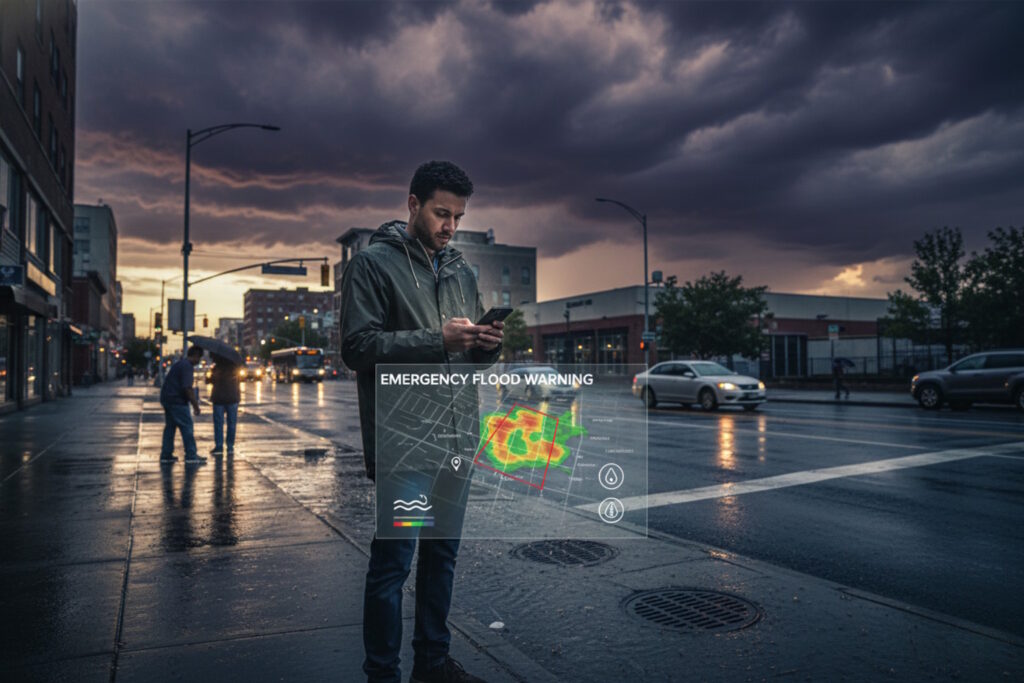
Traditional warnings often focus on the hazard itself. They tell you heavy rain is coming or temperatures will climb. Newer AI work aims to go one step further. It tries to show what those conditions may mean in a specific place. If you have ever thought, “What does this mean for my street?” that is the gap these newer systems try to close.
Think about a storm moving toward a city. Rain totals matter, of course. But they are not the whole picture. Drainage, land cover, elevation, housing, and road networks also shape what happens next. The Nature perspective argues that integrated AI can pull more of those pieces together. That can help systems move from a broad forecast to a clearer local warning. One area may flood first, while another may face heat stress or road closures.
That shift is the heart of the story. It makes climate adaptation feel less abstract. The goal is not flashy automation. The goal is better protection for people, homes, and local services.
A Simple Example You Can Picture
A recent Google example shows why this topic is gaining attention. In March 2026, Google introduced Groundsource. It used Gemini to analyze public reports and identify more than 2.6 million historical flood events across 150 countries. Google says the dataset helped train a model for urban flash flood risk. It says the forecasts can look 24 hours ahead and now appear in Flood Hub.
Flash floods are hard to predict, especially in cities. Historical data has often been patchy. If AI can help fill those gaps, warnings can become more useful for places that have lacked strong local records.
The Real Test Is Action, Trust, and Fairness
This story should not end with a shiny tech demo. Early warning systems work only when people receive the warning, trust it, and know what to do next. WMO says all four elements of an early warning system matter. Its 2025 global status report says progress must include co-development with local communities.
That is an important reminder for anyone exploring sustainable AI. Better models can help, but they are not the finish line. The real win is a system that supports earlier action, clearer choices, and wider access. If the warning is too complex, too costly, or too detached from local reality, the technology misses the point.
Conclusion
Sustainable AI makes sense in climate adaptation because it connects intelligence with action. In early warning systems, that means moving beyond raw forecast accuracy. It means helping people understand risk sooner and respond with more confidence. When the system works, AI becomes less about novelty and more about resilience.
If topics like sustainable AI matters to you, Tech Scope Connect is a good place to keep the conversation going. We explore how emerging technologies shape real-world decisions through expert insights, live discussions, and thoughtful coverage of what comes next. Join today!
Join Green Things Summit 2026 as we take a deeper dive into how AI, IoT, automation, and edge computing help drive efficiency, reduce waste, and advance sustainability goals through thought-leadership panels, industry keynotes, and interactive Q&A sessions. Register here.
Sources:
- Early Warning System | wmo.int
- Global Status of Multi-Hazard Early Warning Systems 2025 | wmo.int
- UNESCO Puts Sustainable AI in the Spotlight at Adopt AI Summit In | unesco.org
- Green AI Takes Centre Stage at MWC Barcelona | unesco.org
- Early Warning of Complex Climate Risk With Integrated Artificial Intelligence | nature.com
- Boosting Disaster Resilience With Google’s Groundsource | blog.google