
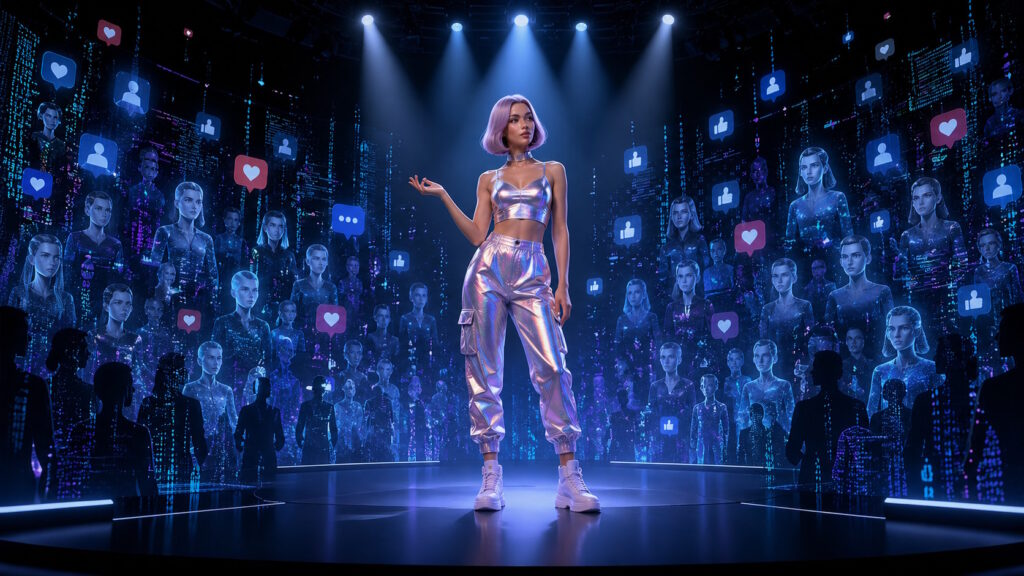
Key takeaway: AI influencers are the most visible sign of a larger shift from generated content to generated presence. “AI slop” describes low-effort, disposable material that clutters digital feeds. Synthetic talent is different. It creates recurring digital personalities with faces, voices, roles, histories, and audiences. That opens useful possibilities for marketing, education, customer communication, and media production. It also raises harder questions about disclosure, trust, authority, and whether audiences know who—or what—they are following.
When the Feed Starts to Feel Less Human
Online content is changing again, but not always in ways that are obvious at first glance.
For several years, generative AI has shown up in the form of odd images, generic voiceovers, shallow explainers, and recycled posts. Much of this material is now dismissed as “AI slop”: cheap, fast, forgettable content produced at scale. The term has become common enough that YouTube’s 2026 CEO letter refers to “AI slop” while discussing low-quality, repetitive AI content and the platform’s efforts to reduce it.
AI slop is irritating, but it is rarely persuasive. It comes and goes. It fills a feed, consumes a few seconds of attention, and is quickly replaced by the next disposable clip.
AI influencers and other forms of synthetic talent are more consequential because they do not merely generate content. They generate presence. They appear with a name, a face, a voice, a wardrobe, a posting rhythm, and a point of view. They may develop a following, respond to comments, appear in campaigns, narrate videos, or become the familiar “host” of a channel.
That is the difference worth watching. A bad AI post is clutter. A synthetic personality is an interface.
From AI Slop to Synthetic Talent
AI slop usually announces itself through sameness. The script sounds flat. The visuals are mismatched. The voiceover feels detached from the subject. The piece seems assembled rather than authored. Viewers may notice it, reject it, or simply scroll past.
Synthetic talent works differently. It depends on continuity. The value is not only in a single image, video, or caption. The value is in the recurring character. A synthetic fashion model can appear across seasonal campaigns. A digital travel host can narrate destinations. A virtual product expert can explain complex technology. A synthetic news-style presenter can deliver short-form updates. A brand mascot can evolve from a logo into a speaking personality.
This is not entirely new. Brands have used fictional characters, mascots, animated figures, and spokescharacters for generations. What is new is the realism, speed, personalization, and portability of the format. Synthetic talent can move through the same digital spaces as human creators. It can appear in a TikTok video, a YouTube Short, a webinar teaser, a product demo, a training module, or a customer-service workflow.
That makes the trend harder to dismiss as a novelty. The most convincing examples may not look futuristic at all. They may look like ordinary people with unusually smooth delivery, perfect availability, and no visible production constraints.
Why AI Influencers Feel Different
An AI influencer is not just an image of a person. It is a managed identity.
A typical synthetic personality can include a biography, a consistent visual style, a voice, a posting schedule, a content niche, a set of opinions, and a pattern of audience interaction. Some are clearly fictional. Others are presented in ways that make their artificial nature less obvious.
That distinction matters because audiences do not respond only to information. They respond to familiarity. They recognize a face. They remember a tone. They notice consistency. Over time, that continuity can create a sense of relationship, even when the “person” is a production system operated by a brand, agency, creator, or software platform.
For harmless entertainment, the stakes may be modest. A synthetic model showing a jacket is not a social crisis. A virtual host introducing a product feature may be useful. A digital guide explaining an industrial sensor, cybersecurity concept, or connected-device workflow could make technical communication easier to understand.
The concern grows when synthetic talent borrows the signals of lived experience, expertise, or independence. A generated figure can look like a doctor, investor, journalist, teacher, engineer, soldier, parent, or concerned citizen. Even without making an explicit false claim, the visual cues can imply authority. A white coat, trading screen, newsroom desk, factory floor, or classroom background can do a great deal of persuasive work before a viewer has evaluated the substance of the message.
The issue is no longer simply whether a video is fake. The issue is whether the audience understands the identity, source, and purpose behind the communicator.
The Bigger Story: Generated Presence
The phrase “synthetic talent” is useful because it reaches beyond AI influencers.
It includes virtual hosts, digital presenters, synthetic narrators, AI-generated brand representatives, character-based customer-service agents, and fictional experts used in training or marketing. These figures may appear in social media, video platforms, online events, advertisements, learning environments, and enterprise content.
The shift is from generated content to generated presence.
A post can disappear in seconds. A persona can return every day. A single AI-generated image may be forgettable. A recurring synthetic host can become familiar. Familiarity can create comfort, and comfort can turn into trust.
That is why synthetic talent is strategically attractive to brands. It can be consistent, multilingual, scalable, and always available. It can deliver product explainers without scheduling a shoot. It can appear in multiple languages without hiring a new presenter for each market. It can be revised quickly when a product changes. It can maintain a tone that is always aligned with the brand.
For business-to-business communication, this is especially relevant. Companies that sell complex technologies often struggle to explain what they do in simple, repeatable language. A well-designed synthetic presenter could walk prospects through a product architecture, introduce a webinar, summarize a white paper, or answer frequently asked questions.
But the advantage is also the risk. The more human the interface becomes, the more important disclosure becomes.
Disclosure Is Moving from Courtesy to Requirement
The major platforms are already treating synthetic media as a disclosure issue, not merely a creative choice.
YouTube introduced a Creator Studio tool requiring creators to disclose realistic altered or synthetic content when viewers could easily mistake it for a real person, place, scene, or event. YouTube also says more prominent labels may appear for sensitive topics such as health, news, elections, and finance.
TikTok says creators must label realistic AI-generated content and may automatically label content made with AI when it detects signals such as Content Credentials. TikTok also states that some AI-generated content can be prohibited even when labeled, including certain uses involving fake authoritative sources, crisis events, public figures, young people, or private individuals used without permission.
Meta has also moved toward broader AI labeling. The company says it applies “AI info” labels when it detects industry-standard indicators or when people disclose that content was generated with AI, while also acknowledging that labels must provide enough context to match user expectations.
There is a technical layer to this as well. The Coalition for Content Provenance and Authenticity, known as C2PA, provides an open technical standard for establishing the origin and edit history of digital content through Content Credentials. These systems will not solve every trust problem. Metadata can be missing, stripped, ignored, or misunderstood. But provenance is becoming part of the trust infrastructure for synthetic media.
Regulation is moving in the same direction. The European Commission describes Article 50 of the EU AI Act as addressing deception and manipulation risks through obligations related to marking, detection, and labeling of AI-generated content, including deepfakes and certain AI-generated publications on matters of public interest. The Commission says those transparency rules are expected to apply in August 2026.
For marketers, the principle is already familiar. In the United States, the FTC’s influencer guidance says endorsements should make material connections to brands obvious, including financial, employment, personal, or family relationships. Synthetic talent adds another layer: audiences may need to know both that a message is sponsored and that the personality delivering it is artificial or controlled.
The New Risk: Synthetic Authority
The biggest risk is not that people will see a bad AI image. The bigger risk is that people will trust a synthetic authority without understanding its origin.
A synthetic persona can be designed to sound calm, informed, and confident. It can use the visual language of expertise. It can appear in a studio, clinic, lab, classroom, trading floor, warehouse, or newsroom. It can repeat claims without hesitation and respond to comments without fatigue. It can also be replicated across many accounts.
One synthetic account may influence a small audience. A network of synthetic accounts can create the appearance of consensus. Viewers may believe they are seeing broad public agreement when they are actually seeing coordinated synthetic output. That is where synthetic talent moves from content production into social engineering.
The same danger appears in product marketing. A synthetic reviewer could praise a product it has never used. A fictional “customer” could describe an experience that never happened. A digital “expert” could imply credentials it does not hold. Even when the underlying product is legitimate, the format can erode trust if the audience later feels misled.
This is why disclosure should not be treated as fine print. A small label buried in a profile is not enough for recurring synthetic talent. Disclosure should appear where the audience encounters the persona: in the profile, in relevant posts, in videos, in captions, in campaign pages, and in paid media.
The standard should be simple: no one should have to become a forensic analyst to understand whether a communicator is human, synthetic, sponsored, fictional, or brand-operated.
The Upside: Useful and Honest Synthetic Talent
The point is not to reject synthetic talent. The point is to use it honestly.
There are many good uses. A digital host can explain a complicated product in clear language. A synthetic instructor can help translate training materials into multiple languages. A virtual guide can help customers navigate support questions. A brand character can create continuity across webinars, events, product demos, and social content. A fictional persona can make education more engaging when its fictional nature is clear.
For technology companies, the possibilities are practical. Many industrial, IoT, cybersecurity, and connectivity products require repeated explanation. Sales teams need consistent messaging. Customers need accessible education. Marketing teams need content that can be updated quickly. A synthetic presenter can help deliver that, especially when paired with expert review and transparent labeling.
The strongest uses will combine creativity with accountability. Synthetic talent should not pretend to have lived experience. It should not claim professional credentials it does not possess. It should not hide the organization or operator behind the account. It should not be used to manufacture fake testimonials, fake grassroots support, or fake expertise.
A useful digital guide can remain useful when the audience knows it is digital.
A Practical Standard for Brands
Businesses exploring synthetic talent should set rules before they launch the persona. The technology is moving faster than audience norms, which means trust has to be designed into the process from the beginning.
A responsible synthetic-talent program should include five basic commitments.
First, disclose the identity. Make clear that the persona is synthetic, fictional, AI-generated, AI-assisted, or brand-operated. Use plain language.
Second, disclose the relationship. If the persona promotes a product, brand, service, partner, or sponsor, say so clearly.
Third, identify the accountable party. Audiences should know which company, publisher, agency, or creator controls the persona.
Fourth, establish human review. Sensitive claims about health, finance, safety, law, politics, security, or technical performance should be reviewed by qualified people before publication.
Fifth, preserve provenance. Keep records of source materials, prompts, scripts, approvals, edits, model outputs, and publication history. Where possible, use content-credentialing systems and platform disclosure tools.
These steps are not obstacles to creativity. They are the conditions that allow synthetic talent to become a durable communication channel rather than a short-term gimmick.
What Viewers Should Ask
Audiences will also need a sharper media habit.
When a digital personality feels polished, tireless, and strangely frictionless, it is worth pausing. Who created this account? Is it a real person, a fictional character, a brand asset, or an automated system? Does the profile say who operates it? Does it disclose sponsorships? Does it claim expertise? Does it provide sources? Does it respond like a person or like a scripted system? Does it appear across many accounts with similar language?
None of these questions requires panic. They require attention.
The future of media literacy will not only be about detecting fake images. It will be about understanding the source, incentive, and identity behind persuasive digital presence.
From Generated Content to Generated Presence
AI slop is noisy, cheap, and disposable. Synthetic talent is persistent, relational, and strategic.
That is why AI influencers are only the visible edge of a much larger shift. We are moving into an environment where brands, media companies, educators, and creators can build digital personalities that return every day, speak fluently, and occupy familiar spaces in the feed.
Some of those personalities will be useful. Some will be entertaining. Some will be manipulative. The difference will often come down to transparency, context, and accountability.
For businesses, synthetic talent opens a new communication channel. It can support marketing, customer education, media production, training, and event programming. It can make complex subjects easier to understand. It can create continuity across formats and languages. But it can also weaken trust if disclosure is treated as optional.
For viewers, the practical takeaway is simple: when a digital personality feels real enough to follow, ask what sits behind it. Who made it? Who benefits from it? What does it want you to believe, buy, share, or repeat? Is it clear about its identity?
AI influencers may be the most visible face of this trend, but synthetic talent is the larger story. The next phase of digital media will not only be shaped by what AI can produce. It will be shaped by who—or what—we allow to speak for us.
To stay close to how AI and technology are reshaping what comes next, join the conversation at Tech Scope Connect through our broadcasts, expert discussions, and live events.
Sources:
- YouTube CEO Neal Mohan’s 2026 Letter: The Future of YouTube |blog.youtube
- How We’re Helping Creators Disclose Altered Or Synthetic Content |blog.youtube
- About AI-Generated Content |support.tiktok.com
- Our Approach to Labeling AI-Generated Content and Manipulated Media |about.fb.com
- Verifying Media Content Sources |c2pa.org
- Code of Practice on Marking and Labelling of AI-Generated Content |digital-strategy.ec.europa.eu
- Disclosures 101 for Social Media Influencers |ftc.gov