Key Takeaway: AR and VR are emerging as powerful tools to support astronaut mental health during long-duration space missions. By offering immersive escapes, personalized environments, and emotional grounding, these technologies help reduce stress, combat isolation, and promote psychological well-being—making them a smart addition to future space travel strategies.
Space is hard on the mind. That’s where AR and VR—augmented reality and virtual reality—come in. These immersive technologies are no longer just about gaming or entertainment. Today, they’re being explored as serious tools to support astronaut mental health on long and lonely missions.
Whether you’re curious about space tech, fascinated by virtual environments, or just wondering how astronauts stay sane in zero gravity, this article will give you a light but eye-opening look at how immersive tools could shape the future of wellness in space.
Why Space Messes With Your Mind
When you imagine an astronaut, you probably picture someone brave, smart, and focused. That’s true—but even the toughest minds can struggle when they’re stuck in a small space station for months, surrounded by machines and stars, far from friends and family.
Astronauts face intense stress, isolation, and sensory monotony. There’s no breeze, no changing scenery, no casual chats at a coffee shop. Just checklists, silence, and floating. It’s mentally exhausting, even for the best of the best.
Over time, this can lead to:
- Sleep issues
- Anxiety or low mood
- Difficulty concentrating
- Sensory disorientation
And on long missions—like those planned to Mars—these effects could intensify. That’s why space agencies are looking at new ways to support astronaut mental health. AR and VR might be part of the answer.
How AR and VR Offer a Mental Escape Hatch
So how exactly can AR and VR help astronauts feel better?
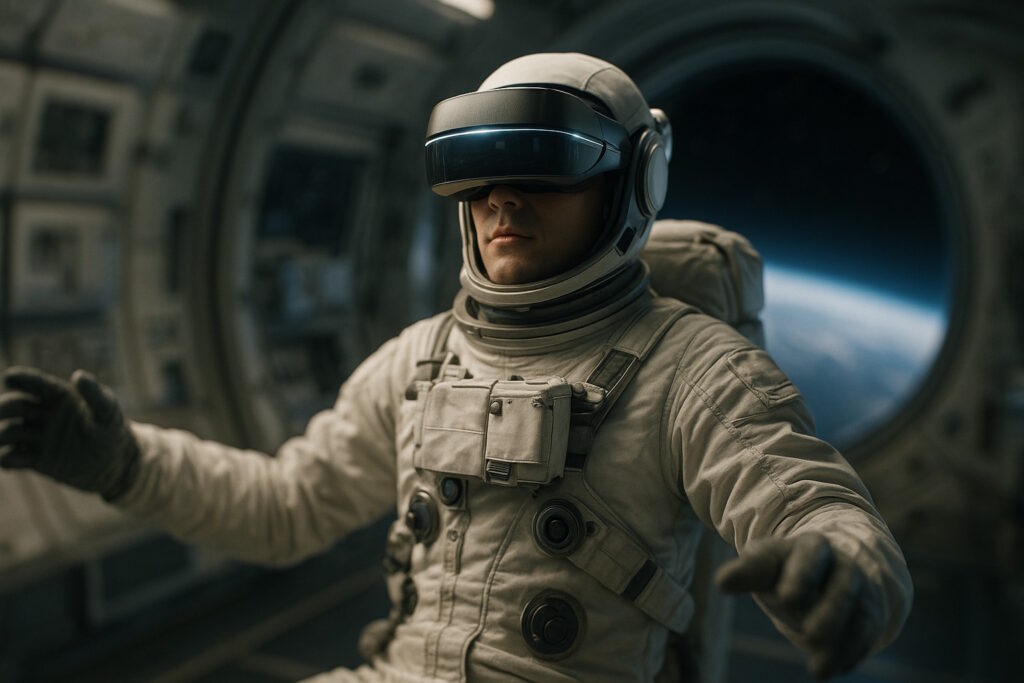
Let’s start with virtual reality. Picture an astronaut floating in microgravity. They put on a VR headset and suddenly find themselves walking through a forest, waves crashing in the distance, birds chirping overhead. For a moment, their senses are tricked—and their brain gets a much-needed break.
Now consider augmented reality. Instead of replacing the world, AR adds to it. A crew member might point their headset at a wall and see a glowing to-do list or floating photo album of loved ones. These small touches can bring comfort and reduce stress.
Researchers are now testing:
- Virtual nature therapy to reduce anxiety and boost mood
- Immersive meditation apps for calm and focus
- AR interfaces to make work tasks more engaging
- Virtual social hangouts that simulate casual contact
These experiences don’t just distract astronauts—they help restore mental balance.
From Earth Simulations to Celestial Solitude
It’s not just theory. NASA and the European Space Agency are already exploring how immersive tech might support space crews.
At NASA’s Johnson Space Center, astronauts use VR for training simulations that double as mental prep. Some programs even recreate Earth environments, like beaches or mountains, to help astronauts “visit” home.
Meanwhile, ESA has tested VR scenarios during confinement studies here on Earth. These studies simulate what it’s like to live in tight quarters for long periods—just like a space mission.
The early results? Promising.
Test participants using VR reported:
- Lower stress levels
- Reduced boredom
- Improved sleep quality
- Better team dynamics
And since these tools are software-based, they’re lightweight and easy to update—ideal for space travel.
What Makes AR and VR a Smart Fit for Space?
There are a few reasons why AR and VR are uniquely suited for supporting astronaut mental health:
1. Portability
You can’t bring a garden or a movie theater to space—but you can bring a headset that creates the illusion of both. Modern VR systems are compact, lightweight, and increasingly wireless, making them ideal for environments where every gram counts. A single headset can provide dozens of experiences without taking up extra storage.
2. Personalization
Astronauts can customize their experiences based on mood, routine, or downtime. From guided meditations to immersive games or familiar Earth scenes, VR environments can be tailored to the preferences of each crew member. Personalized experiences help astronauts feel more grounded and reduce the emotional toll of extended isolation.
3. Low Bandwidth
Most VR content runs locally, so it doesn’t rely on constant internet access—a big plus in space. Since communication delays and limited bandwidth are common on missions beyond Earth orbit, preloaded VR content ensures reliability without disrupting operations. Updates or new content can be scheduled during low-bandwidth usage periods.
4. Adaptability
Immersive tools can be used for both work and relaxation. One moment you’re in a maintenance task, the next you’re floating in a virtual lake. This versatility is critical in space, where multipurpose tools reduce equipment clutter. AR and VR can also be integrated into training, diagnostics, recreation, and even conflict resolution simulations.
5. Emotional Support Through Familiarity
VR environments can recreate familiar locations, like an astronaut’s childhood home or favorite hiking trail. This sense of emotional continuity helps reduce homesickness and provides psychological comfort during moments of stress. It’s not just about distraction—it’s about emotional grounding.
The Bigger Picture: Mental Health in Space Travel
As we look toward longer missions—months, even years—the mental health of astronauts becomes mission-critical. A crew that can’t focus, work together, or stay emotionally well is at risk of failure.
That’s why immersive technologies are being treated as more than novelties. AR and VR may become essential parts of space mission kits, alongside food, water, and oxygen.
Of course, these tools aren’t a silver bullet. But paired with good training, team support, and psychological care, they can make space a little more human.
Conclusion
The idea of using AR and VR to support astronaut mental health might have sounded like science fiction just a few years ago. Today, it’s being tested in labs, studies, and even orbit.
As we push further into the cosmos, we’ll need more than rockets—we’ll need ways to care for the minds inside them. Immersive tools like AR and VR won’t replace traditional support systems, but they can enhance them in meaningful, practical ways.
The space environment is harsh, but the right technology can offer moments of peace, presence, and psychological resilience.
Looking for more insights like this? Tech Scope Connect is where we explore how technology is reshaping human experiences. Join us for fresh takes, expert voices, and real conversations.