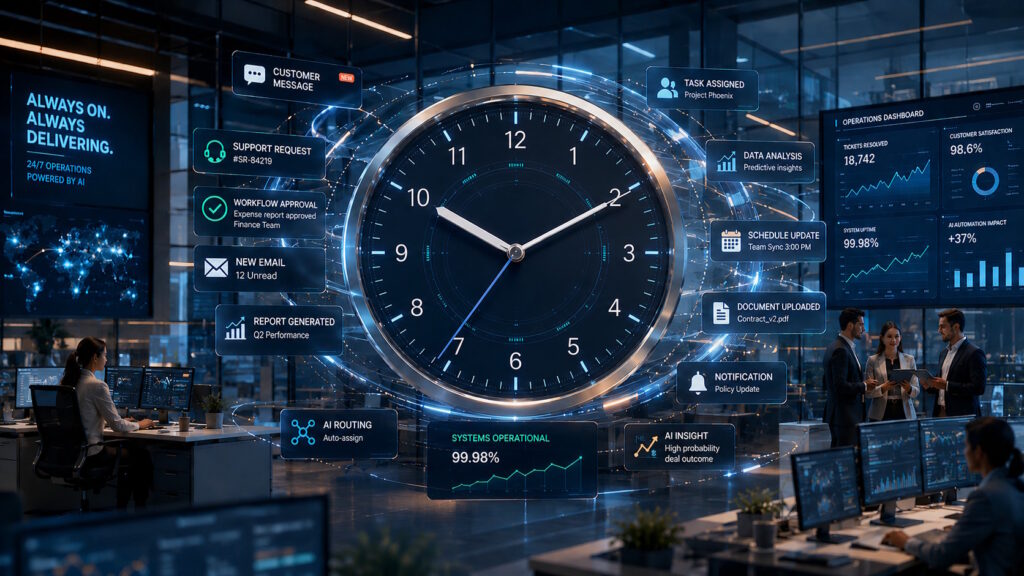
Quick Answer: Yes, AI can help create an “always-on” company by keeping routine processes, customer interactions, monitoring, and workflows moving outside traditional business hours. Rather than replacing employees, AI automation for business often works alongside human teams, handling repetitive tasks and providing continuous operational support while people focus on strategy, decision-making, creativity, and relationship building.
The Business Day Has a New Shape
AI automation for business is starting to change what “open” means. Customer service teams now face rising expectations for faster replies. Operations teams use workflow automation to move tasks forward with fewer delays. Many leaders also explore intelligent automation and AI-driven operations to keep work moving when people step away from their desks.
For many companies, the old business day had a clear rhythm. People arrived, answered emails, joined meetings, handled requests, updated systems, and wrapped up. After hours, some work paused. Customers waited. Reports waited. Internal requests waited. The business kept existing, of course, but many of its processes slowed down.
AI is starting to change that pattern. This does not mean every company becomes fully automated. It also does not mean people disappear from the workflow. A more realistic picture looks different. AI handles routine activity, monitors signals, routes requests, and prepares information. People still make decisions, solve problems, build relationships, and set direction.
That is where the idea of the “always-on” company gets interesting. Can AI help a business stay responsive without asking employees to be available every hour of the day?
What an “Always-On” Company Really Means
An always-on company is not simply a company with a chatbot on its website. It is also not a business that expects employees to answer messages at midnight. At its best, an always-on company can respond, learn, and act across time zones and schedules. It can collect information while a team sleeps. It can flag problems before the morning meeting. It can help customers get basic answers without waiting for office hours.
Think about a customer who submits a question on Saturday night. In the past, that message might sit untouched until Monday. With the right AI system, the customer may receive a helpful first response right away. The system may gather details, suggest resources, and route the issue to the right person.
The human team still enters the picture. They just enter with more context. That shift changes the role of time inside a business. The clock no longer controls every process in the same way.
How AI Automation for Business Extends Capacity
AI automation for business can extend capacity without adding a full overnight team. It can help a company handle more routine work while employees focus on higher-value tasks.
This may include sorting inbound requests, updating records, summarizing customer conversations, drafting reports, or checking data for unusual patterns. None of these tasks sound dramatic. Yet together, they can consume hours of a team’s day.
A sales team might use AI to route leads based on industry, company size, or interest level. A marketing team might use it to organize campaign data and prepare performance summaries. A service team might use it to classify support tickets before assigning them.
The real value often comes from momentum. Work does not stall as often. Small tasks do not pile up as quickly. Employees start the day with cleaner information and fewer loose ends.
For a business leader asking, “Where can AI make a practical difference first?” these everyday workflows offer a clear place to look.
Customer Support Without the Waiting Room
Customer support may be the easiest place to understand the always-on idea. People already expect fast answers. They search, message, chat, and compare options at all hours.
AI can help companies meet that expectation without turning every support team into a 24/7 call center.
A well-designed AI support tool can answer common questions, guide users through simple steps, and collect useful details. It can also recognize when a person needs human help. That handoff matters. Customers do not want endless loops when they have a real issue.
The goal should not be to hide people behind automation. The better goal is to remove unnecessary waiting. AI can handle the first layer of support, while human agents handle judgment, empathy, and exceptions. That balance can improve the experience on both sides. Customers get faster help. Employees spend less time repeating the same answers.
Autonomous Workflows: Small Tasks, Big Momentum
The phrase “autonomous workflows” may sound futuristic, but the basic idea feels familiar. One action triggers another. A form gets submitted. A message gets routed. A reminder appears. A file moves to the next stage. AI can make these workflows more useful. Traditional automation often follows fixed rules. AI can add context, classification, prioritization, and recommendations.
Imagine a new prospect fills out a form after business hours. An AI-powered workflow can review the inquiry, identify the topic, assign the lead, and prepare a short summary. By morning, the sales team has a cleaner starting point.
The same idea can apply across departments. Finance can flag unusual invoices. Operations can track delays. Human resources can organize employee questions. Marketing can prepare campaign insights before the next planning meeting.
These are not flashy examples. That is part of the point. The always-on company may not arrive through one massive transformation. It may arrive through dozens of small improvements that keep work from getting stuck.
Predictive Systems That Notice Trouble Early
Another part of the always-on company involves prediction. AI can monitor patterns and alert teams when something looks unusual.
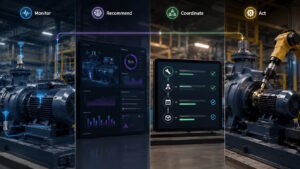
In manufacturing, this could mean spotting signs of equipment trouble. In cybersecurity, it could mean flagging suspicious activity. In logistics, it could mean identifying delays before they affect customers. In sales, it could mean noticing when engagement drops with an important account.
The common thread is awareness. AI can watch signals that humans may not review every hour. This does not make AI perfect. It can miss context. It can over-alert. It can surface patterns that need human review. Still, predictive systems can help teams move from reactive work to earlier intervention.
A natural question follows: “Can AI prevent every problem?” No. But it can help companies notice some problems sooner. For many organizations, that earlier warning can make a real difference.
The Human Side of an Always-On Company
The always-on company sounds efficient, but it also raises a human question. Could AI reduce burnout, or could it create more pressure? The answer depends on how companies use it.
AI can reduce strain when it takes routine work off employees’ plates. It can help people avoid repetitive data entry, constant monitoring, and after-hours catch-up. It can also give teams better information before they make decisions.
The risk appears when leaders treat AI as a reason to expect constant human availability. If systems run all night, people may feel pressure to respond all night. That would defeat one of the best promises of business automation.
The healthiest version of the always-on company separates machine continuity from human exhaustion. AI can keep basic processes moving. People still need boundaries, rest, and time for deep work. That distinction deserves attention as more companies adopt these tools.
Where Human Judgment Still Owns the Room
AI can support many business processes, but it does not replace the full range of human judgment. People still understand nuance, relationships, reputation, timing, and trust in ways AI does not. A difficult customer conversation still needs empathy. A strategic shift still needs leadership. A brand decision still needs taste, context, and accountability.
The always-on company should not remove people from the center of the business. It should give them better support. AI may draft a summary, but a manager decides what action to take. AI may recommend a response, but a team member understands the relationship. AI may flag a risk, but leaders decide how to respond.
This is where the most useful conversation begins. Instead of asking whether AI replaces work, companies can ask which work deserves more human attention.
Challenges Behind the Glossy Promise
The always-on company will not happen by accident. Companies need clean data, connected systems, clear rules, and responsible oversight. A company with messy processes may simply automate confusion. A business with disconnected tools may struggle to get useful results. A team without governance may create risks around privacy, accuracy, and security.
Trust also plays a large role. Employees need to understand how AI fits into their work. Customers need to know when they are interacting with AI. Leaders need to know where automation helps and where it creates risk. The technology may look smooth from the outside. Behind the scenes, implementation still takes planning. A thoughtful approach will usually beat a rushed one.
What Comes Next for AI Automation for Business
AI automation for business will likely become more common as companies look for faster, more flexible operations. The next stage may involve AI agents that complete multi-step tasks across different tools. It may also involve smarter dashboards, better alerts, and more personalized customer experiences.
For now, most companies do not need to jump straight into the most advanced version. They can begin with clear, practical questions. Where does work slow down? Which tasks repeat every week? Where do customers wait too long? Which reports take too much manual effort? Which issues should the team catch earlier?
Those questions can reveal the best starting points. They also keep the conversation grounded in business value, not hype.
Conclusion: The Always-On Company Still Needs People
AI may help create companies that respond faster, monitor more consistently, and keep routine work moving across the clock. That future does not need to feel cold or robotic. In the best version, AI handles the background activity while people focus on the work that needs judgment, creativity, and trust.
The always-on company is not about making employees always available. It is about designing operations that do not stop every time a person steps away. That difference will shape how leaders think about productivity, service, and resilience.
AI automation for business gives companies a new way to imagine responsiveness without overloading their teams. As these technologies continue to evolve, the conversation around how humans and AI work together will only become more important. If you enjoy exploring trends like these, Tech Scope Connect offers ongoing discussions, expert perspectives, and live events focused on the future of technology and business. Join now!