Quick Answer: No. Patching remains essential, but it cannot protect every system before attackers act. Modern vulnerability management also reduces exposed attack paths, prioritizes flaws based on real-world risk, applies temporary safeguards while fixes are pending, and continuously verifies that security controls work. In the age of AI, organizations need a broader, faster, and more risk-focused approach to protecting their systems.
The Patching Clock Is Moving Faster
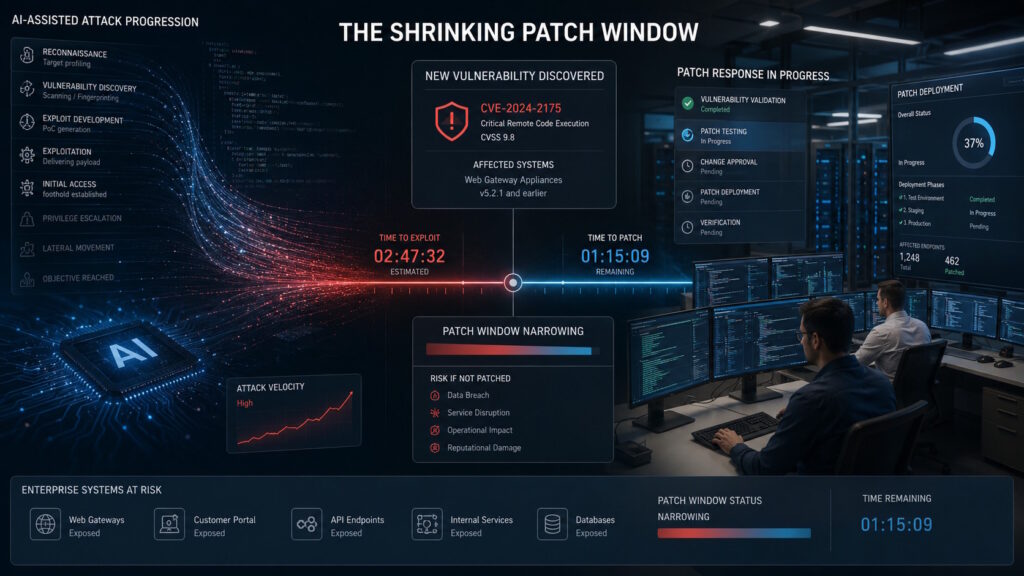
Vulnerability management has always included patching, but today’s threat landscape is widening the job. Many organizations once treated vulnerability remediation as a race to install updates before attackers arrived. Patch management still matters, yet AI is changing how quickly defenders and adversaries can study software weaknesses.
When a vendor announces a flaw, the usual response sounds simple. Find affected systems, test the update, and deploy it. In real environments, updates may require downtime, compatibility checks, or careful scheduling. Meanwhile, attackers may already be searching for exposed systems.
AI adds more pressure to this familiar problem. It can help researchers review code, identify weaknesses, and test possible attack paths. Malicious actors can also use it to research targets, adapt scripts, and troubleshoot failed attempts. In May 2026, Google reported identifying a zero-day exploit it believed was developed with AI.
Not every newly disclosed flaw will become an instant, reliable attack. Still, organizations may have less time to understand their exposure and choose the right response.
AI Is Compressing the Window to Respond
How is AI changing the patching race? It can shorten tasks that once required more time and specialist effort.
Attackers can use AI to summarize research, study public code, modify scripts, or explore possible attack paths. Security teams can use similar capabilities to find flaws, analyze alerts, and support faster remediation. Google has observed adversaries using AI for vulnerability research, exploit development, reconnaissance, and other parts of the attack process.
Recent threat research shows how tight the timeline has become. Mandiant’s 2026 data estimated a mean time-to-exploit of minus seven days. In plain language, exploitation often began before a patch existed.
AI did not create this pressure. Attackers already moved quickly when valuable vulnerabilities appeared. Yet it can make reconnaissance, vulnerability research, and exploit development easier to scale.
The technology also strengthens defense. Google’s Big Sleep project found a real-world SQLite vulnerability before it entered an official release. Developers fixed the issue that day, so users avoided exposure.
The shift involves speed on both sides. Organizations need faster decisions, not a frantic attempt to treat every finding as equally urgent.
Why a Patch-First Vulnerability Management Strategy Falls Short
A patch-first program can create plenty of activity while leaving the most important risks untouched. Large organizations may find thousands of weaknesses across cloud services, employee devices, business applications, and older systems.
Teams cannot always update everything immediately. A patch may disrupt a critical service, conflict with another application, or require a planned maintenance window. Some legacy systems may not support a straightforward update.
Severity scores help describe a vulnerability, but they do not tell the whole story. A severe flaw on an isolated test system may pose less danger than a moderate flaw on a public service.
Other exposures may not involve missing patches. Misconfigurations, weak passwords, unused accounts, excessive privileges, and forgotten public systems can also create openings.
So, which vulnerability should your organization fix first? The answer depends on location, reachability, asset importance, and potential impact.
Better Vulnerability Management Starts With Real Risk
Risk-based prioritization looks beyond a single score. It asks whether the vulnerability exists locally and whether an attacker can reach it. It also considers the affected asset and the likely business impact.
FIRST, which maintains the Exploit Prediction Scoring System, recommends checking presence, reachability, and consequence. It also warns that an exploit probability score is not a complete risk score.
Evidence of active exploitation deserves particular attention. CISA’s Known Exploited Vulnerabilities catalog identifies flaws with confirmed exploitation and supports remediation decisions. Its June 2026 directive also moved federal agencies toward prioritizing security updates according to risk.
This approach does not excuse slow patching. It helps teams direct limited time toward weaknesses that create the greatest immediate exposure.
Shrink the Target Before the Patch Arrives
What can you do when a patch is unavailable or still being tested? You can make the vulnerable system harder to reach and exploit.
An organization might remove an unnecessary public service, restrict remote access, or isolate a sensitive system. It may also disable unused accounts, reduce administrator privileges, or retire unsupported technology.
These changes reduce the paths available to an attacker. They also provide breathing room while teams evaluate and deploy the permanent fix.
Temporary safeguards can help during that period. Endpoint protection, network restrictions, application controls, and added monitoring may block or reveal suspicious activity.
Some organizations also use virtual patching. This approach places filtering or blocking rules around a vulnerable application without changing its underlying code.
These measures should never become excuses to ignore an available update. They provide added protection when immediate remediation remains difficult.
A Green Dashboard Is Not Proof
Security controls often look reassuring in a dashboard. A tool may appear enabled, healthy, and fully deployed. That status does not prove it will stop the attack behavior you expect.
Continuous validation closes this gap. Teams can review configurations, test attack paths, conduct penetration tests, and simulate realistic techniques. They can then address weak spots before an attacker finds them.
NIST’s Risk Management Framework follows a similar principle. It calls for assessing whether controls operate as intended and continuously monitoring changes in risk.
Validation creates evidence that important safeguards still work as systems, users, and threats change. It replaces assumption with a clearer view of defensive performance.
From Counting Patches to Reducing Exposure
Traditional programs often measure progress through patch totals, closure rates, and aging reports. Those numbers remain useful, but they can reward volume instead of meaningful risk reduction.
A better conversation starts with practical questions. Are the most exposed systems receiving attention? Do critical services remain protected while updates move through testing?
Teams should also ask whether controls stop the activity they target. Leaders need a clear view of any risk that remains after remediation.
This broader view turns vulnerability management from a recurring cleanup exercise into a continuous security process.
Conclusion: Patching Is the Foundation, Not the Finish Line
Patching still closes known weaknesses and prevents many avoidable attacks. Organizations should continue improving how quickly and safely they deploy important updates.
However, success cannot depend only on the number of patches installed. AI is helping defenders and attackers work faster, while exposed systems leave little room for delay.
The stronger approach combines timely patching with risk-based priorities, smaller attack surfaces, protective controls, and regular validation. It measures whether the organization reduced real exposure, not whether the backlog simply became shorter.
As vulnerability management continues to evolve alongside AI, Tech Scope Connect explores the trends shaping cybersecurity and emerging technology. Join the conversation through our live newscasts, expert discussions, and global summits.
Sources:
- NIST Risk Management Framework | csrc.nist.gov
- Known Exploited Vulnerabilities Catalog | cisa.gov
- BOD 26-04: Prioritizing Security Updates Based on Risk | cisa.gov
- Adversaries Leverage AI for Vulnerability Exploitation, Augmented Operations, and Initial Access | cloud.google.com
- GTIG AI Threat Tracker: Distillation, Experimentation, and (Continued) Integration of AI for Adversarial Use | cloud.google.com
- M-Trends 2026: Data, Insights, and Strategies From the Frontlines | cloud.google.com
- From Naptime to Big Sleep: Using Large Language Models To Catch Vulnerabilities In Real-World Code – Project Zero | projectzero.google
- Using EPSS | first.org
- EPSS Frequently Asked Questions | first.org