
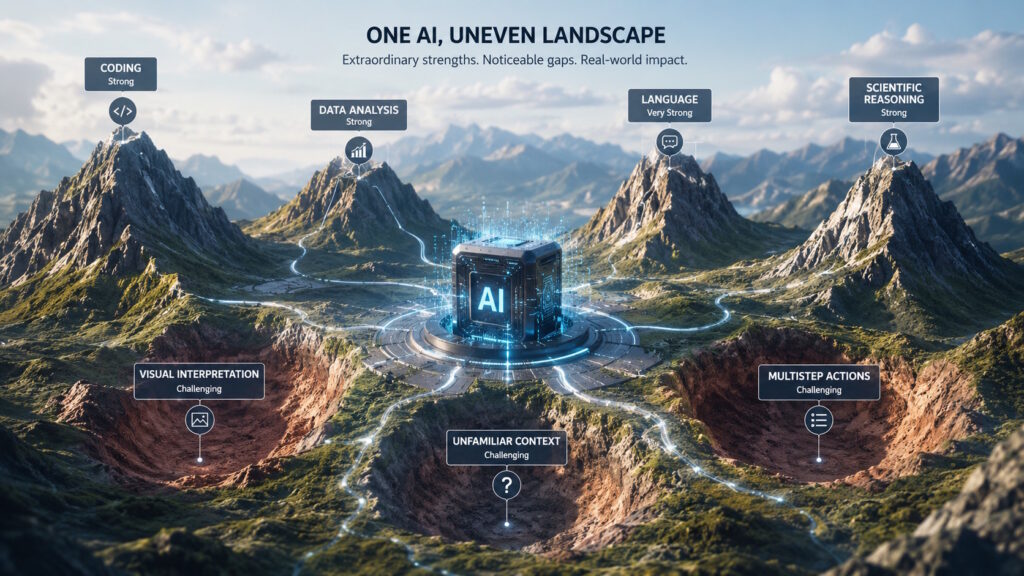
Quick Answer: Jagged intelligence describes the uneven way AI performs across different tasks. A system may excel at complex reasoning, coding, or writing, yet struggle with a simple-looking visual or multistep task. This happens because AI processes information differently from people, and its results depend on training, context, input format, and available tools. Understanding jagged intelligence helps people match AI to the right work and use its strengths more effectively.
AI’s Uneven Talent Map
Jagged intelligence explains why artificial intelligence can produce remarkable work, then stumble over a task that seems almost effortless. This uneven AI capability sits along what researchers describe as a jagged technological frontier. It challenges the familiar idea that intelligence develops from simple skills toward harder ones in a smooth line.
You may have already noticed this contrast. An AI assistant can summarize a dense report, write useful code, or compare several business strategies. Moments later, it may misread an image, overlook a clear instruction, or lose track of a basic sequence.
Those moments do not prove that AI lacks intelligence or value. They show that machine abilities develop differently from human abilities. Understanding that difference offers a clearer view of what AI does well today.
What Is Jagged Intelligence?
Jagged intelligence describes the uneven pattern of strengths and weaknesses across AI tasks. A system may perform brilliantly in one area and less reliably in another. The second task may even look easier to a person.
Picture a mountain range instead of a staircase. The high peaks represent tasks where AI delivers impressive results. The valleys represent tasks where performance remains inconsistent. Those peaks and valleys can sit surprisingly close together.
The idea builds on research into the jagged technological frontier. Harvard researchers use that phrase for the shifting boundary between tasks AI handles well and tasks it does not. Their work found that assignments with similar human difficulty could fall on opposite sides of that boundary.
So, is jagged intelligence another name for unreliable AI? Not quite. It describes a capability pattern, not a verdict on the technology. The pattern helps explain both AI’s major achievements and its occasional missteps.
Why “Easy” Tasks Can Become Surprisingly Hard
People judge difficulty through human experience. We learn from physical surroundings, social habits, cultural context, and years of repetition. Many everyday skills become so automatic that we stop noticing their hidden steps.
Consider reading an analog clock. For many people, a quick glance provides the time almost instantly. Yet the task combines object recognition, spatial judgment, number mapping, and precise visual interpretation.
An AI system must identify the clock face and separate the two hands. It must estimate their positions and connect those positions with the correct numbers. One visual mistake can spoil otherwise sound reasoning.
This contrast became especially visible in recent AI evaluations. In 2025, an advanced version of Gemini Deep Think reached gold-medal standard at the International Mathematical Olympiad. It solved five of six demanding problems in natural language.
Meanwhile, ClockBench continues to show a notable gap between model and human performance on analog clocks. At the time of writing, its live leaderboard reports 66.7% for the top model and 90.7% for people.
These results do not compare one identical model under identical conditions. They reveal a wider industry pattern. Highly structured reasoning can suit AI well, while familiar visual tasks may expose different weaknesses.
Brilliant on One Task, Clumsy on the Next
AI does not carry one universal skill level into every situation. Its results depend on the task, available context, input format, tools, and required number of steps.
A model may write an excellent customer email but struggle to complete an entire service workflow. The longer process could involve opening records, selecting fields, updating details, and confirming each change. Every added step creates another chance for an error.
The same model may explain a broad topic clearly, yet miss highly local or specialized information. It may know an industry well but lack a company’s current policies, private records, or regional context.
Input format also changes performance. A system may understand a written description but misread the same information inside an unusual image. Strong language ability does not automatically guarantee equally strong spatial judgment.
How Jagged Intelligence Appears in Everyday Work
Imagine asking an AI assistant to review a long presentation. It may identify the main argument and suggest a sharper opening within seconds. That result feels sophisticated because it requires language, structure, and judgment.
Now ask the same assistant to update every date across several slides. One date may sit inside a chart, while another appears within an image. A third may use an unexpected format. The simpler request can become the less reliable one.
This pattern also appears in research, coding, customer service, and data analysis. AI often accelerates individual parts of a job before it masters the entire process. The result can still create substantial value.
The practical lesson is not “AI fails at simple tasks.” A better conclusion asks which abilities the exact task requires. That question reveals where the peaks and valleys may appear.
Uneven Does Not Mean Overhyped
AI does not need equal mastery across every activity to become transformative. Most useful technologies have clear strengths, limits, and ideal conditions.
A calculator cannot hold a conversation, yet nobody doubts its value for arithmetic. Modern AI covers a vastly broader range of work. Still, its usefulness also depends on matching capability with purpose.
Today’s systems help people analyze documents, explore ideas, develop software, organize information, and communicate more efficiently. Organizations can also use AI to remove bottlenecks, expand services, and give teams more time for valuable work.
Jaggedness does not erase those gains. It gives users a more realistic way to understand them. A strong result in one setting deserves recognition, even when another setting needs more development.
The frontier also keeps moving. Multimodal systems now combine language, images, audio, and video with growing sophistication. Advances in reasoning, memory, tools, and evaluation continue to smooth many capability gaps.
What Does This Mean for Everyday AI Use?
You do not need a technical benchmark to benefit from this idea. A few thoughtful questions can reveal whether an AI system suits the work in front of you.
Start with the real task, not the most impressive product demonstration. A model’s success in advanced mathematics does not prove it can manage every visual workflow. Its writing skill also does not guarantee factual accuracy in a specialized field.
Next, look beyond a polished sample. Could the system repeat that quality across different inputs and changing conditions? Could it complete the full process, including the less glamorous steps?
Context can also reshape the result. Clear instructions, relevant documents, reliable data, and appropriate tools often improve performance. They help the system operate closer to one of its capability peaks.
Human involvement still adds value, especially when decisions carry financial, legal, safety, or reputational consequences. People contribute context, accountability, and judgment that the system may not possess.
Human support does not signal that the technology has failed. Harvard’s research suggests that people can integrate AI into their work in several productive ways. Some divide tasks between person and system, while others collaborate with AI throughout the process.
This approach supports greater AI adoption, not less. It helps teams place AI where it delivers meaningful value. It also reduces disappointment caused by unrealistic expectations.
Will AI Become Less Jagged Over Time?
AI’s capability landscape will likely become smoother as models improve. Developers now evaluate systems across more realistic tasks, longer workflows, and varied forms of information.
Stanford’s 2026 AI Index uses the math-and-clock contrast to illustrate jagged intelligence. The report also highlights growing attention to reliability, domain performance, and real-world usefulness.
Still, the frontier may never become perfectly even. Each new ability opens more ambitious uses, unfamiliar environments, and higher expectations. Progress removes some valleys while revealing others.
That pattern should not sound discouraging. It reflects an expanding technology. As AI masters more work, people naturally ask it to handle harder and more complex responsibilities.
Today’s weaknesses are not necessarily permanent. Analog-clock performance, for example, has already improved since Stanford captured the results for its 2026 report. The improvement shows how quickly the capability landscape can change.
The important point is not whether AI will become perfect. The more practical question concerns how its expanding strengths will change the ways people work, create, and solve problems.
Conclusion: A Clearer View of AI’s Potential
The question “How intelligent is AI?” invites one broad answer for a technology with many different abilities. A more useful question asks where a specific system performs reliably and what support it needs.
AI can be brilliant and clumsy without creating a contradiction. Its uneven strengths reflect a different path of development, not a lack of progress. Recognizing that path helps people appreciate real achievements while setting practical expectations.
Jagged intelligence gives us a clearer way to discuss AI’s present capabilities and future potential. To keep exploring how those capabilities are evolving, join the conversation at Tech Scope Connect through timely insights, live newscasts, and expert-led summits.
Sources:
- Navigating the Jagged Technological Frontier | aiinstitute.hbs.edu
- Advanced Version of Gemini With Deep Think Officially Achieves Gold-Medal Standard at the International Mathematical Olympiad | deepmind.google
- ClockBench AI Benchmark | clockbench.ai
- Technical Performance — The 2026 AI Index Report | hai.stanford.edu