Quick Answer: Yes, quantum computing could improve EV energy management, especially for complex charging schedules, charger allocation, and grid coordination. Early research suggests it may help reduce peak demand, lower costs, and make charging networks run more efficiently. Still, the field is young, and quantum computing has not yet shown broad, real-world superiority over the best classical systems. For now, it looks most promising as a specialized tool for tough optimization problems, not a universal replacement.
Why EV Charging Has Become a Smarter Energy Question
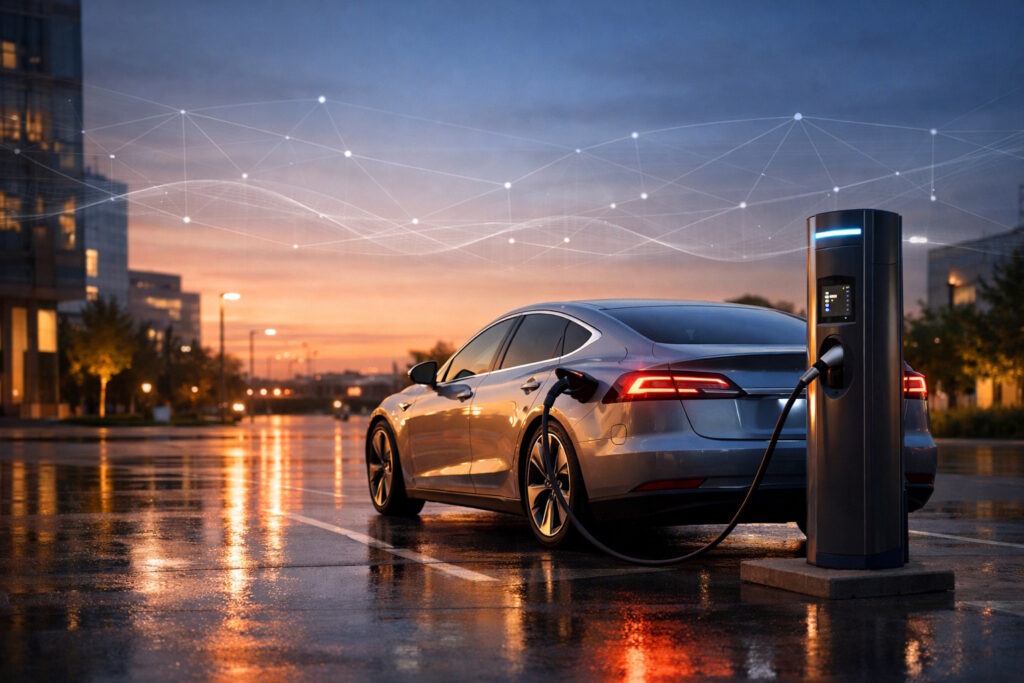
Quantum computing is starting to shape the conversation around EV energy management. It sits within the broader world of quantum technology, including quantum processors and other quantum systems. The real question is simple: can it help charge more vehicles, lower costs, and ease pressure on the grid? That question matters more now because charging networks are growing fast, and operators need to keep pace. The International Energy Agency says more than 1.3 million public charging points were added worldwide in 2024, which was more than 30% above the previous year.
If you are new to the topic, it helps to strip away the mystique. EV energy management is not only about the battery inside one car. It also covers when cars charge, how stations handle demand, how utilities avoid sudden peaks, and how operators balance price, speed, and reliability. In plain terms, it is the art of deciding who charges, when, and at what cost.
Why quantum computing enters the conversation
You might ask, “Why bring a new kind of computing into something as ordinary as charging a car?” The answer is scale. One car is simple. A neighborhood, fleet depot, or citywide network is not. Once you add limited chargers, shifting power prices, driver deadlines, and grid constraints, the scheduling puzzle becomes much harder. That is why researchers see this as a promising test case for quantum tools. NREL’s 2025 transportation work points to EV charging coordination and grid integration as areas where quantum methods may help with complex decision spaces and dynamic constraints.
The Puzzle Behind the Plug
Before going further, it helps to narrow the scope. In this article, EV energy management mostly means external decisions around charging networks, not the electronics inside the car. That distinction matters. The strongest quantum research today focuses on charging schedules, station operations, and grid coordination. Meanwhile, many current EV energy systems still rely on classical software, especially reinforcement learning and other data-driven control methods. A 2025 Nature Communications paper presented a real-world EV energy management framework based on offline reinforcement learning. A 2025 Applied Energy study on charging systems also said deep reinforcement learning had already become a critical tool for scheduling efficiency.
Where the first wins might appear
So where could the first wins appear? Probably not in a dramatic consumer breakthrough. A more realistic path is quieter and more practical. Think community charging programs, apartment buildings, fleet depots, workplace charging, and public stations that must juggle many cars at once. In those settings, the job is not only to deliver electricity. The job is to make thousands of small decisions quickly and well. That is the kind of optimization problem quantum researchers want to test. PNNL’s 2025 review says researchers are already testing several quantum approaches for energy management, often in combination with classical methods.
What Early Quantum Computing Results Actually Show
The strongest evidence so far is encouraging, but it is still early. In a 2025 Applied Energy paper, researchers used a D-Wave quantum computer for residential EV charging management. They modeled charging decisions for both 225-household and 1,000-household community cases. In those simulations, the study reported peak-load reductions of up to 94.2%. It also reported average daily electricity bill savings of about 34.7%. Computing times ranged from seconds to minutes. The same paper said the quantum approach looked especially useful for large, discrete charging problems. Those are eye-catching results, even if they do not settle the case on their own.
Another 2025 Applied Energy paper looked at real-time charger allocation through quantum reinforcement learning. That study found performance comparable to a deep reinforcement learning method, while cutting model parameters by about 20%. In everyday language, that suggests quantum-based learning models may become useful when decisions must happen quickly and demand changes from moment to moment. It does not mean the older tools are obsolete. It does mean the field has moved beyond pure speculation.
If you are wondering whether major energy institutions take this seriously, the answer is yes. NREL published a 2025 research poster on quantum computing in transportation optimization, with vehicle electrification and grid integration as key focus areas. PNNL’s 2025 review reached a similar conclusion. It described both the promise and the limitations of these methods. It also highlighted hybrid quantum-classical strategies as a practical direction.
Why the Hype Needs Guardrails
This is where caution matters. A promising study is not an industry verdict. In a 2025 Nature paper on optimization, researchers said the question of whether quantum can deliver a major advantage in optimization remains largely open. PNNL’s 2025 review makes a similar point in plainer terms. It highlights the gap between theoretical speedups and experimental validation, and it calls for rigorous benchmark studies on representative power-grid cases.
Another practical point often gets lost. Most serious research does not frame quantum as a stand-alone replacement for everything else. PNNL highlights hybrid quantum-classical strategies, and NREL says researchers should prepare quantum-compatible models now. That is a measured view. It assumes quantum methods may become useful in a larger toolkit, not as a simple replacement for every existing system.
The bigger picture is even more interesting. Classical EV control is not standing still while quantum research advances. Nature Communications published a 2025 paper that used real-world vehicle data to improve EV energy management with offline reinforcement learning. So, the better question is not whether quantum will replace everything. It is whether quantum can beat the best current tools on a few high-value tasks. Right now, that answer looks possible, but not yet proven across the board.
Conclusion: A Careful Yes, Not a Victory Lap
Can quantum computing really improve EV energy management? Yes, it probably can in selected cases, especially where charging decisions become large, fast, and hard to coordinate. The most credible near-term opportunities appear in community charging, depot operations, public charging networks, and grid-facing scheduling. Still, the field remains early. The best published work shows promise, while major research groups still call for better benchmarks and stronger real-world validation.
For readers, operators, and energy leaders, the smart stance is curiosity without hype. Quantum computing is no longer just a headline term. It is becoming a serious research path for difficult charging and grid problems. At the same time, it is not a finished answer, and it is not ready to replace strong classical systems across the board.
For a broader view of the ideas and innovations reshaping business and society, Tech Scope Connect provides a place to keep up with the conversation. Join now!
Join Green Things Summit 2026 as we take a deeper dive into how AI, IoT, automation, and edge computing help drive efficiency, reduce waste, and advance sustainability goals through thought-leadership panels, industry keynotes, and interactive Q&A sessions. Register here.
Sources:
- Electric Vehicle Charging – Global Ev Outlook 2025 – Analysis | iea.org
- Quantum Computing in Next-Generation Transportation Optimization | research-hub.nlr.gov
- Data-Driven Energy Management for Electric Vehicles Using Offline Reinforcement Learning | nature.com
- Quantum Computing-Enhanced Large-Scale Residential Electric Vehicle Charging Management | sciencedirect.com
- Quantum Reinforcement Learning for Real-Time Optimization in Electric Vehicle Charging Systems | sciencedirect.com
- Optimization by Decoded Quantum Interferometry | nature.com
- A Review of Quantum Computing Technologies in Power System Optimization | pnnl.gov