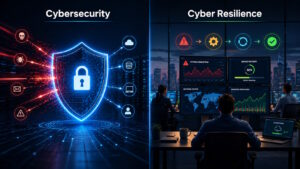
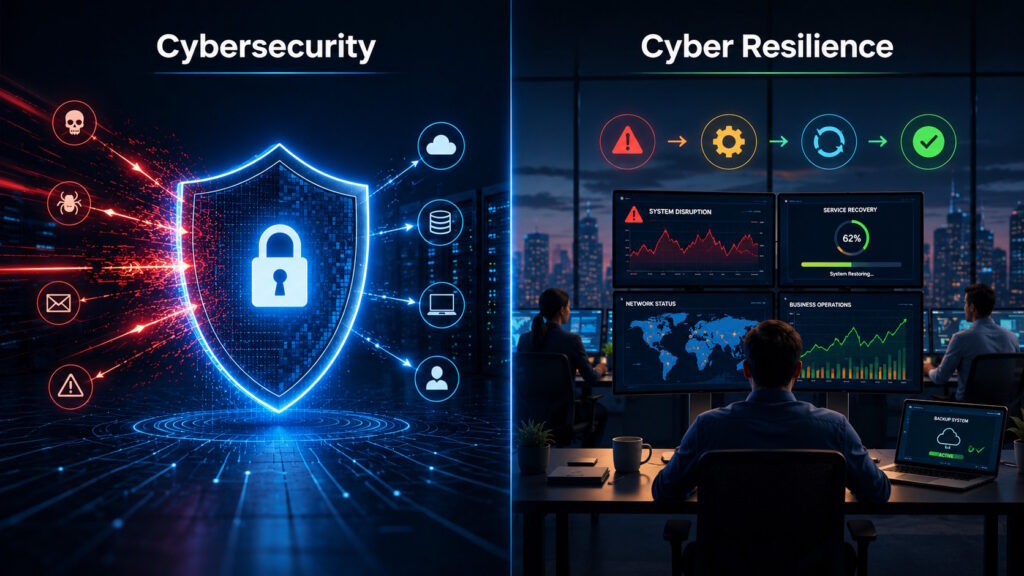
Quick Answer: Cyber resilience is an organization’s ability to prepare for cyber disruption, maintain essential operations, recover safely, and adapt afterward. Cybersecurity manages cyber risk through protection, detection, response, and recovery, while cyber resilience places greater emphasis on keeping the business functioning when disruption occurs.
Cyber resilience helps your organization prepare for cyber disruption, maintain essential operations, and recover safely when systems fail. This digital resilience involves the people answering customer calls as much as the teams restoring computers.
Suppose your email and ordering software suddenly become unavailable. Would employees know how to handle urgent requests, or would everyone wait for IT? The answer reveals something a list of security tools cannot: how your business will cope during disruption.
How Is Cyber Resilience Different from Cybersecurity?
It’s tempting to describe cybersecurity as keeping attackers out and resilience as recovering when they get in. However, that explanation leaves out a substantial part of cybersecurity.
The National Institute of Standards and Technology’s Cybersecurity Framework 2.0 includes six functions: Govern, Identify, Protect, Detect, Respond, and Recover. Cybersecurity therefore already includes responding to incidents and restoring operations.
The distinction is one of emphasis. Resilience focuses on whether your organization can fulfill its purpose despite disruption. NIST’s guidance also includes anticipation and adaptation, so preparation and learning matter alongside recovery.
Rather than choosing between the two, your business needs to connect its security efforts with its operational needs. A protected system and a business prepared for interruption are related goals, but they are not identical.
Why Recovery Deserves More Attention Now
Mandiant’s M-Trends 2026 report, drawing on its 2025 investigations, describes ransomware attacks designed to obstruct recovery. Attackers targeted backups, identity services, and the management systems that control virtual servers. Their targets included the tools organizations would need to restore operations.
For a business leader, that raises an uncomfortable possibility: What happens when the backup plan loses its supporting systems?
Dependencies outside your company deserve attention, too. The World Economic Forum’s Global Cybersecurity Outlook 2026 highlights how supplier and cloud-service dependencies can spread disruption across organizations. A cyber incident at a provider could interrupt your operations even if attackers never enter your network.
Planning for these possibilities does not mean predicting disaster. It means avoiding the assumption that every defense and dependency will always hold.
The Same Incident, Two Very Different Mornings
Consider a hypothetical distributor whose technical team takes email and order-management systems offline during a cyber incident.
In one version, the company has backups but no rehearsed continuity plan. Employees cannot access instructions stored on the unavailable network, and customer service lacks an alternative communication channel. Nobody knows who can authorize temporary ordering procedures, so urgent requests pile up while the technical team investigates.
Now imagine the same distributor has practiced its response. Employees can retrieve instructions without using the affected systems. Managers know which orders qualify for a temporary process, and customer service can explain delays through an independent channel.
The company still loses capacity, and some work must wait. However, employees can preserve selected services while specialists address the incident. Their preparation illustrates cyber resilience: sustaining essential activities without expecting normal operations throughout the incident.
What Helps a Business Keep Going?
A workable approach starts with understanding which activities matter most, then connecting people and recovery resources around those priorities.
Cyber resilience starts with what cannot wait
Business continuity addresses how essential activities continue during and after disruption. Disaster recovery focuses on restoring the technology and data that support those activities. Together, they connect immediate operating needs with the return to normal service.
At our distributor, processing urgent orders might take priority over producing an internal sales report. Operational leaders and technical teams would agree on those priorities before an incident, rather than debate them during one.
People need a plan they can actually reach
Who contacts suppliers when email stops working? Who approves customer updates? A useful response plan assigns those responsibilities and identifies backup communication channels. Australia’s cybersecurity guidance specifically addresses alternative communications and messages for employees, customers, and other stakeholders.
Temporary workarounds also need boundaries. In our example, the distributor might accept selected orders by phone and record them through an approved offline process. Staff would know which requests to pause rather than improvise around safety or privacy requirements.
Backups need more than a success message
A backup notification cannot tell you whether the business can restore a working service. Immutable backups protect retained copies against modification or deletion for a specified period. Isolated backups separate recovery resources from everyday systems and access paths. Mandiant recommends both protections against destructive attacks.
Recovery order matters, too. Restoring an application will not help employees if its required sign-in service remains unavailable. Australia’s cybersecurity guidance calls for coordinated restoration tests that account for dependencies between data, applications, and settings.
Would the Plan Work on a Bad Day?
Two common planning terms answer practical questions about disruption.
A recovery time objective, or RTO, sets a target for how quickly a system or service needs to return. A recovery point objective, or RPO, identifies the point in time to which the organization must restore its data. In everyday language: How long can we manage without the service, and how much recent information can we lose?
For our hypothetical distributor, the targets might mean restoring ordering within four hours and losing no more than one hour’s transactions. These numbers illustrate requirements, not universal recommendations or proof that the company can meet them.
Tabletop exercises let people discuss their decisions during a simulated incident. Technical restoration tests check whether systems and data can actually return as expected. A productive discussion does not prove that a backup will restore successfully, so both types of testing have a role.
Cyber resilience depends on more than recovery speed. Teams also need evidence that restored systems function correctly and that they have addressed the compromise.
After an exercise or incident, the organization can address specific findings, such as missing contacts or an overlooked dependency. Revising procedures and testing changes turns those lessons into better preparation for the next interruption.
Conclusion: Know What Happens After the Screen Goes Dark
Think back to the morning when email and ordering systems disappear. “We have backups” offers only part of the answer. The fuller answer explains who will act, what can safely continue, and how the team will restore essential services.
Strong security remains essential, but your organization also needs a workable response when disruption reaches the business. The goal is not to promise uninterrupted operations; it is to prepare for a manageable, coordinated response.
Want to stay informed about cyber resilience and the technologies businesses depend on? Join the conversation at Tech Scope Connect, where we explore cybersecurity, emerging technology, and the challenges shaping today’s connected world.
Sources:
- Transitioning to a Cyber Resilience Approach (ITSAP.10.190) | cyber.gc.ca
- NIST Releases Version 2.0 of Landmark Cybersecurity Framework | nist.gov
- SP 800-160 Vol. 2 Rev. 1, Developing Cyber-Resilient Systems: A Systems Security Engineering Approach | csrc.nist.gov
- M-Trends 2026: Data, Insights, and Strategies From the Frontlines | cloud.google.com
- 3. The Trends Reshaping Cybersecurity – Global Cybersecurity Outlook 2026 | weforum.org
- Business Continuity Plan (BCP) – Glossary | csrc.nist.gov
- DRP – Glossary | csrc.nist.gov
- Cyber Security Incident Response Planning: Practitioner Guidance | cyber.gov.au
- Proactive Preparation and Hardening Against Destructive Attacks: 2026 Edition | cloud.google.com
- Guidelines for System Management | cyber.gov.au
- Recovery Time Objective – Glossary | csrc.nist.gov
- Recovery Point Objective – Glossary | csrc.nist.gov