
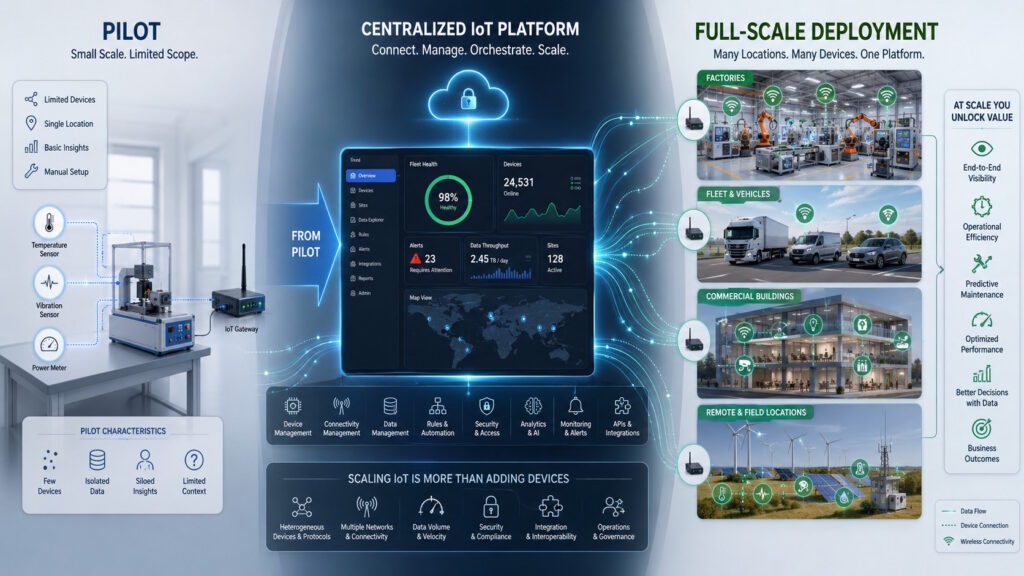
Key Takeaway: Scaling IoT successfully requires more than adding devices. Organizations must prepare for growing demands across device management, connectivity, security, data, integration, and cost. A phased approach, supported by automation, clear ownership, and scalable architecture, helps reduce complexity while protecting long-term business value.
When a Successful Pilot Meets the Real World
Scaling IoT can turn a promising pilot into a much larger business challenge. Expanding a connected-device deployment adds pressure across operations, security, data, and infrastructure. A system that works with 20 devices may struggle when it reaches 2,000.
This shift affects more than the technology team. It can influence budgets, productivity, customer experience, and long-term business value. Leaders need to understand what changes as an IoT program grows.
You may wonder, “Why does adding more devices create so much complexity?” Each endpoint needs monitoring, maintenance, protection, and support. The networks, platforms, and processes around those devices must grow as well.
Why Scaling IoT Gets Hard So Quickly
An IoT pilot usually runs in a controlled setting. The team knows the devices, network, and people involved. Staff can often spot problems and fix them manually. Growth changes that picture. Devices may spread across factories, offices, vehicles, cities, or remote sites. Each location can bring different conditions and support needs.
The challenges also overlap. Device management affects security, while connectivity affects data flow and operating costs. Companies must treat the deployment as one connected system.
Thousands of Devices Need More Than a Spreadsheet
At a small scale, teams can configure devices one at a time. Simple records may provide enough oversight. Those methods become unreliable as the fleet grows. How do you know which devices need updates? Which units have stopped reporting? Which ones should the company repair, replace, or retire?
When scaling IoT, a centralized platform can register devices, monitor their health, and schedule updates. Automation also reduces repetitive work and human error. Companies need a clear device lifecycle too. A consistent process for setup, maintenance, updates, and retirement makes growth easier to manage.
Connectivity Cannot Be an Afterthought
A pilot may work perfectly on a reliable office network. A larger rollout may include warehouses, farms, moving vehicles, or distant facilities. No single connection suits every environment. Wi-Fi may work inside buildings, while cellular can support mobile equipment. LPWAN can suit low-power sensors, while satellite can reach isolated locations.
The best choice depends on coverage, power needs, bandwidth, response time, and cost. Some deployments may need several network types. Teams should also prepare for outages. Devices can store information locally and send it when service returns. This approach keeps minor network issues from disrupting operations.
“Do all devices need to stay connected continuously?” Often, they do not. The business use case should determine how often each device communicates.
A Larger Footprint Creates More Security Work
Every connected device can create another entry point into a wider system. As fleets expand, teams must manage more identities, permissions, updates, and vulnerabilities. Several basic practices can reduce the risk. Each device should have a unique identity, and teams should replace default passwords. Access controls should limit users and systems to what they genuinely need.
Encryption can protect stored and moving data. Network segmentation can stop one compromised device from reaching sensitive resources. Security also needs ongoing attention. Companies should monitor devices, apply patches, and investigate unusual behavior. A secure pilot does not automatically become a secure large-scale deployment.
Organizations must protect device data as well. False readings can affect maintenance, safety, inventory, and other decisions.
More Data Does Not Always Mean More Insight
A growing IoT system can produce a constant stream of readings, alerts, logs, and status updates. Much of that information may offer little immediate value. Sending everything to the cloud can raise storage, bandwidth, and processing costs. It can also delay applications that need a fast response.
Edge computing can filter or summarize information near the device. The system can then send important changes or alerts to the cloud. Data discipline becomes especially important when scaling IoT. Companies should decide which information supports a business goal. Ask, “Will this data change a decision or trigger an action?” If not, the company may not need it.
Different Systems Must Learn to Work Together
IoT deployments often combine products from several vendors. They may also connect new sensors with older machines, business applications, and operational systems. These parts do not always communicate easily. Different formats, protocols, and interfaces can slow integration. Proprietary platforms may also limit future choices.
Open standards and well-documented APIs can reduce these barriers. Gateways and middleware can exchange information between systems that use different technical languages. Vendor selection deserves a long-term view. A cheap device may become expensive if it cannot integrate, update, or move between platforms.
Costs Rise in Places That Pilots Often Hide
Device prices receive early attention, but they represent only one part of the budget. Installation, connectivity, cloud services, security, maintenance, and support create ongoing expenses.
Growth can expose operational gaps too. Someone must own device performance, updates, network issues, and incident response. Small problems can linger when responsibilities remain unclear.
Phased expansion can help control the risk. Each phase should test performance, costs, support needs, and business results before the next rollout. Teams should track outcomes tied to the original goal. Useful measures may include less downtime, lower energy use, or better asset visibility.
Build a Repeatable Path, Not a Bigger Pilot
Organizations do not need to solve every future problem before they begin. They do need an architecture and operating model that can grow. Standardized devices, automated management, flexible connectivity, and clear data rules create a stronger foundation. Security should support every stage, not appear near the end.
Cross-functional planning also helps. Technology, operations, security, finance, and business teams should agree on goals and responsibilities. Measured growth gives teams room to learn. They can adjust costs, workflows, and technical choices before problems spread across the full deployment.
Conclusion: A Smarter Approach to Scaling IoT
IoT growth can deliver wider visibility, better automation, and stronger operational insight. However, scale brings responsibilities that a small pilot may never reveal.
Successful programs prepare for device management, connectivity, security, data, integration, and long-term operations. They also connect each technical choice to a clear business result.
Interested in how organizations are approaching scaling IoT? Join the conversation at Tech Scope Connect. Our expert discussions, live newscasts, and industry events explore the challenges and opportunities shaping connected technology.