
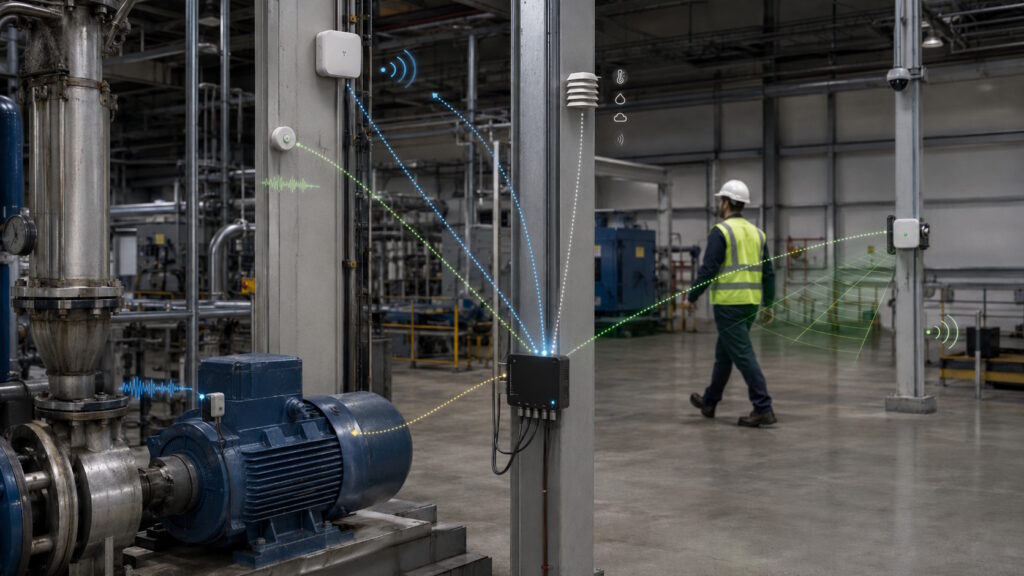
Key Takeaway: The next AIoT sensor may not rely on a camera at all. Wi-Fi, radar, sound, vibration, and environmental sensors can help connected systems detect movement, monitor equipment, and interpret changing conditions without producing an image. Cameras will remain important, but the future of AIoT will increasingly depend on choosing—and sometimes combining—the right senses for each situation.
What If the Next Smart Sensor Never Takes a Picture?
An AIoT sensor may soon understand a room, machine, or building without taking a single picture. A connected sensor could listen for unusual sounds, feel vibrations, or notice changes in wireless signals. A smart sensor might even detect someone in darkness without recording conventional video. Cameras still play a central role in connected systems. However, artificial intelligence now gives other sensors new ways to interpret the physical world.
This shift expands what AIoT can notice. A camera can reveal a damaged package, but it cannot hear a hidden leak. It can watch a motor, but it may miss early vibration changes inside the equipment. Radar can sense movement when lighting fails. Wi-Fi can register changes when someone crosses a room. Together, these technologies create a richer picture without always creating an actual image.
Why Cameras Became AI’s Favorite Sense
Cameras became the familiar face of intelligent sensing for a good reason. Images contain details that people and software can easily recognize. A camera can identify an object, read a label, inspect a surface, or record an event. It also gives someone visual evidence to review later.
Yet cameras only capture what appears within their view. Darkness, blocked angles, dust, weather, and crowded scenes can weaken that view. Some situations also require information that light cannot reveal. A machine may appear normal while its bearings vibrate differently. A room may look empty while someone remains still beyond the camera’s angle. Intelligent sensing becomes more useful when it can draw from more than sight.
What Makes an AIoT Sensor Intelligent?
A traditional sensor measures a condition and sends a reading. It might report temperature, movement, pressure, sound, or vibration. An AI-enabled system goes further by looking for patterns within those readings. It may classify an event, detect an anomaly, or decide that several changes deserve attention.
The intelligence does not always sit inside the sensor itself. A nearby microcontroller, gateway, or cloud platform may interpret the data. However, more sensor packages now include local processing for compact machine-learning tasks. STMicroelectronics, for example, offers sensor technology that runs signal processing and AI algorithms at the edge. Its listed uses include anomaly detection, activity recognition, and sensor fusion. Local processing can reduce the need to send every raw measurement elsewhere.
Can Wi-Fi Really Sense Movement?
Wi-Fi signals travel through rooms and reflect from walls, furniture, equipment, and people. Movement changes the way those signals travel. A sensing system can study those changes and find patterns linked to presence, motion, distance, or gestures.
Think of echoes returning through a room. You may notice that something moved even without seeing the object. Wi-Fi sensing follows a similar idea, although it analyzes radio signals instead of sound.
NIST says IEEE 802.11bf supports Wi-Fi sensing through existing communication infrastructure. The standard aims to help compatible devices estimate distances, detect movement, and identify gestures. IEEE approved the standard in May 2025 and published it on September 26, 2025.
This development gives Wi-Fi another potential role beyond connecting devices. A compatible system could help monitor room occupancy, recognize gestures, or notice movement across a space. It may provide useful awareness without producing ordinary video footage.
However, every existing router will not suddenly become a reliable motion detector. Useful results still depend on compatible hardware, software, placement, and testing. Walls, interference, network traffic, and changing layouts can affect performance. Wi-Fi sensing may reveal that something changed without explaining every detail. It offers another source of awareness, not invisible video.
Radar Notices What the Eye Might Miss
Radar sends radio waves and measures how they return from nearby people or objects. A radar system can estimate movement, distance, direction, or speed. It can also work in darkness because it does not depend on visible light.
That makes radar useful for occupancy, proximity, smart buildings, vehicles, robotics, and safety monitoring. Infineon’s 60 GHz presence-sensing technology, for example, can detect both larger movements and subtle motion. Those capabilities can help a room recognize that someone remains present, even when that person sits quietly.
Radar still cannot answer every visual question. It may detect someone entering a restricted area without identifying clothing, tools, or protective equipment. A camera often provides that finer detail. Radar contributes spatial awareness, while a camera adds visual context. Many systems may eventually use both.
A Machine Can Sound Different Before It Looks Broken
Equipment often gives early warnings through sound and vibration. A bearing may create a new rhythm. A pump may produce an unfamiliar acoustic pattern. A motor may vibrate differently under unusual stress. These changes can appear before anyone sees visible damage.
An acoustic or vibration sensor captures those signals over time. AI can compare them with normal operating patterns and flag unusual behavior. The result does not automatically predict a failure. It can still give maintenance teams an earlier reason to inspect the equipment.
This kind of sensing also reaches places where cameras struggle. A camera observes a machine from the outside. A vibration sensor experiences movement with the machine. A microphone can hear a leak behind a panel. Each signal tells a different part of the story.
When Temperature, Air, and Motion Add Context
Some sensors seem ordinary until AI starts connecting their readings. Temperature, humidity, pressure, air quality, gas, light, and motion all describe surrounding conditions. One reading may say little. A changing pattern across several readings can reveal much more.
Consider a rising temperature inside a facility. The increase could reflect normal production, poor ventilation, hot weather, or failing equipment. Motion, humidity, operating schedules, and machine data can narrow the possibilities. The system gains context by comparing conditions rather than reacting to one number.
These sensors do not gain new physical abilities through AI. They still measure the same conditions. AI helps the system recognize relationships, sequences, and unusual combinations within the data. That interpretation can turn basic measurements into more useful awareness.
Why One AIoT Sensor Is Rarely Enough
The most capable system may not depend on one perfect sensor. It may combine several complementary signals. This approach, known as sensor fusion, helps a system view the same event from different angles.
Imagine a motor on a production line. A vibration sensor notices an unusual pattern. A microphone detects a new sound. Temperature begins to rise. A camera then checks for a visible obstruction. Together, those signals give a technician more context than any single reading.
More sensors do not automatically create better results. Poor data, weak placement, or bad timing can still confuse the system. The value comes from choosing signals that answer different parts of the same question.
One sensor may detect a change. Another may locate it. A third may help explain whether it needs attention. NIST notes that cooperative sensing can improve coverage when sensors combine information. However, multiple devices also introduce challenges involving timing, coordination, and data fusion.
Is Non-Camera Sensing More Private?
Non-camera sensing can reduce some privacy concerns when an application does not need an identifiable image. Radar might detect occupancy without recording a person’s face. A vibration sensor can monitor equipment without filming nearby workers. Local processing can also keep raw data closer to the device.
Still, nonvisual data can remain sensitive. Wi-Fi sensing may reveal movement, routines, or room occupancy. A microphone intended for machinery may also capture speech. Location and behavioral patterns can expose personal information when systems connect them with identities or schedules.
NIST advises organizations to understand what IoT devices collect and where that information travels. Privacy-aware design should limit unnecessary collection, storage, and access. Non-camera sensing can create a different data footprint, but it does not remove the need for clear safeguards.
Cameras Still Have an Important Job
The headline may sound like a challenge to computer vision, but cameras are not disappearing. They remain unmatched for many forms of visual detail. Inspection, object recognition, text reading, and human review often require an image.
Non-camera sensors also bring limitations. Background noise can affect acoustic systems. Wireless environments can change. Vibration patterns may differ across machines. Radar may sense presence without explaining the full situation. AI models can also struggle when real conditions differ from their training data.
The better question is not which sensor wins. A useful system asks what information the decision requires. Sometimes the answer is a camera. Sometimes it will be radar, sound, vibration, or Wi-Fi. Often, the strongest answer will involve more than one.
Conclusion: AIoT Is Learning to Sense More of the World
AIoT first gained attention through connected cameras and computer vision. Now, its awareness is expanding into radio signals, movement, sound, vibration, and environmental conditions. These inputs can reveal events that images miss. They can also support decisions in places where cameras face limits.
The next generation of connected systems will not depend on sight alone. It will match each situation with the right kind of sensing. It may also combine several signals before drawing a conclusion. That wider sensory view could make buildings more responsive and equipment easier to monitor.
The next AIoT sensor may never take a picture, yet it could still reveal something important. Curious about how AIoT is changing the way connected systems understand the physical world? Join the conversation at Tech Scope Connect for expert perspectives, live discussions, and insights into the technologies shaping what comes next.
Sources:
- Whether You Build Them or Buy Them – IoT Device Security Concerns Us All | nist.gov
- Future Wireless Communications Systems and Protocols | nist.gov
- Presence Sensing | infineon.com
- IMUs With Intelligent Sensor Processing Unit: Decision-Making in the Edge | st.com
- MEMS and Sensors | st.com
- Redefining Wireless Networks | nist.gov
- IEEE 802.11, The Working Group Setting the Standards for Wireless LANs | ieee802.org