
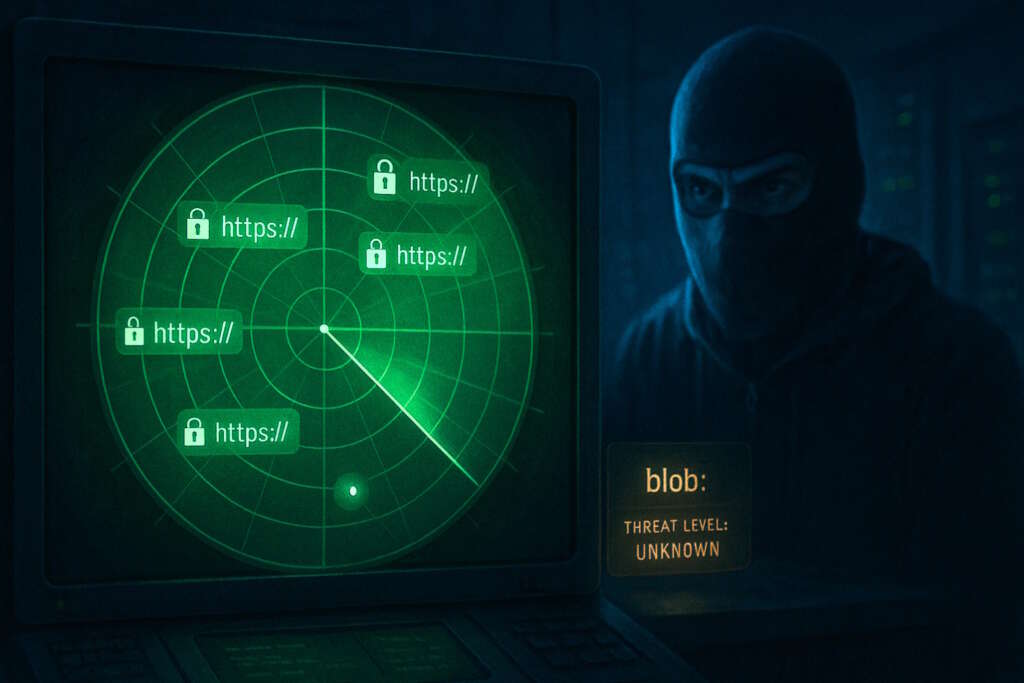
Key Takeaway: Blob URL phishing scams use temporary, browser-generated links to deliver malicious content directly within the user’s session—bypassing traditional security filters and link scanners. These scams are difficult to detect because they don’t rely on external servers or URLs. Instead, attackers embed phishing pages inside the browser itself, making them nearly invisible to most defenses. As this technique gains traction, awareness is key to avoiding deception.
A New Kind of Phishing Scam You’ve Probably Never Heard Of
Phishing scams are getting smarter—and harder to spot. You might already know about fake emails, spoofed websites, or malicious attachments. But there’s a new player on the scene that most people haven’t heard of: Blob URL phishing.
Unlike traditional scams, this one hides in plain sight—right inside your browser. These browser-generated links don’t look suspicious, don’t lead to external sites, and don’t trigger many alarms. Sound sneaky? That’s because it is. And it’s one of the cleverest ways cybercriminals are delivering phishing content today.
If you’ve ever wondered, “How are scams getting past my email filters?” or “Can a link I never clicked hurt me?”, you’re not alone. Let’s break it down.
What Makes Blob URL Phishing Scams So Dangerous?
Blob URL phishing scams work differently from what most people expect. Typically, phishing attacks rely on fake links to real-looking websites. But blob URLs—short for “Binary Large Object”—don’t need to point to any site at all. They load their payload inside the browser itself.
Here’s the twist: these links are created using JavaScript and are valid only during a user’s browser session. They often begin with blob: instead of https:. Because the content is locally generated, many traditional security systems don’t see them as threats. That means even some of the best email security gateways and link scanners miss them.
For the average person, these links appear harmless. They don’t look suspicious, and nothing immediately alarming happens when they appear. But once clicked, they can simulate login pages, steal credentials, or inject malicious code—all without ever leaving your browser.
Let’s Back Up: What’s a Blob URL, Anyway?
Don’t worry if you’re unfamiliar with Blob URLs. Most people are.
A Blob URL is a special type of link that points to content stored in your browser’s memory. It’s not hosted on a website, and it doesn’t live on a server. Instead, a script creates it temporarily—just for your session. It’s like giving someone a locked box, but the key exists only in their hands, during a short time.
Originally, Blob URLs were meant for legitimate uses, like previewing uploaded files in web apps. But scammers have figured out how to misuse them.
By embedding phishing content directly into a Blob URL, attackers bypass traditional detection. There’s no domain to block, no server to trace, and no record after the session ends. Once you close the tab, it’s gone.
Why Cybercriminals Love This Trick
There are several reasons phishing scammers are turning to Blob URLs:
- They’re stealthy. Security tools often don’t flag them because there’s no external site involved.
- They’re temporary. Once a session ends, the link disappears, leaving no trace.
- They’re customizable. Attackers can dynamically generate these links to mimic familiar login pages like Gmail, Outlook, or banking portals.
- They’re hard to investigate. Since they don’t rely on hosted infrastructure, there’s little for researchers to analyze.
These benefits make Blob URL phishing scams ideal for targeted attacks, especially when combined with social engineering—like a fake job offer or calendar invite.
Why This Matters (Even If You Think You’re Safe)
You might think, “I never click shady links, so I’m good.” But not all phishing scams look shady anymore.
Let’s say you receive a file from someone you trust—or what looks like a trusted platform like Google Docs, Teams, or Slack. Inside that file is a Blob URL. It might be masked as a “Click here to view” button. You click, the browser opens a login screen that looks exactly like Google’s, and boom—your credentials are gone.
This technique isn’t limited to just emails. It can show up in shared documents, Discord messages, even inside seemingly secure websites.
Phishing scams are evolving. And the more you know about how they work, the better you can defend yourself and your team.
Conclusion: The Rise of Invisible Phishing Scams
Blob URL phishing scams aren’t science fiction—they’re already here. And the worst part? Most people don’t know they exist. By understanding this new threat, you can start spotting red flags others might miss. While most security tools are still playing catch-up, awareness is your first line of defense.
Looking to stay ahead of the curve on tech and security trends? Tech Scope Connect offers a fresh take through live broadcasts, expert panels, and real-world insights you can actually use. Join now!