
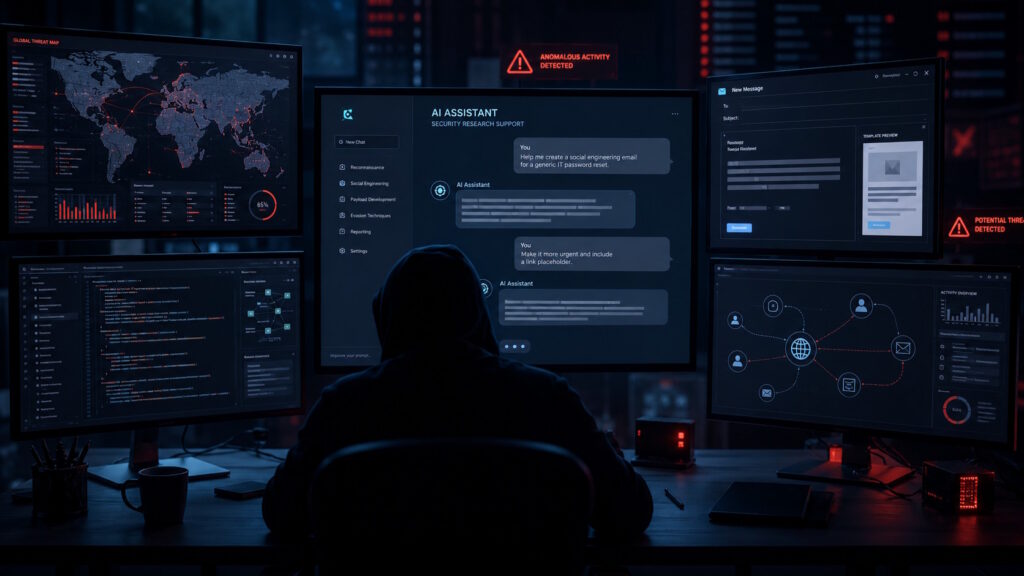
Key Takeaway: A zero-knowledge threat actor is an emerging type of cybercriminal who relies on AI instead of deep technical expertise to carry out attacks. While AI does not turn beginners into expert hackers, it can help them create convincing phishing campaigns, generate code, and accelerate cybercrime. As these AI-assisted attacks become more common, organizations should strengthen their cybersecurity practices and remain alert to a growing threat landscape.
Why Cybersecurity Is Watching AI-Assisted Attackers
Cybersecurity is facing a new kind of pressure as AI tools make technical work easier for people with bad intentions. In digital security and cyber defense, one phrase is starting to gain attention: the zero-knowledge threat actor. It describes a malicious attacker with little or no technical expertise who uses AI to turn harmful intent into phishing messages, malware ideas, exploit code, or attack workflows.
For years, cybercrime had a built-in barrier. Attackers needed to understand programming, networks, operating systems, and security tools. They needed patience, practice, and technical judgment. That barrier has not disappeared, but AI has lowered it.
You may be wondering, “Can someone with no hacking background really become dangerous?” The realistic answer is yes, but with limits. AI does not instantly create an elite hacker. It can, however, help a novice attacker move faster, learn faster, and produce more convincing attacks than they could alone.
That shift explains why cybersecurity professionals are paying attention. The concern is not only about advanced criminal groups using AI. It is also about people who previously lacked the skill to participate in cybercrime at all.
The Name Sounds Technical, but the Idea Is Simple
The phrase zero-knowledge threat actor can sound confusing at first. It does not refer to zero-knowledge proofs, the cryptographic method used to prove something without revealing the underlying data.
In this context, “zero knowledge” means something more straightforward. It refers to the attacker’s starting point. This person may not know how malware works. They may not understand exploit development. They may not know how to write clean code or build an attack plan.
What they do have is intent. They want to steal data, trick users, disrupt systems, or make money through fraud. AI becomes the bridge between that intent and the technical steps required to act on it.
Cato Networks helped popularize the phrase in 2025 when it described how generative AI could lower the barrier for creating password-stealing malware, even without malware coding expertise. That does not mean every AI user can suddenly launch advanced attacks. It means the starting line has moved.
When AI Becomes the Unwanted Tutor
Think about how people use AI at work. A marketer may ask it for campaign ideas. A developer may ask it to explain an error. A student may use it to understand a difficult concept. A small business owner may use it to draft emails or summarize documents. A zero-knowledge threat actor uses the same kind of assistance for harmful goals.
They may ask AI to explain a security weakness in plain language. They may use it to write a more convincing phishing email. They may ask for code, then ask the model to fix errors when the code fails. They may use it to translate scams into different languages or personalize messages for specific targets.
In other words, AI can act like a tutor, writer, assistant, and debugger. For a novice attacker, that combination changes the learning curve. This is one reason the topic feels different from older cybercrime trends. The attacker does not need to master every detail before taking action. They can ask questions, test outputs, adjust prompts, and keep trying.
Why Cybersecurity Teams Are Paying Attention
Cybersecurity teams already deal with phishing, malware, ransomware, credential theft, and social engineering. The zero-knowledge threat actor does not invent those problems. Instead, this emerging actor may increase their volume and improve their quality.
A poorly written phishing email was once easy to spot. Today, AI can help create smoother, more natural messages. A basic malicious script once required coding experience. Now, an attacker may ask AI to generate, explain, or troubleshoot pieces of code. Microsoft has reported that threat actors are already using AI in areas such as phishing, code obfuscation, scripting, and other operational tasks.
Google’s Threat Intelligence Group has also reported that cybercriminals and government-backed actors are experimenting with AI across the attack lifecycle. That includes reconnaissance, social engineering, and malware-related work.
For businesses, this creates a practical concern. Even less skilled attackers may produce more believable scams. They may also attempt more attacks because AI helps them move faster. The result is not always more sophisticated crime. Sometimes it is simply more persistent crime.
What AI Can Do—and Where It Still Falls Short
It helps to stay balanced. Fear-based writing makes the issue sound bigger than it is. Dismissing it makes the issue sound smaller than it is. AI can help attackers write messages, summarize technical material, generate basic code, and troubleshoot errors. It can help them understand unfamiliar tools. It can also help them scale repetitive tasks.
But AI still has major limits. It makes mistakes. It invents details. It may produce broken code. It does not automatically understand a real network environment. It cannot replace deep experience in stealth, persistence, timing, or operational security.
Skilled attackers still have an advantage. They know how to adapt when things break. They understand trade-offs. They know when an attack looks noisy. They can judge whether a tactic is likely to work.
A zero-knowledge threat actor may have AI assistance, but that does not make them an expert. It makes them more capable than they were before. That distinction is important. The real story is not “AI turns anyone into a hacker.” The more accurate story is this: AI can help motivated beginners act with more confidence, speed, and reach.
The Business Risk Is More Ordinary Than Dramatic
When people hear about AI-assisted attackers, they often imagine dramatic movie-style hacks. The more likely risks are much more ordinary. An employee receives a polished phishing email. A finance team gets a fake invoice request. A help desk receives a convincing password reset attempt. A small business sees a flood of scam messages that look more professional than before.
These scenarios do not require genius-level hacking. They require timing, persistence, and enough technical help to avoid obvious mistakes. That is why the zero-knowledge threat actor matters for everyday organizations. Most businesses do not fail because they face the most advanced attacker in the world. They struggle when basic controls are weak, employees are rushed, or systems remain unpatched. AI may make those ordinary weak points easier to exploit.
How Organizations Can Respond Without Panic
The best response is not panic. It is preparation. Businesses should continue strengthening the basics that already matter. Strong authentication reduces the damage from stolen passwords. Employee awareness helps people question suspicious messages. Regular patching closes known weaknesses. Endpoint protection adds another layer of defense. Clear reporting channels help teams act quickly when something feels wrong.
Organizations should also revisit their incident response plans. Who handles a suspicious email? Who reviews a possible account takeover? Who communicates with employees during an active security issue? Simple answers can save time during stressful moments.
AI-assisted attacks may feel new, but many defenses remain familiar. The difference is urgency. Attackers can now create more attempts, better messages, and faster variations. Security teams should also watch how employees use AI internally. Shadow AI tools, copied business data, and unapproved platforms can create fresh exposure. Good governance helps companies benefit from AI without opening unnecessary risks.
Conclusion: A New Starting Point for Attackers
The zero-knowledge threat actor represents an important shift in how cyber risk begins. It does not mean AI has replaced expertise. It means AI can help people with little technical background attempt attacks that once felt out of reach.
For cybersecurity leaders, the takeaway is clear. The threat landscape is no longer shaped only by highly skilled hackers and organized criminal groups. It now includes less experienced attackers who can use AI as a shortcut, coach, and amplifier.
This emerging threat should not create panic, but it should create awareness. Businesses that strengthen basic defenses, train employees, monitor activity, and plan for incidents will be better prepared for the next wave of AI-assisted attacks.
Want to stay informed on how AI is reshaping cybersecurity and the broader technology landscape? Join the conversation at Tech Scope Connect, where our live newscasts and global summits explore the trends, challenges, and innovations shaping the future of technology.
Sources:
- The Rise of the Zero-Knowledge Threat Acto | catonetworks.com
- 2025 Cato CTRL™ Threat Report | catonetworks.com
- AI as tradecraft: How threat actors operationalize AI | microsoft.com
- GTIG AI Threat Tracker: Advances in Threat Actor Usage of AI Tools | cloud.google.com
- GTIG AI Threat Tracker: Distillation, Experimentation, and (Continued) Integration of AI for Adversarial Use | cloud.google.com