
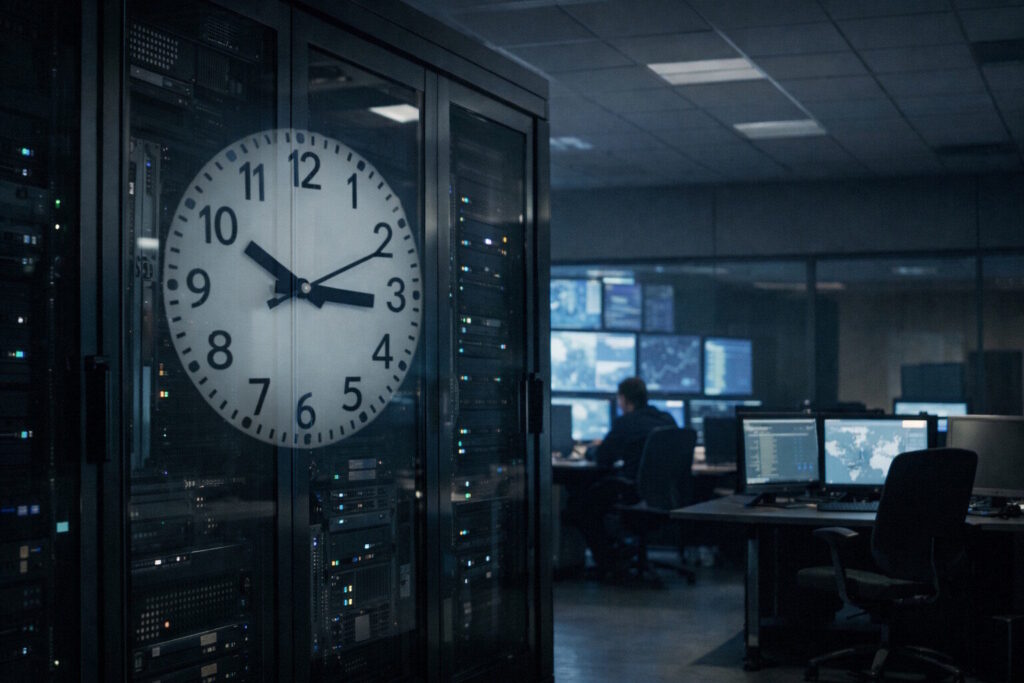
Quick Answer: Time-travel hacking is a post-compromise technique in which attackers manipulate system time or time synchronization to influence security controls. It is used to tilt time-dependent trust decisions, degrade monitoring and forensics, and create cover for defense evasion—especially in environments where time is assumed trustworthy but rarely monitored as a security signal.
“Time-travel hacking” is a sensational phrase for a decidedly practical idea: many security decisions depend on accurate time, and attackers sometimes win by tampering with that assumption.
In modern ransomware operations—where adversaries commonly try to disable endpoint detection and response (EDR) before encrypting data—the system clock can become an unglamorous but effective lever. The typical chain is familiar: initial compromise (often phishing or exploitation), escalation, reconnaissance, and deliberate attempts to impair defenses. In many campaigns, that includes abusing drivers or other trusted components to disable security tools.
Those driver-based tactics are one reason time matters. Code-signing trust is not only about who signed something, but often when it was signed, whether it was properly timestamped, and whether the signing certificate is considered valid during verification.
This article explains what time-travel hacking is, what it accomplishes in real intrusions, why it works, and what defenders can do to keep systems from becoming a “time machine” for attackers.
What Time-Travel Hacking Is
Time-travel hacking is the deliberate manipulation of system time—and sometimes time synchronization—to change how security mechanisms behave. It is not one exploit. It is a technique that supports several objectives:
- Making an old or otherwise untrusted artifact appear trustworthy under time-based rules, such as certificate validity windows and signature checks
- Interfering with detection and incident response by shifting timestamps and confusing event order
- Bypassing time-dependent controls such as license enforcement, update cadence checks, or validation workflows
This has been observed in real malware campaigns. In at least one documented case, malware explicitly reset the system clock to keep a component operating within a valid license window, prompting defenders to treat unexpected time changes as a detection signal rather than a mere nuisance.
What It Does in Real Attacks
Time manipulation does not compromise a system by itself. It is typically a post-compromise accelerant—something attackers use after they already have administrative control.
1. Slipping past trust checks that depend on the current date
Digital certificates include defined validity periods. When software or drivers are verified, the operating system may check whether:
- the signing certificate is currently valid, or
- a trusted timestamp proves the code was signed while the certificate was valid.
If an attacker can influence the time used during verification, they may be able to alter the outcome of a trust decision—especially in edge cases where timestamping is missing, misapplied, or where checks rely on the local clock.
This is not science fiction. It is a practical exploitation of how trust engines evaluate time-dependent constraints.
2. Weakening endpoint defenses before ransomware deployment
Many ransomware operations aim to neutralize EDR before encrypting data. Abused or malicious drivers are a common mechanism for disabling security tools because they operate close to the operating system’s trust boundary.
Time becomes relevant because driver loading and signature validation can involve time-based checks and assumptions. When attackers are trying to get a questionable component accepted—or to influence how trust is evaluated—clock manipulation can become part of the playbook.
3. Confusing investigations and monitoring
Even when clock changes do not directly enable execution, they can still degrade detection and response:
- Log timelines become distorted
- Alerts appear out of sequence
- Freshness and revocation checks may fail or behave inconsistently
Because enterprise environments routinely synchronize time, some time corrections are normal. That normalcy gives attackers cover if defenders are not watching for abnormal shifts, repeated changes, or suspicious timing in relation to other activity.
How Time-Travel Hacking Works
In practice, the technique often follows a predictable sequence:
- Initial access and privilege. Attackers gain a foothold through phishing or exploitation, then escalate privileges.
- Control of time settings. Changing system time is a controlled privilege. Once attackers have sufficient access, they can alter the clock directly, interfere with synchronization, or both—affecting event logs, file systems, scheduled operations, and security telemetry.
- Exploitation of time-dependent behavior. Attackers proceed with defense evasion, relying on the fact that trust decisions and monitoring pipelines may behave differently when time assumptions are undermined.
- Optional restoration. In many cases, attackers restore the clock afterward to reduce the chance of immediate detection, leaving defenders with a distorted investigative trail and reduced confidence in the sequence of events.
Why Time-Travel Hacking Works
Security trust depends on time
Certificates, signatures, revocation behavior, and timestamps all have temporal semantics. Timestamping exists specifically to support trust decisions across time—provided the signing time and the validation path can be trusted.
Operating systems must allow time correction
Legitimate time changes happen: time drift is real, virtualization introduces quirks, and domain environments enforce synchronization. That means time changes are not automatically suspicious—unless defenders decide to treat unusual time behavior as a security signal.
Time-change privileges undermine forensic integrity
The ability to change system time affects logs, audit trails, and event ordering. If time is treated as background noise, attackers can treat it as a control surface that bends multiple defensive systems at once.
How to Prevent Your Device from Becoming a “Time Machine”
There is no single control that eliminates this risk, especially after full compromise. Effective defense requires layered controls that reduce attacker opportunity and increase detection certainty.
1. Reduce the odds attackers reach post-compromise stages
Most time-travel scenarios are post-compromise. The goal is to prevent attackers from reaching administrative control.
- Use phishing-resistant multifactor authentication where possible
- Enforce MFA on remote access paths, especially VPN and administrative portals
- Patch exposed services promptly and reduce unnecessary external exposure
2. Restrict who can change system time
Treat time-change rights as sensitive:
- Apply least privilege to time-change permissions
- Limit who can modify time service configuration
- Treat “time settings” as part of your hardened baseline, not a convenience setting
This will not stop a fully privileged attacker forever, but it does remove avoidable paths and improves signal-to-noise for monitoring.
3. Monitor and alert on suspicious time changes
Time manipulation often leaves evidence, and defenders can turn that into detection.
Alert on:
- Large backward jumps (minutes to hours, not small corrections)
- Repeated time changes within a short period
- Time shifts correlated with suspicious activity, such as driver installation, service tampering, or security tool termination
In Windows environments, time changes are recorded in the Security log and can be used as a practical detection anchor.
4. Harden driver trust and tamper resistance
Because abused drivers are often part of the broader objective, prioritize controls that reduce driver abuse and security-tool termination:
- Keep platform protections enabled where feasible (including secure boot and modern memory protections)
- Enforce driver allow/block policies in enterprise environments where you can
- Ensure EDR self-protection features are turned on, tested, and monitored
5. Make time synchronization visible—not merely configured
Time synchronization should be treated as monitored infrastructure:
- Monitor synchronization status and drift
- Alert when time services are disabled or when a host diverges materially from authoritative time
- In incident response, validate time integrity early and do not assume timestamps are reliable
This is especially important in hybrid estates and virtualized environments where “time weirdness” can be common enough to hide malicious manipulation.
6. Prepare for recovery regardless
Even strong controls fail. Ransomware defenses still hinge on recovery fundamentals:
- Maintain protected backups and test restoration
- Segment networks to limit blast radius and slow lateral movement
If You Suspect Time Manipulation
Use this as a rapid triage checklist:
- Preserve logs quickly (before rotation or reboot changes context)
- Identify when the time changed and which account/process initiated it
- Validate authoritative time sources (domain hierarchy, NTP settings, time service state)
- Hunt for defense evasion (EDR tamper events, driver load attempts, suspicious services)
- Treat the incident as a privileged compromise and respond accordingly (contain, credential reset, scoping, recovery planning)
Closing Thought
Time-travel hacking works because it exploits a blind spot: most organizations treat time as an operational dependency, not a security control. Yet time underpins trust validation, authentication lifetimes, event correlation, and the basic ability to reconstruct what happened during an intrusion. If attackers can change time—or simply make it unreliable—they can force defenders into uncertainty precisely when clarity matters most. The practical goal is not to make time perfectly immutable; it is to make time integrity observable, constrained, and actionable. When time changes unexpectedly, your environment should behave as if something serious happened—because often, it did.
If this kind of overlooked control surface caught your attention, Tech Scope Connect regularly examines similar edges where technology, security, and assumptions collide. Through ongoing analysis, live discussions, and focused briefings, it offers a space to stay engaged with how these issues evolve—and why they matter in practice. Join today!
Sources:
- #StopRansomware: Medusa Ransomware | cisa.gov
- I Solemnly Swear My Driver Is Up to No Good: Hunting for Attestation Signed Malware | cloud.google.com
- Time Stamping Authenticode Signatures | learn.microsoft.com
- 4616(S) The System Time Was Changed | learn.microsoft.com
- Change the System Time – Security Policy Setting | learn.microsoft.com
- System Time Discovery | attack.mitre.org
- Ransomware Risk Management: A Cybersecurity Framework 2.0 Community Profile | csrc.nist.gov
FAQ
Is time-travel hacking an initial access method?
No. It is typically used after attackers gain administrative control, as a way to improve defense evasion and complicate response.
Why manipulate time instead of simply deleting logs?
Because time distortion can degrade many systems at once—correlation, sequencing, trust checks, and investigative confidence—without requiring direct deletion everywhere.
Which systems are most exposed?
Time manipulation is most useful against environments where trust decisions and monitoring rely on time: enterprise endpoints, identity infrastructure, logging pipelines, and systems dependent on signed components. In IoT and OT environments, time drift and inconsistent logging can make manipulation harder to detect.