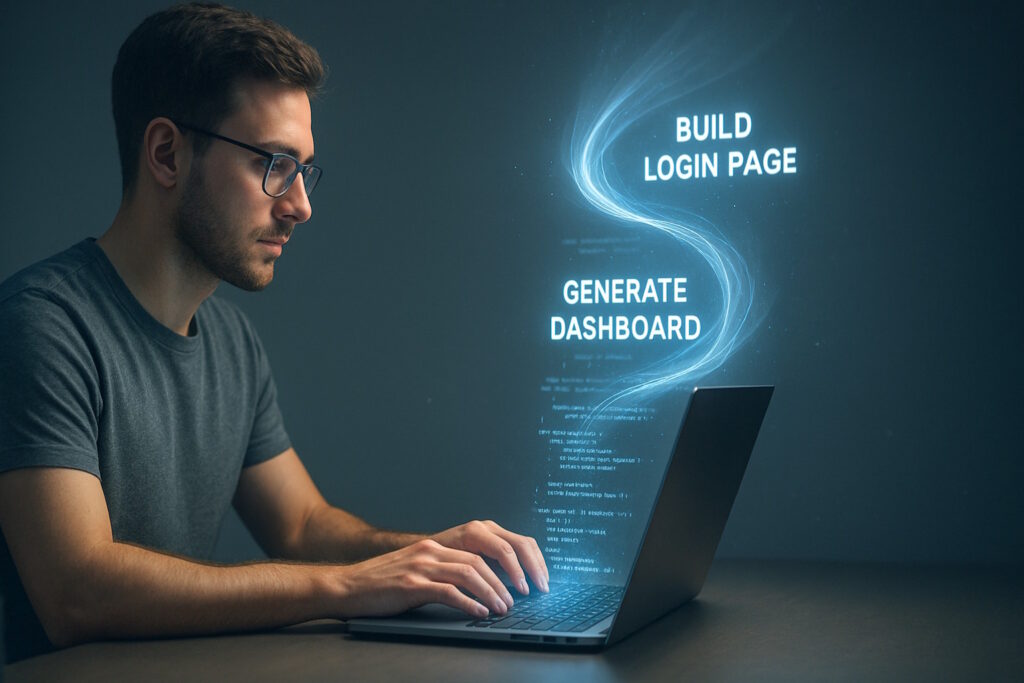
Quick Answer: Vibe coding is an AI-assisted approach to programming where you describe your intent in natural language, and an AI model—such as ChatGPT or GitHub Copilot—translates that description into working code. Instead of manually writing syntax, developers “set the vibe” of what they want to build, and the AI generates, refines, and structures the logic accordingly. This method lets teams move faster from idea to prototype, making software creation more accessible and conversational.
The Shift That’s Rewriting How We Code
Software development is entering a more intuitive era—one where expressing intent matters as much as writing syntax. Instead of starting from a blank screen, creators now begin with a conversation. They describe an idea, outline what they need, and intelligent assistants help bring it to life in real code.
This change is less about replacing developers and more about reimagining how people interact with technology. It blends creativity with computation, allowing builders, designers, and even non-technical thinkers to turn concepts into working prototypes faster than ever.
If you’ve noticed more people talking about AI helping them “code by vibe,” you’re catching an important cultural and technical moment.
Definition of Vibe Coding in Plain English
So, what exactly is vibe coding?
It’s an AI-assisted programming approach where you describe what you want in natural language, and an AI model—like ChatGPT or GitHub Copilot—generates the underlying code. The term, popularized by Andrej Karpathy, reflects a growing shift in programming: developers are moving from writing syntax to describing intent.
Instead of typing precise commands, you tell the AI the vibe of what you’re trying to build—its function, tone, or behavior—and the model creates a starting point. You then refine, test, and iterate from there.
From Plain English to Working Code
Here is the simple loop many teams follow. You describe the goal, the context, and any constraints or examples. The model proposes code that fits your intent. You run it, spot gaps, then nudge the prompt with clearer guidance. It learns from your feedback and tries again.
Say you want a basic survey app for a club event. You describe the screens, the fields, and a simple export. The model drafts a form, storage calls, and a small dashboard. You adjust tone, names, and edge cases through short prompts. In an afternoon, you hold a working prototype.
Quick Examples of Vibe Coding in Practice
To see what vibe coding looks like in real situations, here are a few examples of how teams and individuals are using it today:
- Product managers sketch small features without waiting for a sprint. By describing what a new widget or dashboard should do, they can generate a first draft of working code. This speeds early validation and keeps engineering resources focused on higher-priority tasks.
- Designers prototype interactions by describing user flows instead of writing syntax. They can say, “I want a simple login screen with a friendly message and a progress bar,” and the AI builds the visual and logic structure in seconds. It’s a faster, more iterative way to test ideas.
- Data analysts request cleaning scripts using natural descriptions of messy datasets. Instead of recalling every command, they might say, “Remove empty cells, standardize date formats, and calculate the monthly average.” The AI delivers code that performs exactly those steps.
- Founders validate ideas by turning quick prompts into testable demos. They can describe the functionality, tone, or design of a product idea, receive the first version instantly, and use that to gauge user interest before investing in full development.
These small but practical moments show how vibe coding reduces the time between imagination and implementation, giving teams freedom to explore ideas without heavy setup or technical bottlenecks.
How It Differs from Traditional Coding
Traditional coding starts with syntax and frameworks. You think about structures first, then craft each line. This new style centers intent, constraints, and desired behavior. You still review, test, and refactor, because quality always matters. And yes, you often hand edit the final result.
Why Builders Care Right Now
It speeds early work, which unlocks momentum. Teams move from idea to demo before interest fades. Leaders see progress, which supports budget and buy-in. Because prompts read like everyday speech, more roles can participate. That inclusion lifts product discovery and reduces rework later.
Benefits You Can See Today
The benefits of vibe coding are already visible across industries. Here are a few ways teams are putting it to work:
- Faster prototyping: Developers and product leads can move from concept to demo within hours. This speed makes it easier to test ideas before committing significant resources.
- Shorter feedback loops: Because prompts are conversational, users can quickly adjust instructions and see new outputs. This interactive flow encourages experimentation and learning.
- Less creative friction: A blank screen is intimidating, but a rough draft invites collaboration. Vibe coding helps teams start somewhere—giving them code they can shape instead of theory to debate.
- Consistent assistance: Unlike human teammates, an AI assistant is always available. It can offer suggestions, flag missing logic, and even draft documentation, keeping momentum steady.
- Cross-disciplinary input: Since anyone can describe intent in plain English, designers, marketers, or analysts can all contribute meaningfully to a prototype’s early development.
Together, these advantages help teams work faster, communicate better, and maintain focus on solving real problems instead of fighting syntax.
Caveats and Good Habits
While vibe coding unlocks new creative speed, it also brings responsibilities. To make the most of it, consider these practices:
- Always review AI-generated code. Large language models can make confident mistakes. A human eye is still essential for accuracy, performance, and security.
- Test everything. Even small changes or missing semicolons can break a workflow. Automated tests and code reviews remain non-negotiable.
- Protect sensitive data. Never include private keys, credentials, or proprietary code in prompts. Treat the model like a helpful intern, not a secure vault.
- Be specific, but concise. Long or vague prompts can confuse the model. The sweet spot is clear direction in natural language—like giving instructions to a teammate.
- Iterate deliberately. Don’t expect perfection in one try. Use short prompt-and-feedback loops to guide the model toward your intent.
Used wisely, these habits keep vibe coding productive, safe, and aligned with your team’s development standards.
Who Benefits and When to Try It
Vibe coding fits best where speed, experimentation, and accessibility matter. Here’s who tends to benefit most:
- Early-stage startups: They can transform ideas into prototypes quickly, helping validate product concepts before committing to full builds.
- Designers and researchers: Without deep coding skills, they can still create working prototypes or interaction flows, bridging design and functionality.
- Experienced developers: They use vibe coding to eliminate repetitive setup tasks, generate boilerplate, or explore unfamiliar frameworks.
- Educators and students: Teachers introduce programming logic in approachable language, while learners see instant cause-and-effect between intent and result.
- Non-technical professionals: Marketers, analysts, and operations teams use AI-generated scripts to automate tasks that once required developer time.
Each of these groups gains something different—speed, flexibility, or empowerment—but all share one outcome: the ability to turn ideas into action faster than before.
Conclusion: Intent Over Syntax
This programming moment feels different because intent sits in the driver’s seat. You describe the outcome, add constraints, and refine through dialogue. That conversational loop turns ideas into working software faster than many teams expect. It also opens the door for broader collaboration across roles. With steady guardrails, the approach complements proven engineering practices rather than replacing them.
Looking for deeper insights on how people and technology are evolving together? Join Tech Scope Connect to engage with forward-thinking experts, live discussions, and fresh ideas shaping the next wave of innovation.