Quick Answer: Yes. Connected tires equipped with IoT sensors could help monitor road conditions by collecting information as vehicles travel. Tire data can provide clues about roughness and surface irregularities, while cameras and other vehicle sensors add context. Together, these observations could help identify road sections that may need closer inspection.
A Second Job for Your Tires
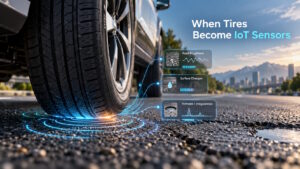
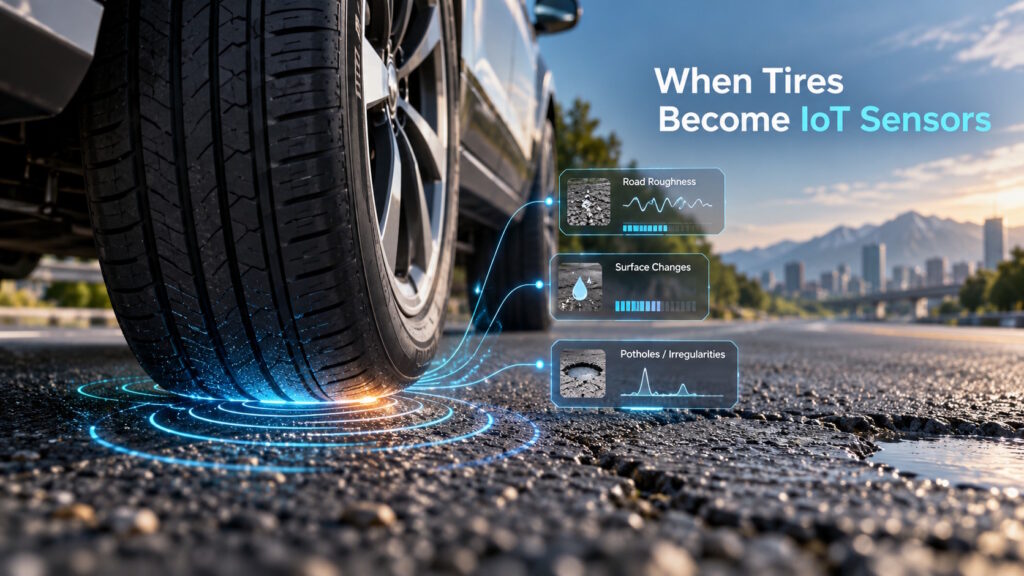
IoT sensors could give your tires a second job: helping monitor the roads beneath them. Researchers are exploring how these connected sensing devices can gather clues about rough pavement and surface irregularities. The goal extends beyond tire health to information about the road itself.
You probably recognize the thump of an uneven patch, even when you barely notice it through the windshield. What if your vehicle could record that encounter and help road managers decide where to look more closely?
That possibility connects an ordinary vehicle component with a much broader challenge: understanding what happens between scheduled road inspections.
Your Tires Have a Front-Row Seat
Every turn of a wheel brings the tire into contact with another stretch of pavement. As the rubber flexes and vibrates, sensors inside an equipped tire can capture aspects of that movement. Software then examines those signals for clues about the surface.
Researchers at Beihang University have tested a tire-sensing system for estimating roughness and detecting road irregularities. Their work demonstrates a useful principle: the physical interaction between tire and road can generate information about both.
The appeal of these IoT sensors comes from their position, right where the vehicle meets the pavement.
From Pressure Warnings to IoT Sensors
Your dashboard’s low-pressure warning addresses a familiar concern: whether a tire needs attention. A tire-pressure monitoring system alerts you when pressure falls too far. That warning does not, by itself, tell you whether the pavement needs repairs.
More advanced systems can analyze pressure, temperature, and acceleration, depending on their design. Acceleration measurements capture changes in motion, which software can interpret alongside other information. Road sensing requires suitable measurements and analysis, not merely a longer list of readings.
In an internet of things (IoT) system, connectivity allows information to travel beyond the component that collected it. The tire can communicate with vehicle electronics, while the vehicle handles connections to external services. It does not need its own direct internet connection to contribute to a larger system.
What Can a Tire Tell Us About the Road?
Tire-derived measurements can help estimate pavement roughness or flag unusual surface interactions. However, an irregular reading does not automatically identify a particular defect.
“Can it spot a pothole?” is a reasonable question, but a jolt alone leaves room for interpretation. A raised joint and a damaged patch might both produce an abrupt movement. Software needs context before labeling either observation as a maintenance problem.
The useful result might therefore be a location worth checking, rather than a definitive diagnosis. That distinction leaves room for road engineers to investigate the cause and decide what action makes sense.
The Camera Sees the Road. The Tire Feels It.
A camera can supply visual evidence about pavement damage, markings, and signs. Tire measurements offer another perspective by capturing the physical response to the surface. Combining those observations could help explain what a vehicle encountered, rather than relying on either source alone.
One example comes from Italy’s Puglia region, where a pilot announced in 2025 paired tire data with camera observations. Pirelli and computer-vision company Univrses outlined plans for regional service vehicles to gather the information. Their April 29, 2026, partnership announcement described the project as underway and proposed closer integration of their technologies.
Those announcements establish an active development effort. They do not establish universal detection, proven maintenance savings, or fewer accidents.
When Separate Journeys Start Telling the Same Story
Suppose one equipped vehicle records an unusual movement along a particular stretch of road. Another vehicle encounters something similar later, followed by several more during the week.
A monitoring platform could compare those observations, using their locations and timestamps to look for patterns. Repeated readings might strengthen the case for inspection, while comparable measurements over time could reveal changes.
Research involving Purdue University has already explored connected-vehicle data for comparing pavement roughness before and after construction. That work used onboard vehicle data, rather than relying on sensors embedded inside tires. It supports the broader monitoring concept, without proving every tire-based approach.
Combining observations from IoT sensors across different journeys creates the larger network. The tires themselves do not need to communicate directly with one another.
Why Let the Sensors Travel?
A fixed sensor observes its surroundings from one location, while a dedicated survey vehicle follows a planned inspection route. Vehicles carrying IoT sensors offer another possibility: collecting observations during journeys that would happen anyway.
For example, an equipped delivery van might provide repeated observations along its regular route. Those readings could help identify changes between formal surveys, without requiring a separate journey for every update.
MIT researchers have demonstrated a related approach using smartphone motion sensors to estimate road roughness. Their work uses phones, not intelligent tires, but illustrates how everyday travel can contribute infrastructure information.
Mobile sensing is therefore another way to gather evidence, not an automatic replacement for detailed inspections.
Where Would All That Information Go?
For a road manager, a map highlighting suspicious stretches would be more useful than thousands of unexplained sensor readings. Location, timing, and understandable summaries would help turn scattered observations into something a maintenance team could investigate.
How IoT Sensors Could Support Road Decisions
In one possible setup, a vehicle attaches location and time information before sharing observations with a central platform. That platform groups reports by road segment, allowing users to compare conditions across journeys.
Road authorities could use the resulting information to prioritize inspections and review changes following repairs. Research on connected-vehicle monitoring has explored these applications, while recognizing the role of more precise follow-up measurements.
Fleet operators might also find route-condition information useful when planning operations. With compatible systems, vehicles could eventually share relevant warnings with other vehicles or roadside equipment. That possibility connects road sensing with vehicle-to-everything, or V2X, communications.
The Hard Part Is Knowing What to Trust
Two vehicles can react differently to the same road. Vehicle weight, speed, and suspension characteristics influence the motion that sensors capture. Researchers must account for these differences when estimating road roughness from vehicle movement.
Tire-based systems also need testing across tire conditions and changing weather. A method that performs well during controlled trials still needs validation under the conditions its users will encounter.
Coverage creates another practical question. A busy delivery route might generate frequent observations, while a quiet rural road receives very few. An empty map should not become shorthand for “nothing needs attention.”
Nor do more readings automatically guarantee better answers. Shared measurement errors can persist across a dataset, so operators need calibration checks and comparisons with trusted measurements.
There are data-sharing questions, too. Who can access the observations, how long should providers retain them, and how should different platforms exchange information? A useful road map should not require exposing someone’s travel history.
A Different Way to Think About Smart Roads
Smart infrastructure does not always require installing another device beside the pavement. Connected tires suggest a complementary approach: gathering information through objects already moving across that infrastructure.
The appeal is easy to understand. A vehicle completes its journey while contributing observations that may help someone responsible for the same road.
However, the most useful network would not depend on tires alone. Cameras, other vehicle sensors, and professional assessments could contribute different pieces of the picture. The combination deserves attention, even while individual technologies continue to develop.
Conclusion: The Next Observation Could Come From Below
Could your tires become the road’s next sensors? Sensor-equipped tires already provide a starting point, but useful road monitoring requires much more than collecting measurements. Software must interpret the signals, networks must connect observations, and people must judge whether the information warrants action.
The next advance in road awareness may arrive on four wheels, rather than through another roadside installation. Curious about how IoT is changing the way we understand and interact with the world around us? Join the conversation at Tech Scope Connect, where we explore emerging technologies through expert insights, live newscasts, and global summits.
Sources:
- Applications of Using Connected Vehicle Data for Pavement Quality Analysis | frontiersin.org
- Crowdsourcing Data on Road Quality and Excess Fuel Consumption | news.mit.edu
- Roughness-Induced Vehicle Energy Dissipation From Crowdsourced Smartphone Measurements Through Random Vibration Theory | cambridge.org
- Pirelli: Cyber™ Tyre Technology Gains Worldwide Recognition | press.pirelli.com
- Apulia Regional Government and Pirelli Launch Pilot Project to Monitor Road Infrastructure Thanks to Cyber Tyre | press.pirelli.com
- An Intelligent Tyre System for Road Condition Perception | research.buaa.edu.cn
- Tire Safety Ratings and Awareness | nhtsa.gov
- Pirelli and Univrses Signed a Partnership to Enhance Cyber Tyre™ Technology by Integrating the Swedish Company’s AI‑Based Computer Vision Systems | press.pirelli.com