Key Takeaway: AI forecasting with time-series foundation models gives businesses a new way to estimate future demand using pretrained forecasting capabilities. These models can work with historical data without task-specific retraining, but they do not eliminate uncertainty or business judgment. Their real value depends on how well their forecasts perform against existing methods and support better planning decisions.
Planning Before Customers Arrive
I forecasting tackles a familiar business question: how much demand should we prepare for next month? Machine-learning predictions offer another input when you plan inventory and staffing.
At a hypothetical home-goods retailer, an upcoming promotion creates a delicate balancing act. Ordering too many lamps could leave shelves crowded for months, while ordering too few could disappoint customers. The manager needs an estimate before placing orders and assigning extra staff.
Time-series foundation models introduce a different starting point: forecasting patterns learned before encountering this retailer’s sales history.
What AI Forecasting Learns from Patterns over Time
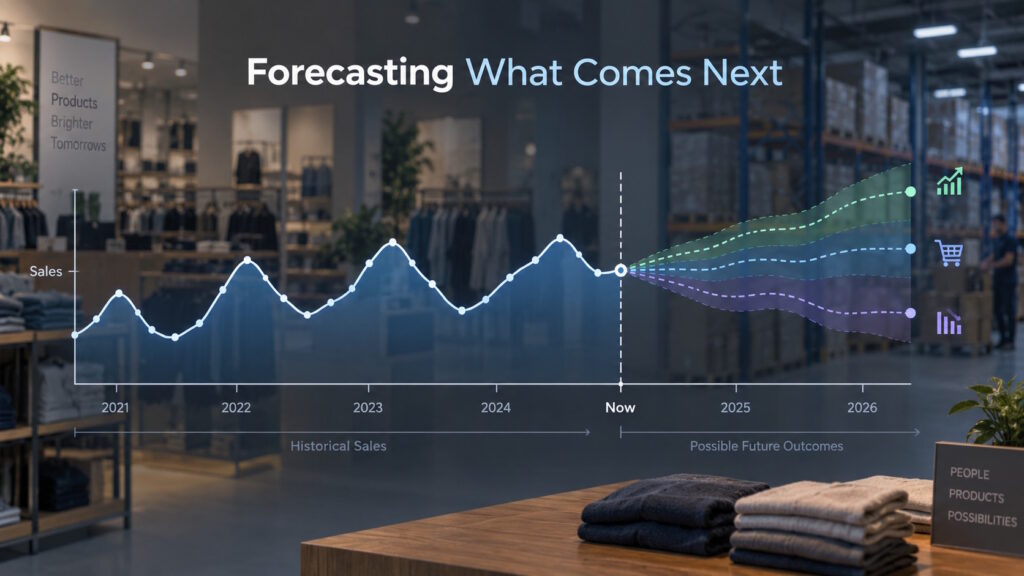
A time series records observations in time order, such as daily sales or hourly electricity consumption. Instead of seeing only a monthly total, you can examine how activity rises and falls. That sequence can reveal patterns that a single total would hide.
For our retailer, two months could show identical lamp sales but tell very different stories. One might contain steady demand, while another includes quiet weeks followed by a promotion rush. Those differences could lead the manager to investigate when extra coverage would help.
A time-series foundation model learns from many sequences during pretraining, aiming to transfer useful patterns to unfamiliar forecasting tasks. The goal is to apply that earlier learning to a dataset the model has not encountered before.
This differs from simply asking a chatbot to guess next month’s sales. Models such as TimesFM process numerical histories and produce numerical forecasts. A conversational interface could help you interact with a forecasting system, but the interface is not the forecasting method.
A Model with a Head Start Still Needs Your History
“Do we still need our own data?” is a reasonable first question. For the zero-shot forecasting described here, the answer is yes. The business supplies historical observations, while the model generates forecasts without additional training for that particular task.
Zero-shot describes the absence of task-specific retraining, not the absence of preparation. Our retailer still has to select its sales records and decide how far ahead it needs an estimate.
For teams exploring AI forecasting, this shifts the immediate work from training toward comparison. They can evaluate a pretrained model before committing to a dedicated model-training project.
That does not mean businesses previously invented every forecasting method from scratch. Established approaches already offer reusable methods, and simple seasonal forecasts can provide surprisingly effective benchmarks. Pretraining adds another candidate, not an automatic replacement.
Looking Beyond Last Month’s Sales
Our retailer also sells lampshades and small tables, giving the team other sales histories to consider. It has records of earlier promotions and next month’s campaign schedule, too. Could demand forecasting consider these signals together, rather than treating lamp sales in isolation?
Google Research introduced TimesFM-3 on August 31, 2026, with native support for forecasting multiple related time series together. It can also incorporate historical information and supplied inputs available for the future forecast period, such as planned promotions.
For the retailer, that capability could connect its planning question with more than one sales history. However, the model does not automatically know the campaign schedule; the team must provide it. A scheduled discount is information available beforehand, whereas next month’s actual customer traffic remains unknown.
Neither multiple-variable forecasting nor related business signals began with foundation models. The development here combines those capabilities with broad pretraining and zero-shot forecasting. Whether the extra inputs improve a particular forecast still requires testing.
One practical caveat applies to this example. TimesFM-3’s published download license restricts commercial and production use, including using outputs for commercial decisions without separate authorization. The retailer illustrates the broader model category, not unrestricted permission to deploy this particular download.
Next Month Will Not Fit into One Number
“What will we sell?” rarely captures everything a planning team needs to know. A point forecast gives one estimate, while a prediction interval expresses uncertainty around possible future outcomes. Forecasters used these intervals long before time-series foundation models arrived.
Suppose the retailer receives a central estimate of 1,000 lamp sales for a promotion week. It also receives an estimated 80 percent prediction interval of 800–1,250 units. These hypothetical numbers illustrate the idea; they do not represent a real retailer or a TimesFM-3 test.
An 80 percent interval aims to cover actual outcomes about eight times in ten across comparable forecasts. Actual sales can still fall outside it, so neither endpoint offers a guarantee.
Instead, the retailer can discuss how different outcomes would affect its plans. Would stock cover a busier week, and could the team absorb a quieter one?
How Can You Tell Whether AI Forecasting Helps?
A useful AI forecasting test goes beyond one persuasive demonstration. It recreates previous planning situations using only information available when the team would have made each forecast. The team then compares its forecasts with what actually happened across several periods.
For our retailer, the test should reflect its real planning horizon. A strong forecast for tomorrow does not establish how well the approach predicts sales four weeks ahead. The comparison needs to examine that longer window.
The retailer would compare the pretrained model with its current forecast and an appropriate simple benchmark. For seasonal sales, that benchmark might use the corresponding period from the previous year. A newer model should earn its place through useful performance, rather than novelty.
The team would also check how often actual sales fall inside the model’s stated prediction intervals. That comparison would help assess whether its uncertainty estimates deserve confidence.
The manager could then examine the consequences of the errors. Repeated underestimates during promotions might be more troublesome than small misses during quiet weeks. The evaluation could also ask whether improvements justify the effort involved in preparing inputs and reviewing results.
Conclusion: Turning an Estimate into a Plan
Even a useful forecast leaves the retailer with choices. Long replenishment delays might encourage extra inventory, while limited storage could push the team toward a smaller order. Staffing commitments would involve another discussion about coverage and service expectations.
The same estimate could therefore lead to different plans under different business conditions. A forecast describes what might happen; planning determines how the organization prepares.
Time-series foundation models give teams another forecasting approach to evaluate, while business judgment remains part of planning. For the manager facing next month’s promotion, the model’s novelty is secondary to whether its estimates improve preparation.
As AI forecasting continues to evolve, so will the ways businesses turn predictions into practical decisions. Join Tech Scope Connect for more conversations about AI, emerging technologies, and what they could mean for the way organizations plan and operate.
Sources:
- TimesFM-3: A Zero-Shot Foundation Model for Multivariate Forecasting | research.google
- A Decoder-Only Foundation Model for Time-Series Forecasting | research.google
- 5.2 Some Simple Forecasting Methods | otexts.com
- 6.4.1. Definitions, Applications and Techniques | itl.nist.gov
- LICENSE · Google/timesfm-3.0-Pytorch at Main | huggingface.co
- 5.5 Distributional Forecasts and Prediction Intervals | otexts.com
- 5.10 Time Series Cross-Validation | otexts.com
- 1.1 What Can Be Forecast? | otexts.com
- [2310.10688] A Decoder-Only Foundation Model for Time-Series Forecasting | arxiv.org
- 6.4. Introduction to Time Series Analysis | itl.nist.gov