Key Takeaway: Edge computing can help businesses query information across multiple locations without first centralizing every record. Data federation sends requests to local systems and combines their responses into one view. Queries and results still travel, and reports need to flag missing responses or incomplete records to avoid misleading conclusions.
One Question, Twenty Buildings
Edge computing can help your business query scattered information without first gathering every record in one central database. With local processing, each site can contribute results while keeping detailed records near their source.
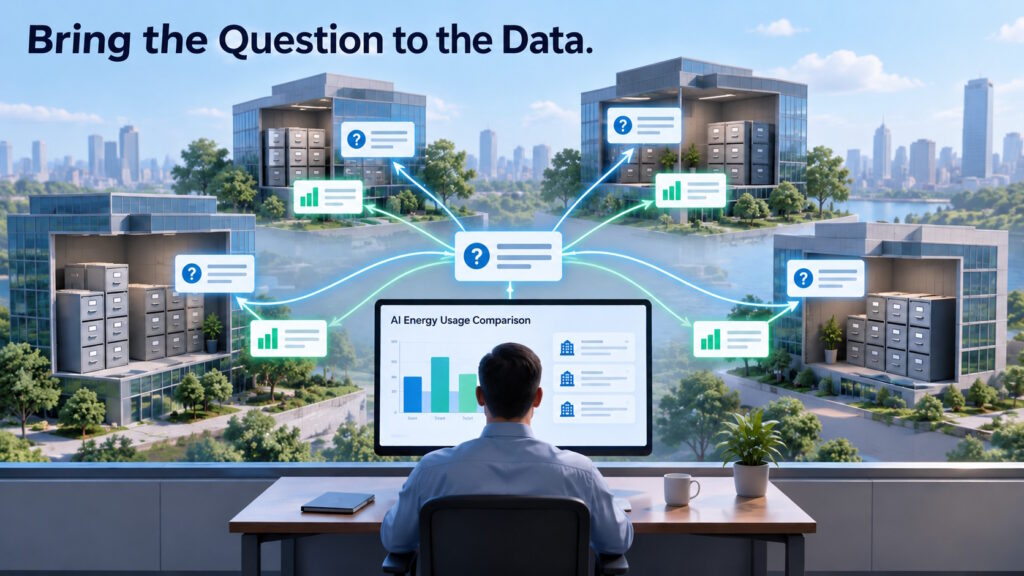
Imagine you manage twenty commercial buildings, each storing electricity readings and operating hours in a local system. You want to know which buildings used more electricity after closing last week than the week before. The information exists, but you don’t yet have a comparison across all twenty sites.
Can you get that comparison without collecting every reading centrally? Yes, with a suitable data federation setup. It sends requests to the relevant locations and combines their responses into one view.
A Shared View Doesn’t Require a Shared Storage Location
A centralized approach could copy every building’s readings into one database before making the comparison. A federated approach could leave those records locally and assemble the comparison from each building’s response.
The distinction concerns where the work happens, not simply how the final report looks. You could see all twenty buildings together without first creating another collection of their detailed records.
EdgeLake, an open-source LF Edge project, illustrates this approach. It gives applications a unified view of records that live across different edge locations.
On July 29, 2026, LF Edge announced that EdgeLake 2.0.2606 had shipped. The release added connectivity options and cluster diagnostics for checking participating systems. These developments address the practical work of connecting and managing distributed information.
How Edge Computing Brings the Question to Each Building
Suppose you ask your reporting application to compare after-hours electricity use across the company.
Behind the scenes, the coordinating software identifies which locations hold the relevant records. It then sends requests to those locations and brings their responses together. EdgeLake documents this general pattern in its architecture.
For our example, assume the local systems support the required calculations. Each building could calculate consumption outside operating hours for both weeks. Its reply might contain a building identifier and two totals, rather than every individual reading.
The application could compare those totals and highlight buildings with rising consumption. Your team could then decide where to investigate, without examining every reading from every site.
Does That Mean No Data Moves?
Even in this edge computing setup, queries travel to other systems, and their answers travel back. Those answers might contain summaries or selected records, depending on your question. Processing part of a query locally can reduce network traffic, but the software and request must support that work.
In our example, the initial comparison needs only a few totals from each building. Once a building stands out, you could request its hourly readings to look for a pattern. Perhaps its heating system continued operating long after everyone left.
By contrast, asking for every reading from all twenty buildings means requesting the records themselves. Federation changes how you reach that information; it doesn’t make the requested detail disappear.
The useful promise is avoiding unnecessary centralization—not eliminating all data movement.
What If Two Buildings Stay Silent?
Now suppose eighteen buildings respond, while two cannot connect. If a dashboard adds those replies into a company-wide total, it leaves out the two unavailable locations. Compared with an earlier, complete report, that total could suggest a drop that never happened.
A useful report in this scenario might say, “Results include eighteen of twenty buildings. Two locations could not respond.”
However, receiving twenty replies wouldn’t settle every concern. One building might respond despite missing several days of meter readings. Another might provide figures that stop before the requested period ends.
Before comparing weeks, you would need to know which buildings contributed and whether their records covered the same periods. A building that cannot answer is not a building that used no electricity.
Handling these gaps is a requirement to check, not a feature to assume. Your team would need to understand whether the system stops or returns partial results, and how it reports missing coverage.
Where This Approach Helps—and What It Still Needs
For our hypothetical company, federation becomes interesting when buildings already retain useful local records. A company-wide question might need only a small part of that information, such as weekly consumption totals.
Still, the team would have some preparation to do. Electricity figures need compatible units, and reporting periods need clear boundaries. The calculations should follow each building’s actual operating schedule, including holidays or temporary closures.
The company would also have to decide who can request information from each site and what they may retrieve. Connecting the systems would not automatically resolve those decisions.
Where Edge Computing Fits Alongside the Cloud
Federation also doesn’t guarantee a faster answer. Google warns that BigQuery federated queries can be slower than queries over data already stored in BigQuery. The service must wait for the external database to process its request and transfer results.
For our buildings, a mixed setup could make sense. Detailed records could stay locally, while the company stores weekly summaries centrally for recurring reports. Targeted queries could retrieve extra detail whenever an investigation needs it.
In that arrangement, edge computing would complement the company’s central systems rather than replace every central database.
Conclusion: Start With the Answer You Need
The facilities director’s original goal was to identify buildings worth investigating, not to collect every reading in another location. A useful result would point toward the next decision while showing which buildings and reporting periods it covers.
That offers a practical starting point for your own business: what needs to come together to answer your question? Sometimes, the answer may require fewer records to travel than you expected.
For more perspectives on edge computing and its practical business applications, join the conversation at Tech Scope Connect.
Sources:
- EdgeLake: Data Lake on the Edge | github.com
- Pushdown — Trino 483 Documentation | trino.io
- Introduction to Federated Queries — BigQuery | docs.cloud.google.com
- EdgeLake 2.0: Building Momentum at the Edge | lfedge.org
- EdgeLake | lfedge.org